
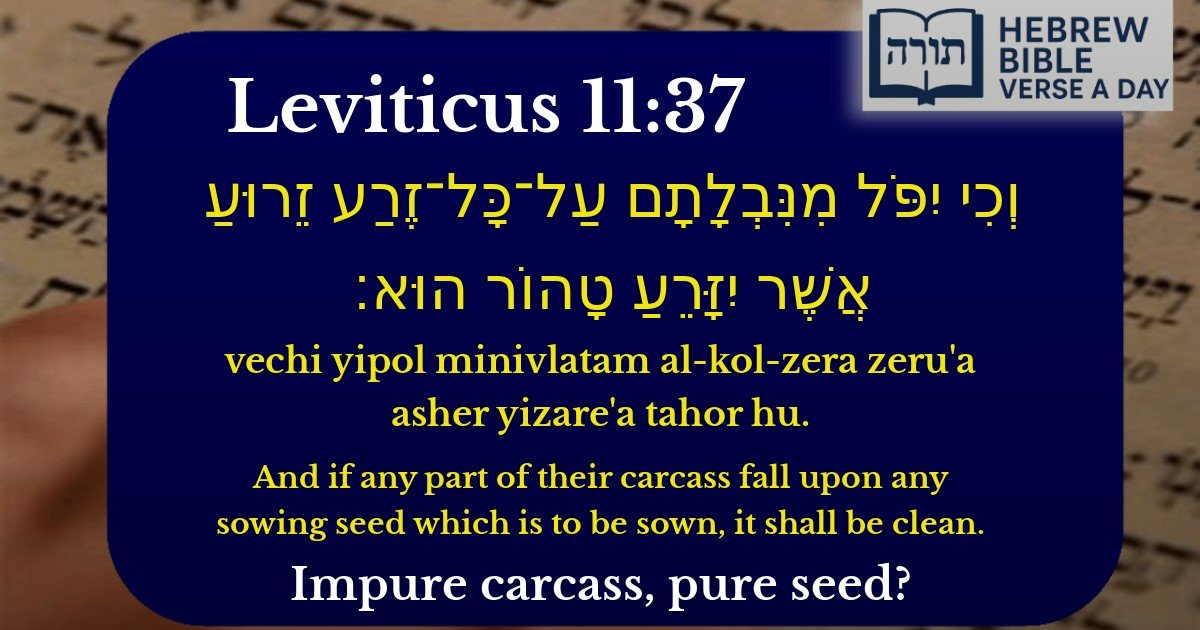

Leviticus 11:37 - Impure carcass, pure seed?

Leviticus 11:37 - ויקרא 11:37

Hebrew Text

וְכִי יִפֹּל מִנִּבְלָתָם עַל־כָּל־זֶרַע זֵרוּעַ אֲשֶׁר יִזָּרֵעַ טָהוֹר הוּא׃

English Translation

And if any part of their carcass fall upon any sowing seed which is to be sown, it shall be clean.

Transliteration

Vechi yipol minivlatam al-kol-zera zeru'a asher yizare'a tahor hu.

Hebrew Leining Text

וְכִ֤י יִפֹּל֙ מִנִּבְלָתָ֔ם עַל־כׇּל־זֶ֥רַע זֵר֖וּעַ אֲשֶׁ֣ר יִזָּרֵ֑עַ טָה֖וֹר הֽוּא׃

🎵 Listen to leining

Parasha Commentary

Context and Source

The verse (Vayikra 11:37) appears in the Torah's discussion of the laws of tum'ah (ritual impurity) caused by contact with the carcasses of certain animals. Here, the Torah specifies an exception: if a dead sheretz (a creeping creature that is impure) falls upon seeds that are designated for planting, the seeds remain tahor (ritually pure).

Rashi's Explanation

Rashi (Vayikra 11:37) clarifies that this exemption applies specifically to seeds that are still attached to the ground and have not yet been harvested. Once harvested, seeds would become susceptible to tum'ah like other foods. Rashi bases this on the phrase "asher yizarei'a" ("which is to be sown"), indicating the seeds must still be in the process of being sown or growing.

Halachic Implications

  • Rambam's Ruling: In Hilchos Tum'as Ochalin (3:15), Rambam codifies this law, stating that seeds in the ground cannot contract impurity from a sheretz, but harvested seeds can.
  • Practical Application: The Shulchan Aruch (Yoreh De'ah 83:8) rules accordingly, emphasizing that this purity applies only while the seeds are still part of the earth's growth process.

Midrashic Insight

The Toras Kohanim (a halachic Midrash on Vayikra) connects this law to the concept of hashgacha pratis (Divine providence) in agriculture. Since seeds are destined to sustain life, they are protected from impurity while fulfilling their purpose in the ground. This reflects the broader principle that items actively involved in mitzvah observance or life-sustaining activities receive special spiritual protection.

Philosophical Significance

Rabbi Samson Raphael Hirsch notes that this law teaches that the potential for future growth (represented by unharvested seeds) maintains a higher spiritual status than harvested produce. The connection to the earth represents man's partnership with Hashem in creation, and thus enjoys a unique sanctity that insulates it from impurity.

📚 Talmud Citations

This verse is quoted in the Talmud.

📖 Chullin 117b
The verse is discussed in the context of the laws of ritual purity and impurity, specifically regarding the contamination of seeds by a carcass.

Frequently Asked Questions

Q: What does Leviticus 11:37 mean?
A: Leviticus 11:37 discusses the laws of ritual purity (tum'ah and taharah) related to seeds that come into contact with the carcass of a non-kosher animal. The verse teaches that if a dead non-kosher animal (neveilah) falls on seeds meant for planting, the seeds remain ritually pure (tahor) and can still be used. This is because seeds in their unprocessed state are not susceptible to impurity (Rashi, Chullin 121a).
Q: Why is this verse important in Jewish law?
A: This verse is important because it establishes a key principle in the laws of kashrut and ritual purity: unprocessed seeds are not affected by impurity from a dead animal. This impacts agricultural practices, food preparation, and the handling of crops according to halacha (Jewish law). The Talmud (Chullin 120b-121a) elaborates on this rule, explaining that only when seeds are moistened or processed do they become susceptible to impurity.
Q: What practical lesson can we learn from Leviticus 11:37?
A: A practical lesson from this verse is that Torah law distinguishes between different states of food—raw seeds are treated differently than prepared food. This teaches us to be mindful of how we handle and store food according to halachic guidelines. The Rambam (Hilchos Tum'as Ochlin 3:1) codifies this law, emphasizing that only food ready for human consumption can contract impurity.
Q: Does this verse apply to modern gardening or farming?
A: Yes, the principle still applies today. If a non-kosher animal dies in a field and touches seeds that are dry and unprocessed, the seeds remain permissible for planting or eating (assuming they are otherwise kosher). However, if the seeds were already soaked or prepared for eating, they could become impure (Shulchan Aruch, Yoreh De'ah 83:1). Farmers and gardeners following halacha should be aware of these distinctions.