Frequently Asked Questions
Q: Why does the Torah specify birds like turtledoves and pigeons for offerings?
A: The Torah specifies turtledoves and young pigeons because they were common and accessible to people of all economic levels. Rashi explains that these birds were chosen since they were readily available and affordable, ensuring that even the poor could bring offerings to Hashem (Leviticus 1:14).
Q: What is the significance of bringing a bird as a burnt offering (Olah)?
A: The bird offering (Olah) symbolizes complete devotion to Hashem, as the entire bird is burned on the altar. The Rambam teaches that the Olah represents a person's commitment to elevate themselves spiritually. Birds, which fly upward, are a fitting symbol for this type of offering (Guide for the Perplexed 3:46).
Q: Why are only turtledoves and young pigeons acceptable for bird offerings?
A: The Talmud (Chullin 22a) explains that turtledoves and young pigeons were chosen because they are not typically used for human consumption in the same way as other birds, making them uniquely suitable for sacred offerings. Additionally, these birds are known for their loyalty, symbolizing the relationship between the Jewish people and Hashem.
Q: Can a person bring any bird as an offering, or must it be specifically turtledoves or pigeons?
A: The verse explicitly states that only turtledoves or young pigeons are acceptable for bird offerings (Leviticus 1:14). The Midrash (Vayikra Rabbah 3:5) teaches that these birds were selected by Hashem due to their symbolic purity and availability, and no other birds may be substituted for this type of korban (offering).
Q: How does this verse relate to Jewish practices today, since we no longer bring sacrifices?
A: Although we no longer bring physical offerings, the principle behind this mitzvah remains relevant. The Talmud (Berachos 17a) teaches that prayer has replaced sacrifices, and just as the bird offering represented devotion, our tefillot (prayers) should be offered with sincerity and humility. Additionally, acts of kindness and Torah study are considered spiritual substitutes for sacrifices (Proverbs 21:3, Menachos 110a).

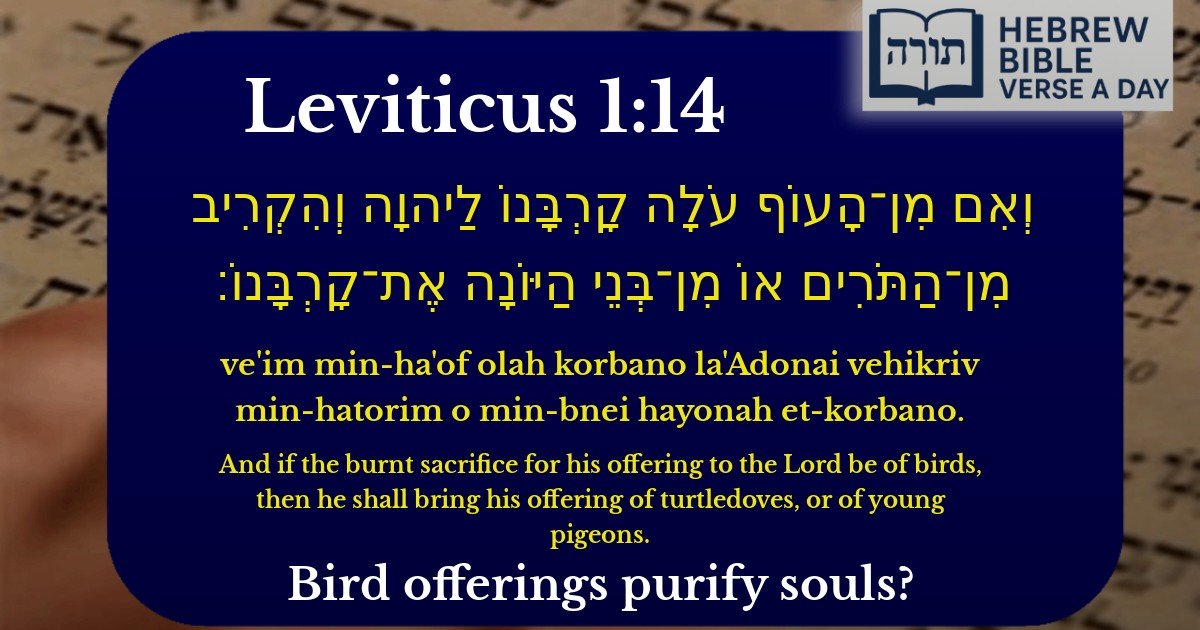

The Offering of Birds as an Olah
The verse (Vayikra 1:14) discusses the laws of bringing birds as an olah (burnt offering) to Hashem. Rashi explains that this provision is specifically for those who cannot afford to bring an animal sacrifice, as birds are a more affordable option. The Torah specifies two types of permissible birds: torim (turtledoves) and bnei yonah (young pigeons).
Choice of Turtledoves and Young Pigeons
According to the Talmud (Chullin 22a), these birds were chosen because they are commonly found and easily accessible. The Rambam (Hilchos Ma'aseh HaKorbanos 3:1) adds that these species are particularly suitable for sacrifices because they are not birds of prey, symbolizing kindness rather than cruelty.
The Significance of the Bird Offering
The Sefer HaChinuch (Mitzvah 119) teaches that the bird offering, though simpler than an animal sacrifice, carries deep spiritual meaning. The act of offering a bird—a creature that soars high—symbolizes the elevation of one's soul toward Hashem. Additionally, the Kohen performs melikah (a specific method of slaughter for birds) to emphasize the sanctity of the offering.
Halachic Details
The Mishnah (Menachos 13:7) states that only male birds may be brought as an olah, unlike animal offerings, which can be either male or female. The Tur (Yoreh De'ah 192) further clarifies that the birds must be free of defects, just like animal sacrifices, to be acceptable.