
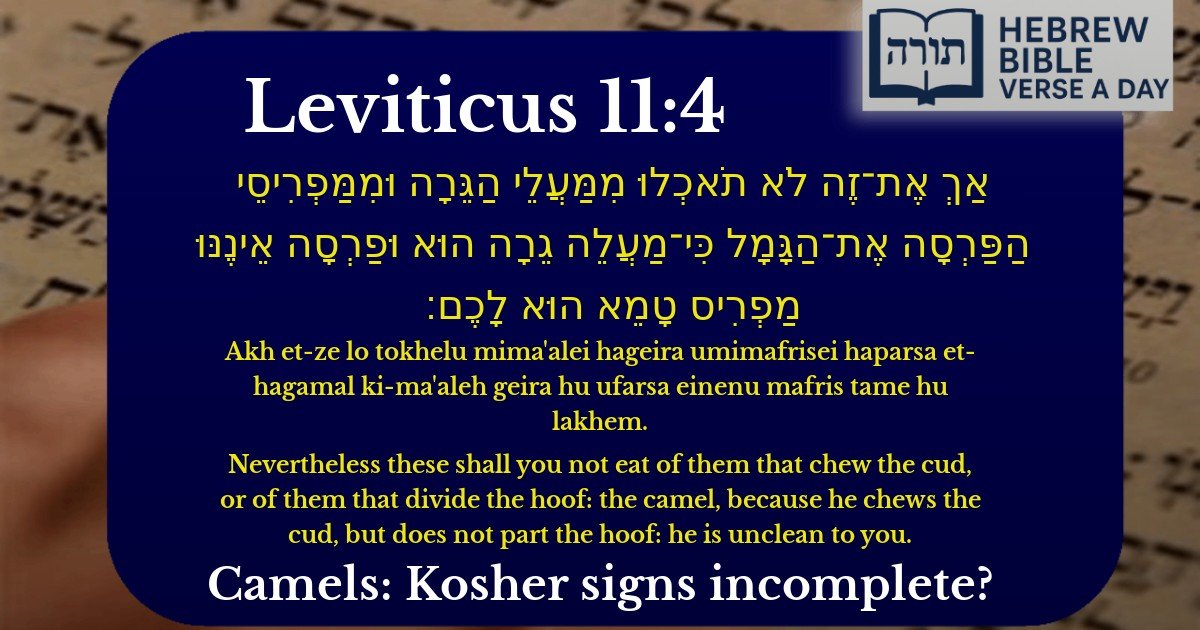

Leviticus 11:4 - Camels: Kosher signs incomplete?

Leviticus 11:4 - ויקרא 11:4

Hebrew Text

אַךְ אֶת־זֶה לֹא תֹאכְלוּ מִמַּעֲלֵי הַגֵּרָה וּמִמַּפְרִיסֵי הַפַּרְסָה אֶת־הַגָּמָל כִּי־מַעֲלֵה גֵרָה הוּא וּפַרְסָה אֵינֶנּוּ מַפְרִיס טָמֵא הוּא לָכֶם׃

English Translation

Nevertheless these shall you not eat of them that chew the cud, or of them that divide the hoof: the camel, because he chews the cud, but does not part the hoof: he is unclean to you.

Transliteration

Akh et-ze lo tokhelu mima'alei hageira umimafrisei haparsa et-hagamal ki-ma'aleh geira hu ufarsa einenu mafris tame hu lakhem.

Hebrew Leining Text

אַ֤ךְ אֶת־זֶה֙ לֹ֣א תֹֽאכְל֔וּ מִֽמַּעֲלֵי֙ הַגֵּרָ֔ה וּמִמַּפְרִסֵ֖י הַפַּרְסָ֑ה אֶֽת־הַ֠גָּמָ֠ל כִּֽי־מַעֲלֵ֨ה גֵרָ֜ה ה֗וּא וּפַרְסָה֙ אֵינֶ֣נּוּ מַפְרִ֔יס טָמֵ֥א ה֖וּא לָכֶֽם׃

🎵 Listen to leining

Parasha Commentary

Overview of the Verse

The verse (Vayikra 11:4) delineates the laws of kashrut, specifically identifying animals that are forbidden for consumption. The camel is singled out as an example of an animal that chews its cud (ma'aleh gerah) but does not have split hooves (maphris parsah), rendering it tamei (ritually impure) and unfit for eating.

Rashi's Commentary

Rashi explains that the camel is mentioned first among the non-kosher animals because it possesses one of the two signs of a kosher animal (chewing its cud) but lacks the other (split hooves). This serves as a warning not to be misled by partial compliance with the kosher signs. Rashi also notes that the Torah emphasizes "ma'aleh gerah hu" ("it chews the cud") to clarify that the camel genuinely chews its cud, unlike animals that merely appear to do so.

Rambam's Perspective

In Hilchot Ma'achalot Asurot (1:2), the Rambam categorizes the camel as a behemah temeiah (impure animal) due to its incomplete kosher signs. He emphasizes that both signs—chewing the cud and having split hooves—must be present for an animal to be permitted. The Rambam further discusses the rationale behind these laws, suggesting they serve to discipline the soul and distance individuals from undesirable traits.

Midrashic Insights

The Midrash (Vayikra Rabbah 13:2) connects the camel's impurity to its symbolic representation of arrogance. The camel's name (gamal) is linked to the word gomel (to wean or repay), hinting at its stubborn nature. The Midrash teaches that just as the camel is unfit for consumption, traits like arrogance are spiritually "unfit" and must be avoided.

Halachic Implications

  • The Shulchan Aruch (Yoreh De'ah 79:1) rules that any animal lacking one of the two kosher signs is forbidden, regardless of whether it chews its cud or has split hooves.
  • The Mishnah (Chullin 3:1) discusses how to verify an animal's kosher status, emphasizing that both signs must be clearly identifiable.
  • Rabbi Samson Raphael Hirsch adds that the split hoof symbolizes moral separation (between good and evil), while chewing the cud represents thoughtful reflection. The camel's lack of a split hoof signifies an inability to properly distinguish between right and wrong.

📚 Talmud Citations

This verse is quoted in the Talmud.

📖 Chullin 59a
The verse is discussed in the context of the laws of kosher animals, specifically regarding the characteristics that make an animal unclean for consumption.
📖 Niddah 51b
The verse is referenced in a discussion about the signs of clean and unclean animals, emphasizing the criteria for determining whether an animal is permissible to eat.

Frequently Asked Questions

Q: Why is the camel considered unclean in Leviticus 11:4?
A: The camel is considered unclean because, although it chews the cud (makes it a 'ma'aleh gerah'), it does not have split hooves ('mefrisei parsah'). According to the Torah's laws of kashrut (Vayikra 11:3), an animal must have both signs to be kosher. Rashi explains that the Torah specifies this to teach us that both conditions must be met for an animal to be permitted.
Q: What is the significance of chewing the cud and split hooves in kosher animals?
A: Chewing the cud ('ma'aleh gerah') and having split hooves ('mefrisei parsah') are the two signs of a kosher animal as given in the Torah (Vayikra 11:3). The Talmud (Chullin 59a) discusses these signs in detail. Rambam (Hilchot Ma'achalot Asurot 1:2) explains that these physical traits symbolize spiritual refinement—chewing the cud represents thoughtful digestion of ideas (like Torah study), and split hooves represent discernment in one's path (distinguishing between right and wrong).
Q: How do we know which animals are kosher based on Leviticus 11:4?
A: The Torah (Vayikra 11:3-8) lists clear signs: an animal must both chew the cud ('ma'aleh gerah') and have fully split hooves ('mefrisei parsah') to be kosher. The camel, hare, and hyrax chew the cud but lack split hooves, making them non-kosher. The pig has split hooves but does not chew the cud, so it is also forbidden. Traditional Jewish sources like the Mishnah (Chullin 3:6) and Shulchan Aruch (Yoreh De'ah 79) provide further details on identifying kosher animals.
Q: Why does the Torah specify animals like the camel in Leviticus 11:4?
A: The Torah specifies animals like the camel to clarify the rules of kashrut and prevent confusion. Rashi (on Vayikra 11:4) notes that one might mistakenly think the camel is kosher because it chews the cud, so the Torah explicitly states that it is unclean due to its lack of split hooves. The Midrash (Torat Kohanim) teaches that these laws help train us in self-discipline and holiness by distinguishing between permitted and forbidden.
Q: Can we derive any practical lessons from Leviticus 11:4 today?
A: Yes! The laws of kosher animals teach us about spiritual discernment. Just as kosher animals must have both signs (chewing cud and split hooves), we must also cultivate both thoughtful reflection ('ma'aleh gerah'—like Torah study) and clear moral boundaries ('mefrisei parsah'—distinguishing right from wrong). The Sefer HaChinuch (Mitzvah 156) explains that these laws elevate us by making everyday eating an act of holiness and connection to Hashem.