Frequently Asked Questions
Q: Why is the hare considered unclean according to Leviticus 11:6?
A: The hare is considered unclean because, although it appears to chew its cud (a sign of kosher animals), it does not have split hooves—one of the two required signs for an animal to be kosher according to Torah law (Vayikra 11:3). Rashi explains that the hare's chewing motion resembles cud-chewing, but it is not true rumination like kosher animals.
Q: What does 'chewing the cud' mean in Leviticus 11:6?
A: Chewing the cud ('ma’aleh gerah' in Hebrew) refers to the process where kosher animals regurgitate partially digested food to chew it again. The Talmud (Chullin 59a) discusses the signs of true rumination. The hare's behavior may look similar, but it does not meet the Torah's criteria for a kosher animal, as it lacks split hooves.
Q: How do we know which animals are kosher based on Leviticus 11:6?
A: The Torah gives two clear signs for land animals to be kosher: they must both chew their cud AND have split hooves (Vayikra 11:3). The hare is used as an example of an animal that appears to meet one criterion (chewing motion) but fails the other (no split hooves). The Rambam (Hilchos Ma’achalos Asuros 1:2) lists these signs as definitive for determining kosher status.
Q: Why does the Torah mention the hare specifically in Leviticus 11:6?
A: The hare is mentioned because its chewing motion could be mistaken for true cud-chewing. The Midrash (Toras Kohanim 11:6) teaches that the Torah specifies this to prevent confusion—even if an animal seems to fulfill one kosher sign, both signs must be present. This emphasizes the precision required in following kosher laws.
Q: Does Leviticus 11:6 mean we can't eat rabbits today?
A: Yes, according to halacha (Jewish law), hares and rabbits remain non-kosher as they do not possess both required signs (split hooves and true cud-chewing). The Shulchan Aruch (Yoreh De’ah 79) rules that all animals lacking even one of these criteria are forbidden, based on this verse and its Talmudic interpretation.

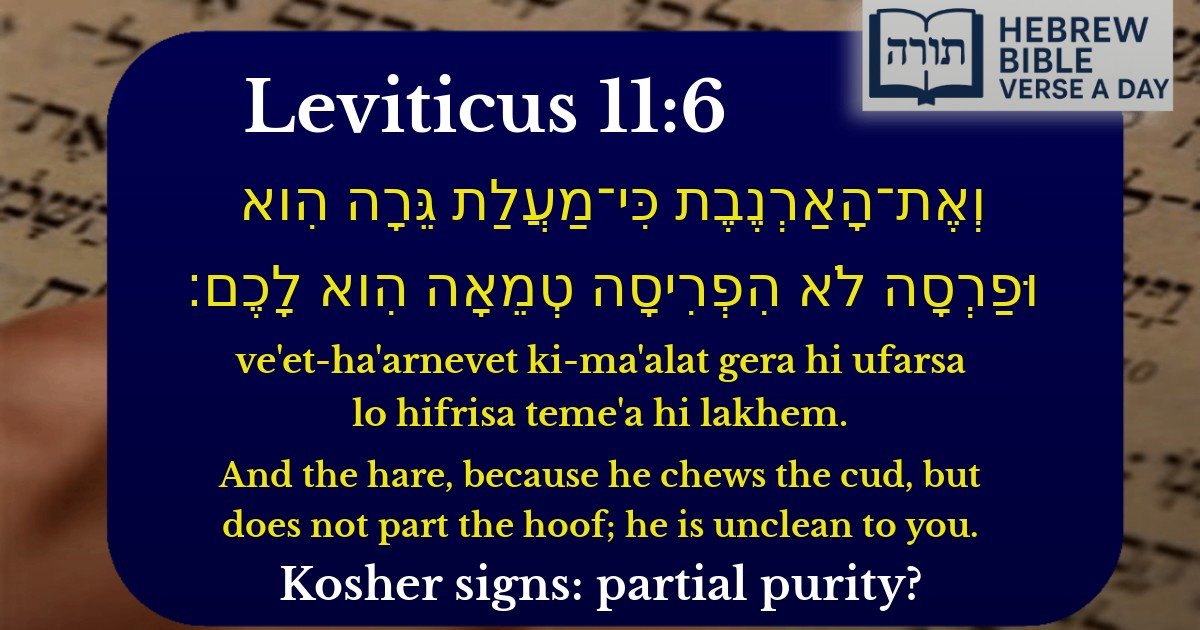

The Prohibition of the Hare in Leviticus 11:6
The verse states: "And the hare, because he chews the cud, but does not part the hoof; he is unclean to you." This identifies the hare (אַרְנֶבֶת) as a non-kosher animal due to its partial fulfillment of the kosher signs—chewing the cud without having split hooves.
Rashi's Explanation
Rashi (Vayikra 11:6) clarifies that the hare's chewing motion resembles rumination (מַעֲלַת גֵּרָה), but it is not true cud-chewing. Rather, the hare regurgitates and re-chews its food in a manner that mimics kosher animals, yet it lacks the essential sign of split hooves (פַרְסָה שְׁסוּעָה). Thus, it remains טְמֵאָה (impure) and forbidden for consumption.
Halachic Perspective from Rambam
Rambam (Hilchot Ma'achalot Asurot 1:3) emphasizes that for an animal to be kosher, it must possess both signs: chewing the cud and having split hooves. The hare's failure to meet the second criterion renders it non-kosher, regardless of its chewing behavior. This aligns with the Torah's strict binary classification of permitted and forbidden animals.
Midrashic Insight
The Midrash (Vayikra Rabbah 13:5) suggests that the hare symbolizes deception—appearing kosher in one aspect but lacking in another. This teaches a moral lesson about discernment: outward appearances can be misleading, and one must scrutinize whether something truly meets halachic standards.
Talmudic Discussion
The Talmud (Chullin 59a) examines the hare's physiology, noting that while it regurgitates food like a kosher animal, its digestive process differs. True rumination involves a multi-chambered stomach, which the hare lacks. Thus, its chewing is merely superficial resemblance, not halachic validity.