Frequently Asked Questions
Q: What does Leviticus 11:8 mean?
A: Leviticus 11:8 prohibits eating the flesh of certain non-kosher animals and even touching their carcasses. According to Rashi, this teaches that not only is consumption forbidden, but physical contact with their dead bodies also transmits ritual impurity (tumah). The verse emphasizes that these animals are 'unclean to you,' meaning they are spiritually harmful for Jews to engage with.
Q: Why is touching a non-kosher animal's carcass forbidden?
A: The Torah forbids touching the carcass of a non-kosher animal because it causes ritual impurity (tumah), as explained in the Talmud (Chullin 9a). This impurity affects a person's spiritual state and may restrict their participation in certain holy activities, like eating terumah (priestly food) or entering the Temple area. Rambam (Hilchot Tum'at Ochalin) elaborates on the laws of impurity from carcasses.
Q: How does this verse apply today?
A: Today, Orthodox Jews still avoid eating non-kosher animals and are careful not to touch their carcasses to maintain ritual purity. While the Temple is not standing, the principles of kashrut (kosher laws) remain binding. The Shulchan Aruch (Yoreh De'ah 79-81) details practical halachic guidelines for handling non-kosher animals and avoiding impurity.
Q: What can we learn from Leviticus 11:8?
A: This verse teaches the importance of spiritual boundaries. Just as certain foods are forbidden to protect our holiness, we must also avoid influences that can spiritually contaminate us. The Midrash (Vayikra Rabbah 13:2) compares non-kosher food to negative traits, reminding us that our physical actions impact our spiritual growth.
Q: Are all non-kosher animals equally forbidden?
A: Yes, the Torah generally prohibits all non-kosher animals, but there are different levels of prohibition and impurity. For example, the Talmud (Chullin 122a) discusses how some carcasses (like rodents) convey impurity through mere carrying, while others (like large animals) require direct contact. The Rambam (Hilchot Ma'achalot Asurot) categorizes these laws in detail.

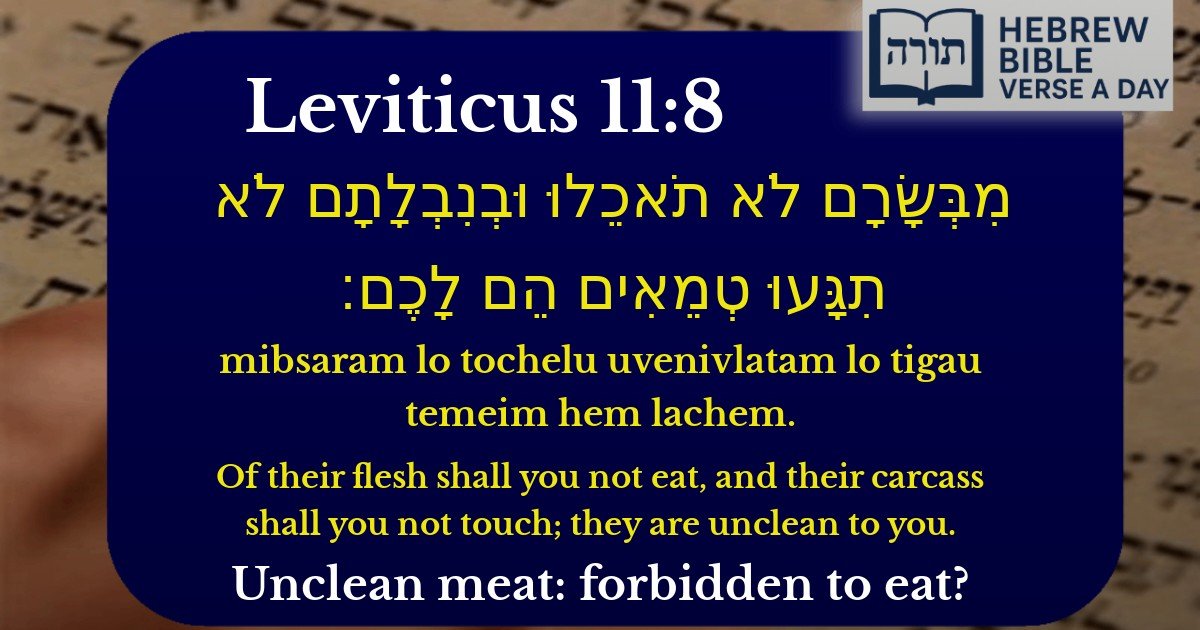

Prohibition Against Eating and Touching Unclean Animals
The verse (Vayikra 11:8) states: "Of their flesh shall you not eat, and their carcass shall you not touch; they are unclean to you." This is part of the Torah's laws regarding kosher and non-kosher animals, specifically addressing those that are tamei (ritually impure).
Rashi's Explanation
Rashi (Vayikra 11:8) clarifies that the prohibition against touching the carcass of an unclean animal applies specifically when one intends to eat it. He derives this from the juxtaposition of the two clauses—"you shall not eat" and "you shall not touch"—indicating that the restriction on touching is connected to consumption. However, Rashi notes that the Sages extended this prohibition to all cases of touching, even without intent to eat, as a seyag l'Torah (protective fence around the Torah) to prevent accidental consumption.
Rambam's Perspective
Rambam (Hilchot Ma'achalot Asurot 4:1) explains that the Torah forbids not only eating non-kosher animals but also deriving any benefit from them. The prohibition against touching their carcasses serves to distance a person from any interaction that might lead to transgression. Rambam emphasizes that these laws cultivate discipline and holiness, separating the Jewish people from practices associated with impurity.
Talmudic and Midrashic Insights
Practical Halachic Implications
According to Shulchan Aruch (Yoreh De'ah 81:1), one must avoid direct contact with the carcasses of non-kosher animals. If accidental contact occurs, the person becomes tamei and may require immersion in a mikveh, depending on the circumstances. This reinforces the Torah's emphasis on maintaining ritual purity in daily life.