
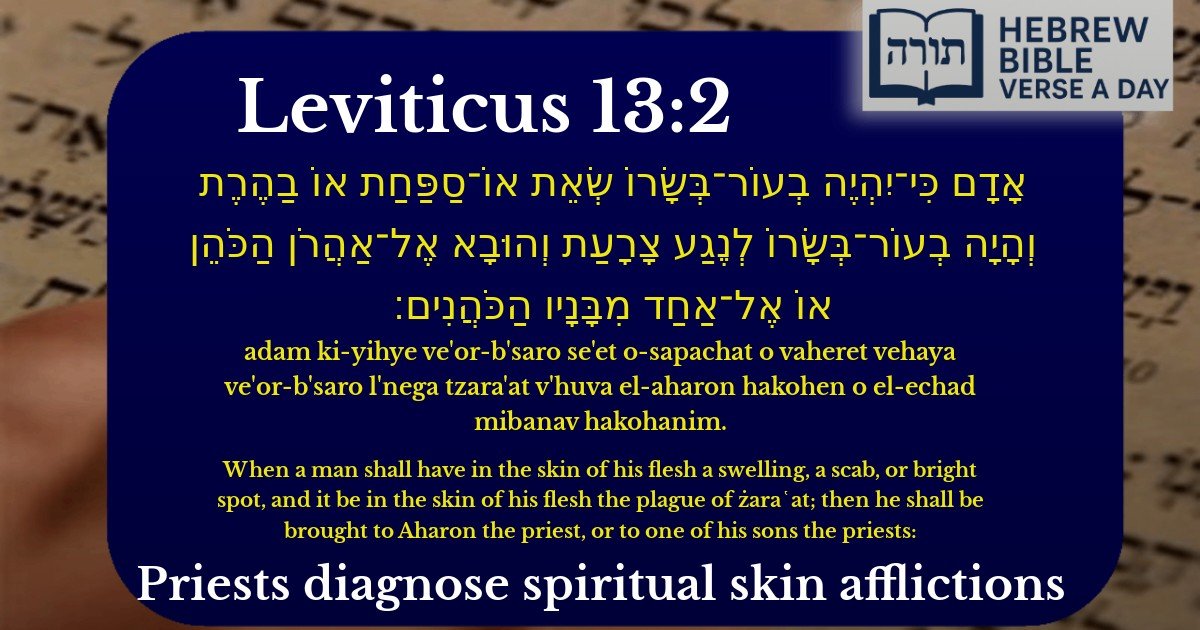

Leviticus 13:2 - Priests diagnose spiritual skin afflictions

Leviticus 13:2 - ויקרא 13:2

Hebrew Text

אָדָם כִּי־יִהְיֶה בְעוֹר־בְּשָׂרוֹ שְׂאֵת אוֹ־סַפַּחַת אוֹ בַהֶרֶת וְהָיָה בְעוֹר־בְּשָׂרוֹ לְנֶגַע צָרָעַת וְהוּבָא אֶל־אַהֲרֹן הַכֹּהֵן אוֹ אֶל־אַחַד מִבָּנָיו הַכֹּהֲנִים׃

English Translation

When a man shall have in the skin of his flesh a swelling, a scab, or bright spot, and it be in the skin of his flesh the plague of żara῾at; then he shall be brought to Aharon the priest, or to one of his sons the priests:

Transliteration

Adam ki-yihye ve'or-b'saro se'et o-sapachat o vaheret vehaya ve'or-b'saro l'nega tzara'at v'huva el-aharon hakohen o el-echad mibanav hakohanim.

Hebrew Leining Text

אָדָ֗ם כִּֽי־יִהְיֶ֤ה בְעוֹר־בְּשָׂרוֹ֙ שְׂאֵ֤ת אֽוֹ־סַפַּ֙חַת֙ א֣וֹ בַהֶ֔רֶת וְהָיָ֥ה בְעוֹר־בְּשָׂר֖וֹ לְנֶ֣גַע צָרָ֑עַת וְהוּבָא֙ אֶל־אַהֲרֹ֣ן הַכֹּהֵ֔ן א֛וֹ אֶל־אַחַ֥ד מִבָּנָ֖יו הַכֹּהֲנִֽים׃

🎵 Listen to leining

Parasha Commentary

Overview of the Verse

The verse (Vayikra 13:2) introduces the laws of tzara'at (often mistranslated as "leprosy"), a spiritual affliction manifesting as physical skin discolorations. Unlike a medical condition, tzara'at is a supernatural phenomenon requiring examination by a kohen (priest) to determine its status as pure or impure.

Key Terms and Their Meanings

  • שְׂאֵת (swelling): Rashi explains this refers to a raised, white spot on the skin, resembling frost (based on Vayikra 13:2 and Talmud Nega'im 1:1).
  • סַפַּחַת (scab): Rambam (Hilchot Tumat Tzara'at 1:1) defines this as a thin, spreading lesion.
  • בַהֶרֶת (bright spot): The Talmud (Nega'im 1:1) describes this as a bright white discoloration, whiter than an eggshell.

The Role of the Kohen

The Torah emphasizes that only a kohen—specifically Aharon or his descendants—may declare a person tamei (impure) or tahor (pure). Rashi (on Vayikra 13:2) notes that even if the kohen is unlearned, his status as a priest grants him the authority to make this determination, highlighting the divine nature of the law rather than medical expertise.

Spiritual Dimensions of Tzara'at

The Midrash (Vayikra Rabbah 15:5) teaches that tzara'at is a punishment for lashon hara (evil speech), arrogance, or other moral failings. The affliction serves as a divine wake-up call for repentance. The requirement to appear before the kohen underscores the need for spiritual introspection and correction of one's ways.

Halachic Process

  • Initial Inspection: The kohen examines the lesion to determine if it meets the criteria for tzara'at (e.g., size, color, spread).
  • Quarantine: If uncertain, the individual is isolated for seven days (Vayikra 13:4), allowing time for reflection and potential healing.
  • Final Ruling: After reevaluation, the kohen declares purity or impurity, leading to purification rituals or further isolation.

📚 Talmud Citations

This verse is quoted in the Talmud.

📖 Nega'im 3a
The verse is discussed in the context of the laws concerning leprosy (tzara'at) and the role of the priests in diagnosing it.
📖 Arachin 16a
The verse is referenced in a discussion about the various types of skin afflictions that are considered signs of tzara'at and require priestly examination.

Frequently Asked Questions

Q: What is 'tzara'at' mentioned in Leviticus 13:2?
A: Tzara'at is a spiritual affliction described in the Torah that appears as unusual discolorations or growths on the skin, clothing, or homes. According to Rashi and the Talmud (Arachin 15b), it is not a medical condition but rather a physical manifestation of spiritual impurity, often associated with the sin of lashon hara (evil speech). The Kohen (priest) examines it to determine its status.
Q: Why does the Torah require a Kohen to check tzara'at?
A: The Kohen serves as a spiritual authority in determining whether the affliction is indeed tzara'at. The Rambam (Hilchot Tumat Tzara'at) explains that this process is part of the Torah's system of purity and impurity. Only a Kohen, who is trained in these laws, can declare a person pure or impure, emphasizing the spiritual rather than medical nature of tzara'at.
Q: What lesson can we learn from the laws of tzara'at today?
A: The Midrash (Vayikra Rabbah 16:2) teaches that tzara'at comes as a consequence of negative speech and arrogance. Even though we no longer have tzara'at today, the message remains relevant: we must guard our speech, avoid gossip, and cultivate humility. The purification process (involving isolation and repentance) also teaches the importance of self-reflection and correcting one's ways.
Q: Why does the verse mention 'a swelling, a scab, or bright spot'?
A: Rashi explains that these are different possible appearances of tzara'at, each with its own halachic (legal) criteria. The Torah lists them to show that not all skin discolorations are tzara'at—only specific types, as determined by the Kohen. The Talmud (Nega'im 1:1) elaborates on the detailed signs that distinguish ordinary blemishes from actual tzara'at.
Q: Does tzara'at still exist today?
A: According to traditional Jewish sources (Rambam, Hilchot Tumat Tzara'at 9:1), tzara'at does not appear today because it was a miraculous phenomenon tied to the spiritual state of the Jewish people when the Temple stood. Without the Temple and the Kohanim trained in its laws, we no longer have the ability to diagnose or purify tzara'at. However, its moral lessons remain eternally relevant.