

Join Our Newsletter To Be Informed When New Videos Are Posted
Hebrew Text
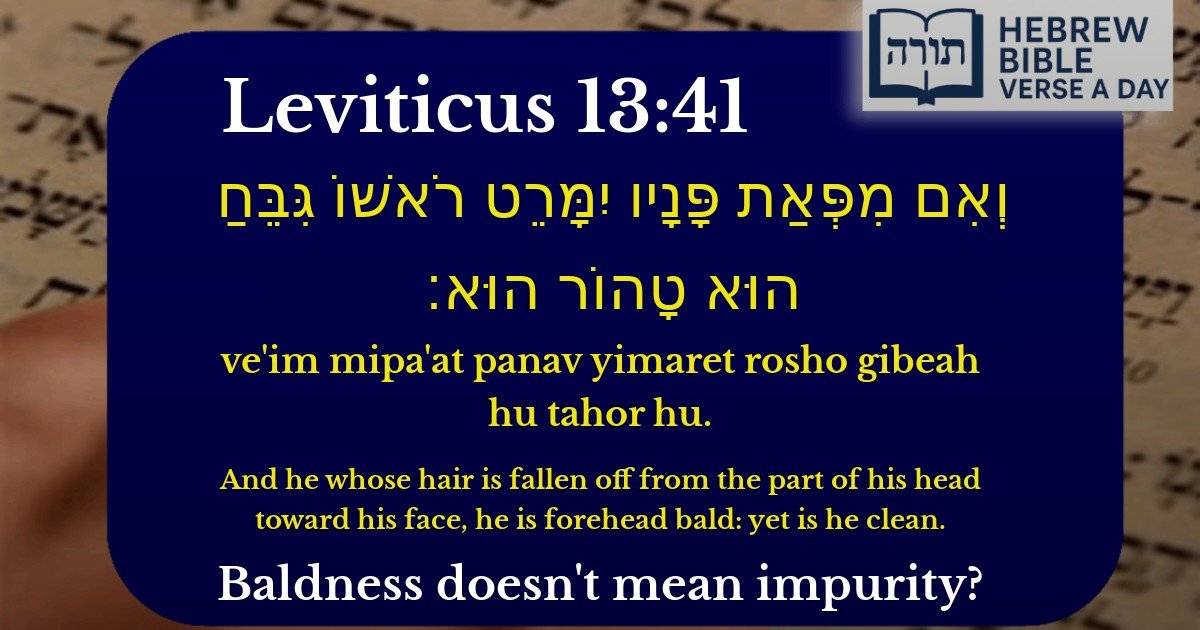
וְאִם מִפְּאַת פָּנָיו יִמָּרֵט רֹאשׁוֹ גִּבֵּחַ הוּא טָהוֹר הוּא׃
English Translation
And he whose hair is fallen off from the part of his head toward his face, he is forehead bald: yet is he clean.
Transliteration
Ve'im mipa'at panav yimaret rosho gibeah hu tahor hu.
Hebrew Leining Text
וְאִם֙ מִפְּאַ֣ת פָּנָ֔יו יִמָּרֵ֖ט רֹאשׁ֑וֹ גִּבֵּ֥חַ ה֖וּא טָה֥וֹר הֽוּא׃
🎵 Listen to leining
Parasha Commentary
📚 Talmud Citations
This verse is quoted in the Talmud.
📖 Nega'im 6:7
The verse is discussed in the context of the laws concerning leprosy (tzara'at) and the signs of impurity, specifically addressing the condition of baldness and its implications for ritual purity.
Context in the Torah
This verse (Vayikra 13:41) appears in the section discussing the laws of tzara'at (often mistranslated as "leprosy"), specifically addressing baldness or hair loss. The Torah distinguishes between different types of baldness to determine ritual purity or impurity.
Literal Meaning
The verse states that if hair loss occurs at the front of the head ("from the part of his head toward his face"), resulting in a bald forehead (gibéach), the person remains tahor (ritually pure). This contrasts with other forms of baldness that may indicate tzara'at.
Rashi's Commentary
Rashi (Vayikra 13:41) explains that "gibéach" refers to baldness at the front of the head, near the forehead. He clarifies that this type of baldness does not render a person impure because it is a natural condition, unlike the patches of hair loss associated with tzara'at, which appear elsewhere on the scalp.
Halachic Implications
Midrashic Insight
The Midrash (Vayikra Rabbah 15:6) connects this law to Divine justice, teaching that Hashem does not declare a person impure for natural phenomena beyond their control. Only unnatural afflictions, which may carry spiritual significance (e.g., lashon hara as a cause of tzara'at), require purification.
Symbolic Interpretation
Some commentators suggest that the forehead, being the most visible part of the head, symbolizes openness and sincerity. Natural baldness here does not indicate hidden spiritual flaws, unlike concealed patches of tzara'at, which may reflect internal shortcomings.