Frequently Asked Questions
Q: What does 'the Tora of the one stricken with żara῾at' mean in Leviticus 14:2?
A: This phrase refers to the detailed laws and procedures for purifying someone who had been afflicted with 'żara῾at' (often mistranslated as leprosy, but actually a spiritual skin condition). The Torah outlines the steps for their purification, which includes being examined by a Kohen (priest) and bringing specific offerings.
Q: Why does the verse say the person must be brought to the priest?
A: According to Rashi and other commentaries, the Kohen (priest) had a special role in diagnosing and declaring someone pure or impure from żara῾at. Only the Kohen could officially determine if the person was healed and guide them through the purification process, emphasizing the spiritual dimension of the affliction.
Q: What can we learn from the purification process of the metzora (person with żara῾at)?
A: The Talmud (Arachin 16a) teaches that żara῾at often came as a punishment for sins like lashon hara (evil speech). The purification process—including isolation, introspection, and offerings—teaches the importance of repentance, humility, and repairing one's ways before returning to the community.
Q: Does the law of the metzora apply today?
A: Since we no longer have the Temple or Kohanim performing their duties, the practical laws of żara῾at do not apply today. However, the moral lessons—such as avoiding harmful speech and seeking spiritual purification—remain eternally relevant, as emphasized by Rambam in Hilchot Tumat Tzara'at.
Q: Why is the metzora's purification called a 'Tora' (law) in this verse?
A: The term 'Tora' here refers to the entire set of instructions (like a manual) for this specific situation. The Midrash (Vayikra Rabbah 16:2) notes that this teaches that every detail of the purification process is significant and must be followed precisely, showing the care required in spiritual rehabilitation.

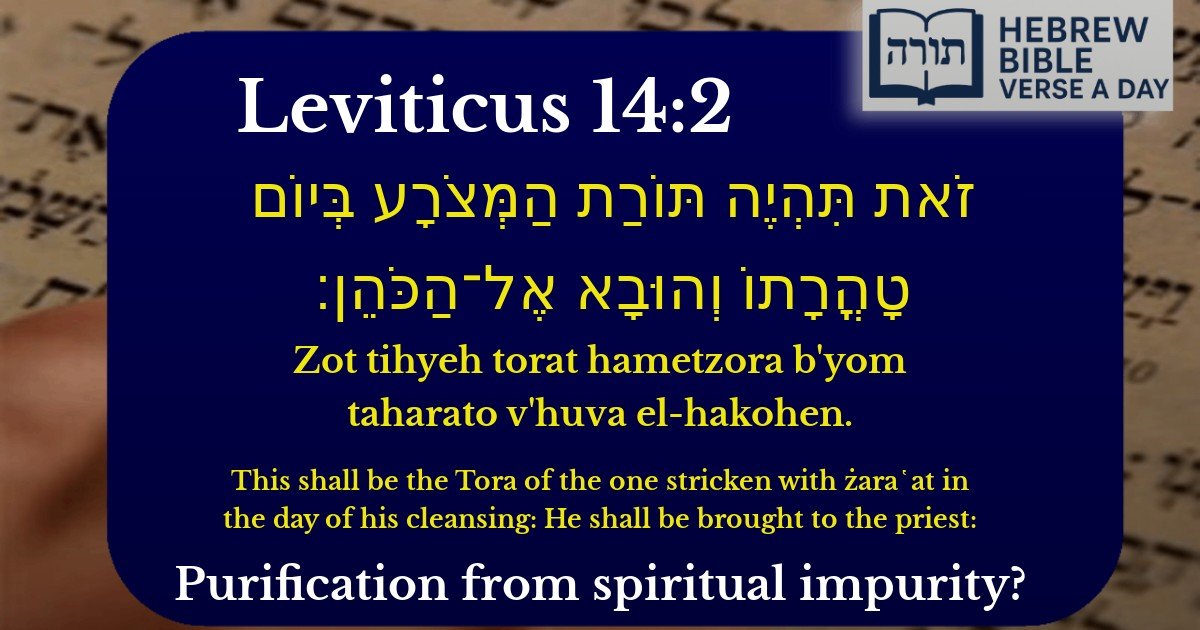

Understanding the Verse in Context
The verse (Vayikra 14:2) introduces the laws pertaining to the purification process of a metzora (one afflicted with tzara'at, often mistranslated as leprosy). According to Rashi, the term torat hametzora ("the Torah of the one stricken with tzara'at") refers to the detailed procedures that follow, which include sacrifices, immersions, and other rituals to restore the individual to purity.
The Role of the Kohen
The verse emphasizes that the metzora must be brought to the kohen (priest) for examination and purification. Rambam (Hilchot Tumat Tzara'at 9:1) explains that the kohen serves as the sole authority in determining purity or impurity, as the Torah states, "According to the word of the kohen shall it be" (Vayikra 13:59). This underscores the centrality of the kehunah (priesthood) in matters of ritual purity.
Spiritual Significance of Tzara'at
The Talmud (Arachin 16a) teaches that tzara'at is not merely a physical affliction but is often a consequence of spiritual failings, particularly lashon hara (evil speech). The purification process, therefore, serves as both a physical and spiritual rectification. The Midrash (Vayikra Rabbah 16:2) elaborates that the metzora must undergo a period of isolation and introspection before being permitted to rejoin the community.
The Day of Purification
The phrase b'yom taharato ("in the day of his cleansing") highlights the importance of timing in the purification process. The Kli Yakar explains that the purification must occur during daylight hours, symbolizing a transition from spiritual darkness (impurity) to light (purity). This aligns with the broader Torah principle that major rituals, such as circumcision and sacrifices, are performed during the day.
Key Lessons from the Verse