Frequently Asked Questions
Q: What does Leviticus 14:20 mean?
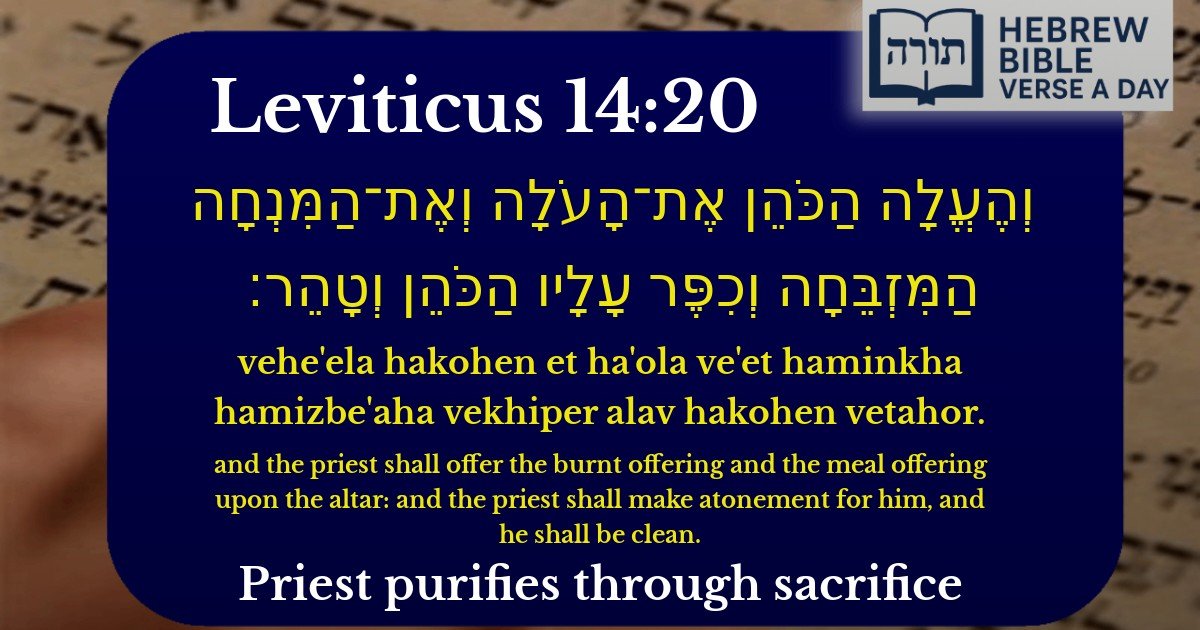
A: Leviticus 14:20 describes part of the purification process for someone who had tzara'at (a spiritual skin affliction often translated as 'leprosy'). The kohen (priest) offers a burnt offering (olah) and meal offering (mincha) on the altar to achieve atonement, after which the person is declared spiritually clean (tahor). Rashi explains that this follows the earlier steps of the purification process detailed in the chapter.
Q: Why is the burnt offering and meal offering important in this verse?
A: The burnt offering (olah) and meal offering (mincha) are essential for achieving kaparah (atonement) in this context. The olah represents complete devotion to Hashem, while the mincha, made of flour, symbolizes humility. Together, they help restore the person's spiritual purity after their affliction, as taught in the Talmud (Arachin 16a), which connects tzara'at to sins like arrogance and lashon hara (evil speech).
Q: What can we learn from Leviticus 14:20 today?
A: Although we no longer bring sacrifices today, this verse teaches the importance of repentance and spiritual renewal. The Rambam (Hilchot Tumat Tzara'at) explains that tzara'at served as a wake-up call to correct one's behavior. The process reminds us to approach atonement with sincerity, humility, and commitment to self-improvement, values that remain central in Jewish life.
Q: Who performs the purification process in Leviticus 14:20?
A: The kohen (priest) is the one who offers the sacrifices and declares the person clean. This highlights the kohen's role in guiding people through spiritual rectification, as emphasized in the Torah and Talmud. The Midrash (Vayikra Rabbah 16) notes that the kohen's involvement symbolizes divine mercy, as he facilitates the person's return to purity.
Q: How does this verse connect to the broader theme of purity in Leviticus?
A: Leviticus focuses heavily on the concepts of taharah (purity) and tumah (impurity). This verse is part of a larger section detailing how to restore purity after different forms of tumah. The Sforno explains that these laws teach us to strive for holiness in both physical and spiritual aspects of life, as impurity distances a person from sanctity and the Mishkan (Tabernacle).


Explanation of the Verse
The verse describes the process of atonement through korbanot (sacrifices) in the Beit HaMikdash (Holy Temple). The Kohen (priest) offers the olah (burnt offering) and minchah (meal offering) on the mizbe'ach (altar), facilitating kaparah (atonement) and taharah (purification) for the individual.
Key Components of the Verse
Halachic and Philosophical Insights
The Rambam (Hilchot Teshuva 1:1-3) emphasizes that while korbanot are part of the atonement process, true forgiveness requires viduy (confession), charatah (regret), and kabbalah al ha'asid (resolution for the future). The korban serves as a physical manifestation of this spiritual process.
The Midrash (Vayikra Rabbah 7:3) teaches that the mizbe'ach (altar) represents the connection between heaven and earth, and through the korbanot, a person repairs their relationship with Hashem. The olah, being entirely consumed, signifies the individual's desire to elevate their entire being to divine service.