

Join Our Newsletter To Be Informed When New Videos Are Posted
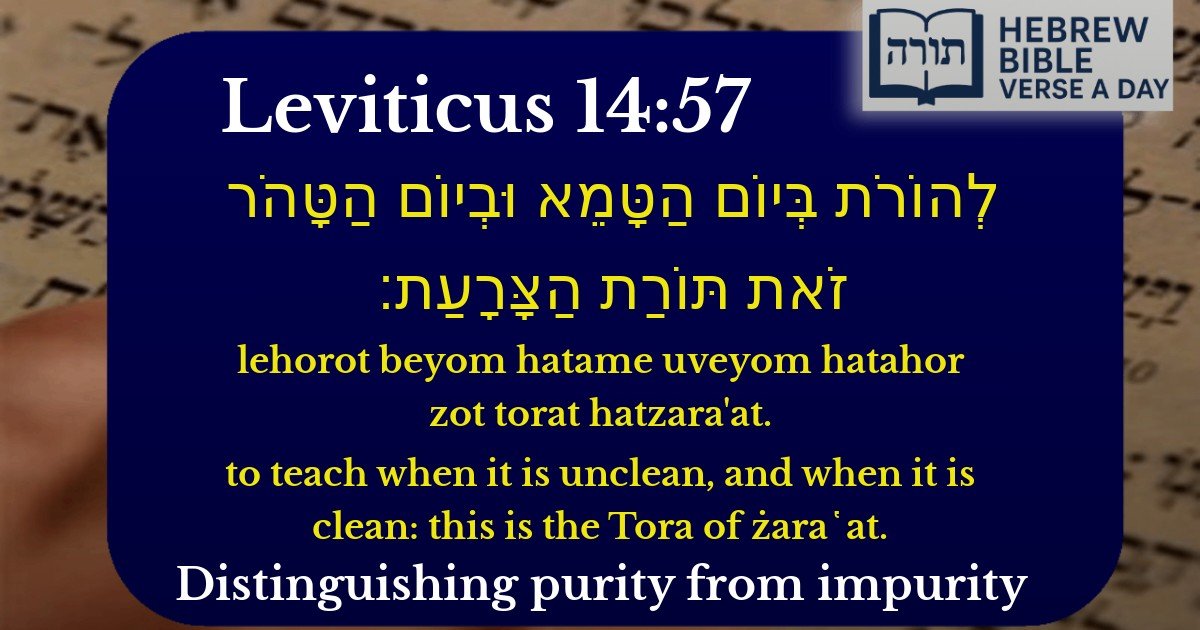
Hebrew Text
לְהוֹרֹת בְּיוֹם הַטָּמֵא וּבְיוֹם הַטָּהֹר זֹאת תּוֹרַת הַצָּרָעַת׃
English Translation
to teach when it is unclean, and when it is clean: this is the Tora of żara῾at.
Transliteration
Lehorot beyom hatame uveyom hatahor zot torat hatzara'at.
Hebrew Leining Text
לְהוֹרֹ֕ת בְּי֥וֹם הַטָּמֵ֖א וּבְי֣וֹם הַטָּהֹ֑ר זֹ֥את תּוֹרַ֖ת הַצָּרָֽעַת׃ {פ}
🎵 Listen to leining
Parasha Commentary
📚 Talmud Citations
This verse is quoted in the Talmud.
📖 Nega'im 3:1
The verse is referenced in the Mishnah discussing the laws of leprosy (tzara'at), particularly in relation to determining the purity or impurity of a person affected by it.
📖 Arakhin 15b
The verse is cited in the context of discussing the laws and procedures related to tzara'at, emphasizing the importance of distinguishing between clean and unclean states.
Understanding the Verse in Context
The verse "לְהוֹרֹת בְּיוֹם הַטָּמֵא וּבְיוֹם הַטָּהֹר זֹאת תּוֹרַת הַצָּרָעַת" (Vayikra 13:59) concludes the detailed laws of tzara'at (often mistranslated as "leprosy," but more accurately referring to a spiritual affliction manifesting on skin, garments, or houses). The verse emphasizes the role of the kohen (priest) in determining the status of purity or impurity, underscoring the Torah's system of tumah and taharah (ritual impurity and purity).
Rashi's Commentary
Rashi explains that this verse serves as a summary of the entire parashah of tzara'at, stating that the kohen must be the one to declare whether a person, garment, or house is tamei (impure) or tahor (pure). He emphasizes that this determination is not based on medical diagnosis but on the kohen's adherence to the Torah's laws. Rashi also notes that the phrase "זֹאת תּוֹרַת הַצָּרָעַת" ("this is the law of tzara'at") parallels similar phrases in other Torah sections, indicating a structured legal framework.
Rambam's Perspective
In Hilchot Tumat Tzara'at (Laws of Tzara'at Impurity), Rambam elaborates on the procedural aspects of this verse. He clarifies that the kohen's declaration is binding even if he lacks expertise in identifying tzara'at, as the Torah grants this authority exclusively to the priesthood. Rambam further connects tzara'at to the broader concept of hashgachah pratit (divine providence), suggesting that these afflictions serve as divine warnings against lashon hara (evil speech) and other moral failings.
Midrashic Insights
The Midrash (Vayikra Rabbah 16:6) links tzara'at to the sin of arrogance, drawing a parallel between the swelling (se'et) of tzara'at and the "swelling" of pride. It teaches that the purification process—which often involves isolation—serves as a corrective measure, humbling the afflicted individual and encouraging repentance. The phrase "לְהוֹרֹת" ("to teach") is interpreted as a call to introspection, urging the individual to learn from their spiritual missteps.
Practical Halachic Implications