

Join Our Newsletter To Be Informed When New Videos Are Posted
Hebrew Text
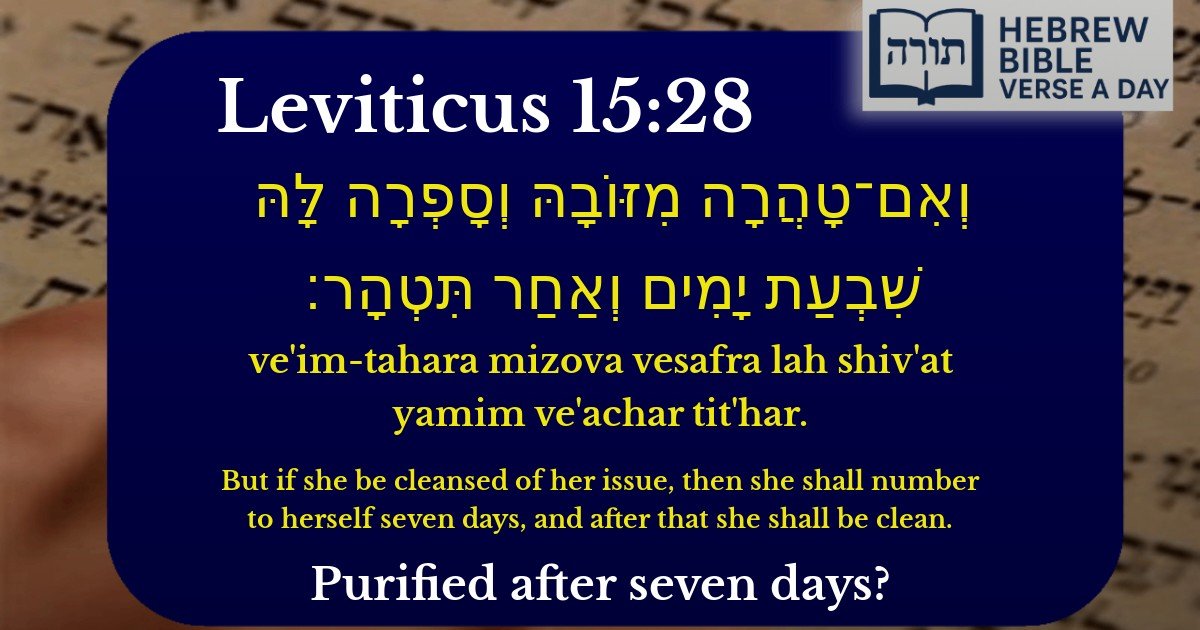
וְאִם־טָהֲרָה מִזּוֹבָהּ וְסָפְרָה לָּהּ שִׁבְעַת יָמִים וְאַחַר תִּטְהָר׃
English Translation
But if she be cleansed of her issue, then she shall number to herself seven days, and after that she shall be clean.
Transliteration
Ve'im-tahara mizova vesafra lah shiv'at yamim ve'achar tit'har.
Hebrew Leining Text
וְאִֽם־טָהֲרָ֖ה מִזּוֹבָ֑הּ וְסָ֥פְרָה לָּ֛הּ שִׁבְעַ֥ת יָמִ֖ים וְאַחַ֥ר תִּטְהָֽר׃
🎵 Listen to leining
Parasha Commentary
📚 Talmud Citations
This verse is quoted in the Talmud.
📖 Niddah 72a
The verse is discussed in the context of the laws concerning a woman's purification after her menstrual period, particularly the counting of seven clean days.
📖 Niddah 73b
The verse is referenced in a discussion about the timing and conditions under which a woman is considered clean after her issue.
Verse Context: Laws of Niddah and Zavah
The verse (Vayikra 15:28) discusses the purification process for a woman who experienced zivah (abnormal uterine bleeding beyond the regular niddah period). This is part of the Torah's detailed laws regarding ritual purity and impurity (tumah and taharah).
Rashi's Explanation
Rashi clarifies that the phrase "וְאִם־טָהֲרָה מִזּוֹבָהּ" ("if she be cleansed of her issue") refers to the cessation of bleeding. The woman must then count seven clean days (shivah neki'im) without any discharge, after which she may immerse in a mikveh to achieve full purity. Rashi emphasizes that these seven days are distinct from the initial days of impurity caused by the zivah itself.
Rambam's Halachic Perspective
In Hilchot Mechusrei Kapparah (1:5), Rambam rules that this counting period is a Torah obligation (mitzvah de'oraita). He notes that even if the woman experienced only a single day of zivah, she must still observe the seven clean days before immersion, underscoring the stringency of these laws.
Talmudic Discussion (Niddah 66a)
The Talmud explores whether the seven days must be consecutive. The conclusion is that they must be uninterrupted; if bleeding recurs during this period, the count restarts. This is derived from the phrase "וְסָפְרָה לָּהּ" – "she shall count for herself," implying a complete, uninterrupted count.
Midrashic Insight (Torat Kohanim)
The Midrash connects this purification process to spiritual renewal. Just as the seven days of counting lead to physical purity, they parallel the seven days of creation, symbolizing a woman's renewal and return to a state of holiness. This reflects the broader Torah principle that physical purity is a gateway to spiritual elevation.
Practical Halachic Implications