Frequently Asked Questions
Q: What does 'making atonement for the holy place' mean in Leviticus 16:20?
A: In Leviticus 16:20, 'making atonement for the holy place' refers to the Kohen Gadol (High Priest) performing special purification rituals on Yom Kippur (Day of Atonement) for the Mishkan (Tabernacle), the altar, and all the sacred vessels. Rashi explains that this atonement cleansed these holy spaces from any spiritual impurities that may have accumulated from the sins of the Jewish people throughout the year.
Q: What is the significance of the live goat mentioned in Leviticus 16:20?
A: The live goat mentioned here is the 'scapegoat' (שעיר המשתלח) that plays a central role in the Yom Kippur service. After atonement is made for the holy places, this goat is symbolically laden with the sins of Israel and sent away into the wilderness (as described in later verses). The Talmud (Yoma 39b) discusses how this ritual represents the complete removal of sins from the Jewish people.
Q: Why does the verse mention three places needing atonement (holy place, Tent of Meeting, altar)?
A: The three places mentioned - the Holy of Holies (קדש), the Tent of Meeting (אהל מועד), and the altar (מזבח) - represent different levels of sanctity where different types of impurities might occur. The Rambam (Hilchot Avodat Yom HaKippurim 1:2) explains that each required its own special atonement because they served different functions in the Divine service and were affected differently by the people's actions.
Q: How does Leviticus 16:20 relate to Yom Kippur today without the Temple?
A: Although we no longer have the Temple service, the concepts in this verse remain central to Yom Kippur. The Talmud (Yoma 85b) teaches that while we can't bring sacrifices today, teshuva (repentance), tefilla (prayer), and tzedaka (charity) serve similar atoning functions. The structure of our Yom Kippur prayers mirrors the ancient Temple service described in this verse.
Q: What lesson can we learn from the order of atonement in this verse?
A: The order teaches us that spiritual purification begins with the holiest spaces (the Holy of Holies) and moves outward. The Midrash (Vayikra Rabbah 21:7) explains this shows that true atonement must start from our innermost, holiest selves before addressing our external actions. Just as the Kohen Gadol purified the sacred spaces before dealing with the people's sins, we must first purify our intentions before correcting our behaviors.


Context in the Yom Kippur Service
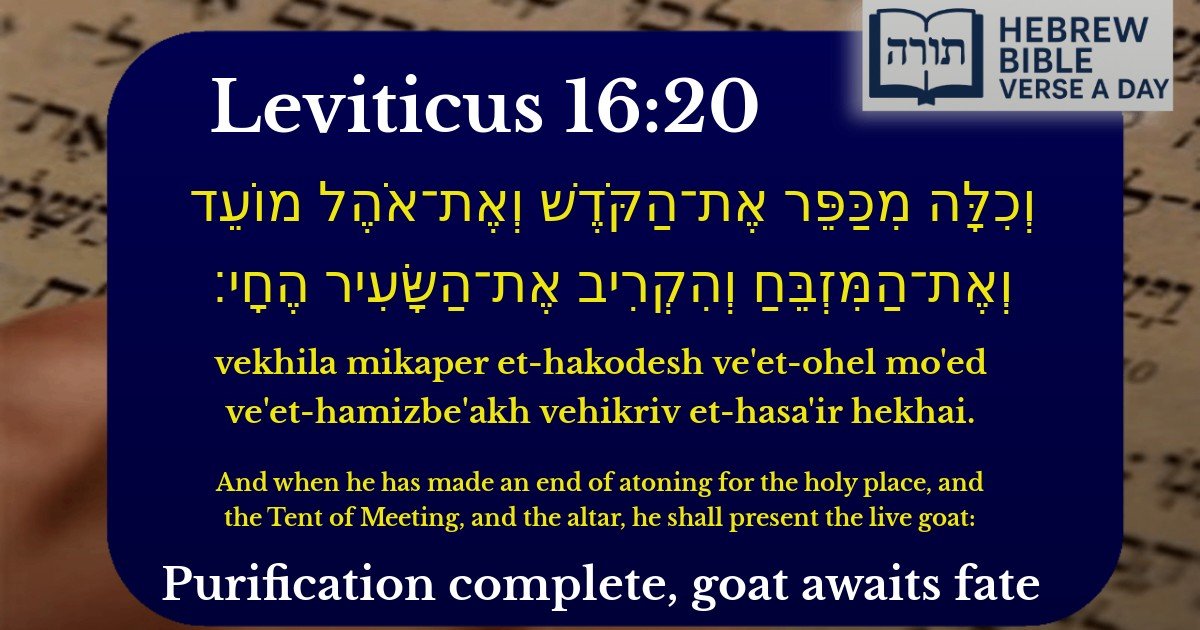
This verse (Vayikra 16:20) describes a critical moment in the Yom Kippur service performed by the Kohen Gadol (High Priest). After completing the atonement rituals for the Kodesh (Holy of Holies), the Ohel Moed (Tent of Meeting), and the Mizbeach (Altar), the Kohen Gadol turns his attention to the live goat—the "Sa'ir La'Azazel" (scapegoat).
Rashi's Explanation
Rashi explains that the phrase "וְכִלָּה מִכַּפֵּר" ("when he has made an end of atoning") refers to the completion of the sprinkling of blood, which was the primary method of atonement for these sacred areas. Only after this is done does the Kohen Gadol proceed to the next stage—confessing the sins of Israel over the live goat.
The Order of Atonement
Rambam (Hilchot Avodat Yom HaKippurim 3:6) emphasizes that each step must follow this precise order, as deviation invalidates the service.
Symbolism of the Live Goat
The "Sa'ir HaChai" (live goat) represents the final stage of atonement, where the sins of Israel are symbolically transferred and sent away into the wilderness (to Azazel). The Midrash (Vayikra Rabbah 21:11) teaches that this act demonstrates complete removal of sin, as the goat carries the transgressions far from the camp, never to return.
Halachic Significance
The Talmud (Yoma 67a) derives from this verse that the atonement for the Mikdash and its vessels must precede the atonement achieved through the scapegoat. This teaches that communal sanctity (Kedushat HaMakom) must be restored before individual atonement can be fully effective.