Frequently Asked Questions
Q: What does Leviticus 16:30 mean?
A: Leviticus 16:30 refers to Yom Kippur (the Day of Atonement), when the Kohen Gadol (High Priest) would perform special services in the Temple to atone for the sins of the Jewish people. According to Rashi, this verse teaches that sincere repentance (teshuvah) combined with the sanctity of Yom Kippur brings complete forgiveness from Hashem.
Q: Why is Yom Kippur important based on this verse?
A: This verse highlights Yom Kippur as the holiest day of the year, when Hashem grants atonement for those who repent. The Rambam (Hilchot Teshuvah 2:7) explains that Yom Kippur atones for sins between a person and Hashem, provided one does proper teshuvah (repentance).
Q: How does this verse apply to us today without the Temple?
A: Even without the Temple, the Talmud (Yoma 85b) teaches that Yom Kippur still atones when accompanied by repentance. The day remains a sacred opportunity for spiritual cleansing through prayer, fasting, and sincere commitment to improve.
Q: What does 'clean from all your sins' mean in this verse?
A: The phrase means that through the combined power of Yom Kippur and true repentance, a person can achieve complete forgiveness. The Midrash (Vayikra Rabbah 30:7) compares this to being as pure as a newborn, free from all past transgressions.
Q: Does this verse mean all sins are automatically forgiven on Yom Kippur?
A: No. The Mishnah (Yoma 8:9) clarifies that Yom Kippur only atones for sins between a person and Hashem if one repents. Sins between people require first seeking forgiveness from those we wronged. The day provides the opportunity, but teshuvah is essential.

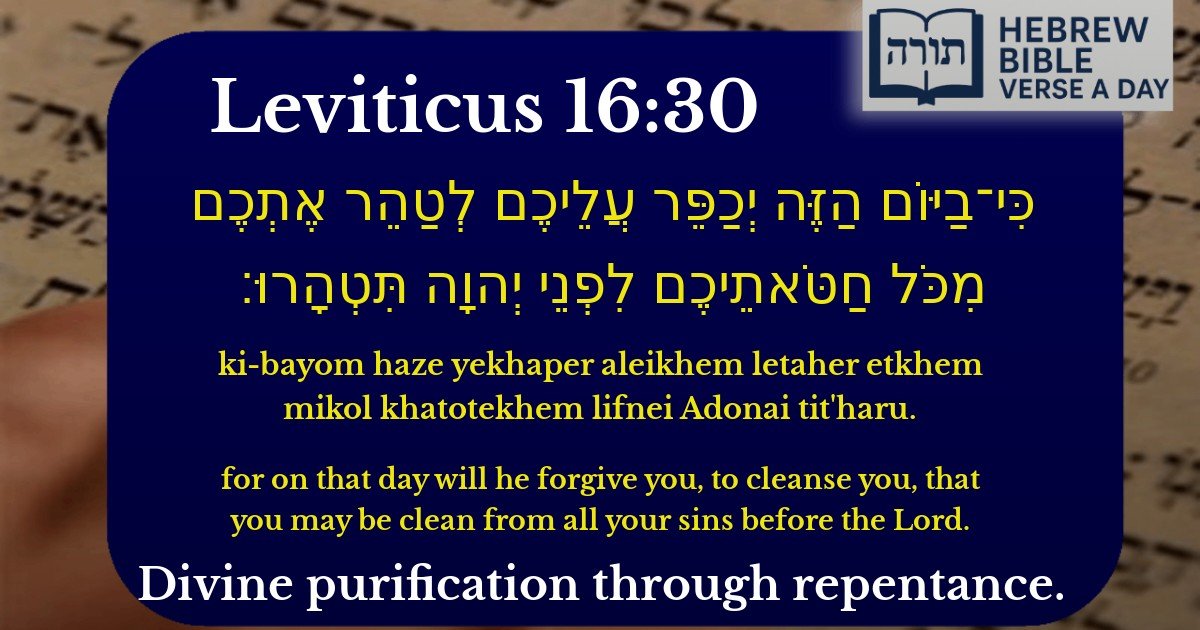

Context in Vayikra (Leviticus) 16:30
The verse appears in the Torah portion of Acharei Mot, describing the atonement achieved on Yom Kippur (the Day of Atonement). It emphasizes the unique power of this day to purify Bnei Yisrael from their sins when they properly observe its laws and engage in teshuvah (repentance).
Rashi's Explanation
Rashi (Vayikra 16:30) clarifies that the phrase "כִּי־בַיּוֹם הַזֶּה יְכַפֵּר עֲלֵיכֶם" ("for on this day He will atone for you") refers specifically to the service of the Kohen Gadol (High Priest) in the Beit HaMikdash (Holy Temple). The atonement is contingent upon the proper performance of the avodah (Temple service), including the korbanot (sacrifices), the confessions, and the sending of the se'ir la'azazel (scapegoat).
Rambam on Teshuvah and Yom Kippur
Rambam (Hilchot Teshuvah 1:3) explains that while Yom Kippur provides kaparah (atonement) for sins between man and Hashem, complete forgiveness requires teshuvah—genuine repentance consisting of:
Without teshuvah, Yom Kippur only atones for minor transgressions.
Midrashic Insight
The Midrash (Vayikra Rabbah 21:4) teaches that the phrase "לִפְנֵי יְהוָה תִּטְהָרוּ" ("before Hashem you shall be purified") indicates that the purification is not merely external but reaches the innermost spiritual state of a person when they stand sincerely before Hashem. This aligns with the concept of Yom Kippur as a day of spiritual renewal.
Talmudic Perspective
The Talmud (Yoma 85b) derives from this verse that Yom Kippur atones only if one observes the prohibitions of the day (affliction of the soul—i.e., fasting—and refraining from work). The Gemara emphasizes that the atonement is granted "מִכֹּל חַטֹּאתֵיכֶם" ("from all your sins"), including even the most severe transgressions, provided there is sincere repentance.