Frequently Asked Questions
Q: What does Leviticus 20:21 mean?
A: Leviticus 20:21 prohibits a man from marrying his brother's wife while the brother is still alive, as it is considered an 'unclean thing' (נִדָּה) and a violation of family boundaries. The Torah states that such a union would result in them being 'childless' (עֲרִירִים), meaning either they will not have children or their children will not be considered legitimate in a spiritual sense (Rashi, Ibn Ezra).
Q: Why is marrying a brother's wife forbidden in Judaism?
A: Marrying a brother's wife while the brother is alive is forbidden because it violates the sanctity of family relationships and is considered an uncovering of 'his brother’s nakedness' (עֶרְוַת אָחִיו). The Torah emphasizes maintaining proper boundaries within the family to uphold moral and social order (Rambam, Hilchot Issurei Bi'ah 1:6). However, after the brother's death with no children, there is a mitzvah of Yibbum (levirate marriage), as described in Deuteronomy 25:5-10.
Q: What does 'they shall be childless' mean in Leviticus 20:21?
A: The phrase 'they shall be childless' (עֲרִירִים יִהְיוּ) can be understood in two ways: 1) Literally—they may not be able to have children as a consequence of this forbidden union. 2) Spiritually—even if they have children, those children may not be considered fully part of the Jewish people in a halachic sense (Rashi, Talmud Yevamot 55a).
Q: Does this law apply if the brother has passed away?
A: No, this prohibition only applies while the brother is still alive. In fact, if a brother dies without children, there is a mitzvah called Yibbum (levirate marriage), where the surviving brother is encouraged to marry the widow to perpetuate his brother’s name (Deuteronomy 25:5-10). However, if the brother refuses, the ceremony of Chalitzah (removing the shoe) is performed instead (Talmud Yevamot 24a).
Q: How does Leviticus 20:21 apply today?
A: Today, Orthodox Judaism strictly upholds this prohibition, and marrying a brother’s wife while the brother is alive remains forbidden under Torah law. Even in cases where civil law permits it, Jewish law (Halacha) does not. If a brother dies childless, the practice of Yibbum is still technically valid, but Ashkenazi communities generally perform Chalitzah instead to avoid complications (Shulchan Aruch, Even HaEzer 165).

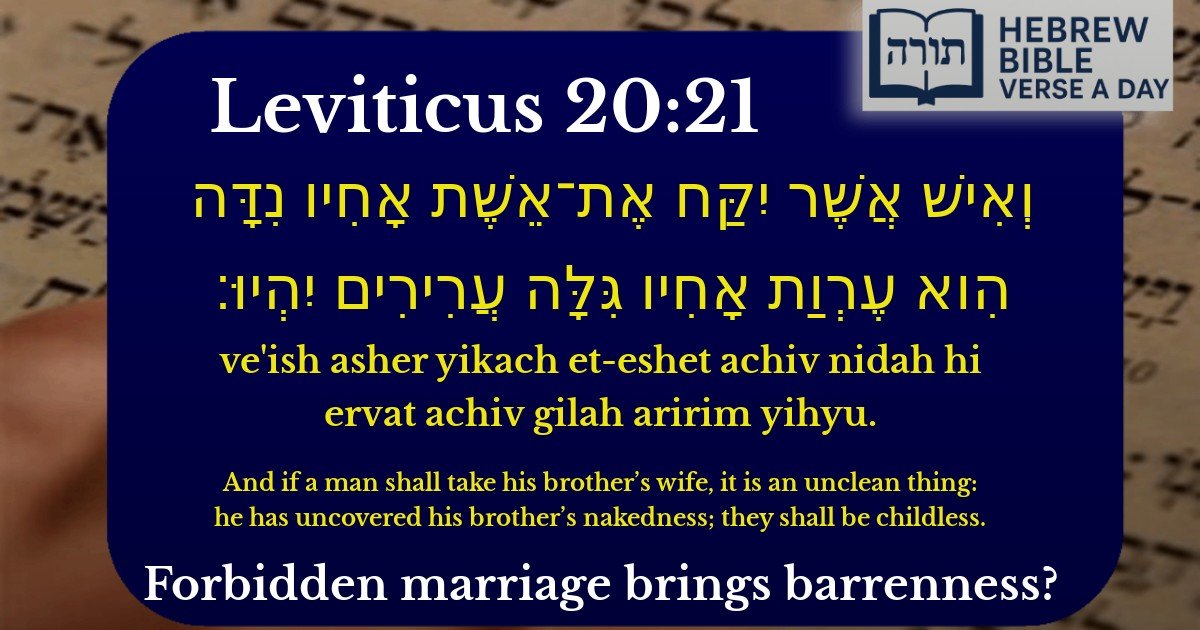

Prohibition of Marrying a Brother's Wife
The verse (Vayikra 20:21) prohibits a man from marrying his brother's wife, classifying it as niddah (an unclean thing) and an uncovering of his brother's "nakedness" (ervat achiv). This prohibition is part of the Torah's broader laws concerning forbidden relationships (arayot).
Explanation of the Term "Niddah"
Rashi explains that the term niddah here does not refer to menstrual impurity but rather denotes something repulsive and forbidden. The Ramban adds that this usage emphasizes the severity of the transgression, as it is an abhorrent act in the eyes of Hashem.
Uncovering a Brother's Nakedness
The phrase ervat achiv gilah ("he has uncovered his brother's nakedness") is interpreted by the Talmud (Yevamot 55a) as referring to the intimate relationship between a man and his brother's wife. The Sifra (Kedoshim 10:8) states that this prohibition applies even after the brother's death, unless it is a case of yibbum (levirate marriage), which is a mitzvah under specific circumstances (Devarim 25:5-10).
Consequence: Childlessness
The verse concludes with the punishment aririm yihyu ("they shall be childless"). The Talmud (Yevamot 55a) discusses whether this means they will literally have no children or that their children will not be considered legitimate. Rambam (Hilchot Issurei Bi'ah 1:7) rules that the prohibition applies regardless of whether the brother is alive or deceased (outside of yibbum), and such a union produces mamzerim (illegitimate children).
Exceptions: Yibbum and Chalitzah