
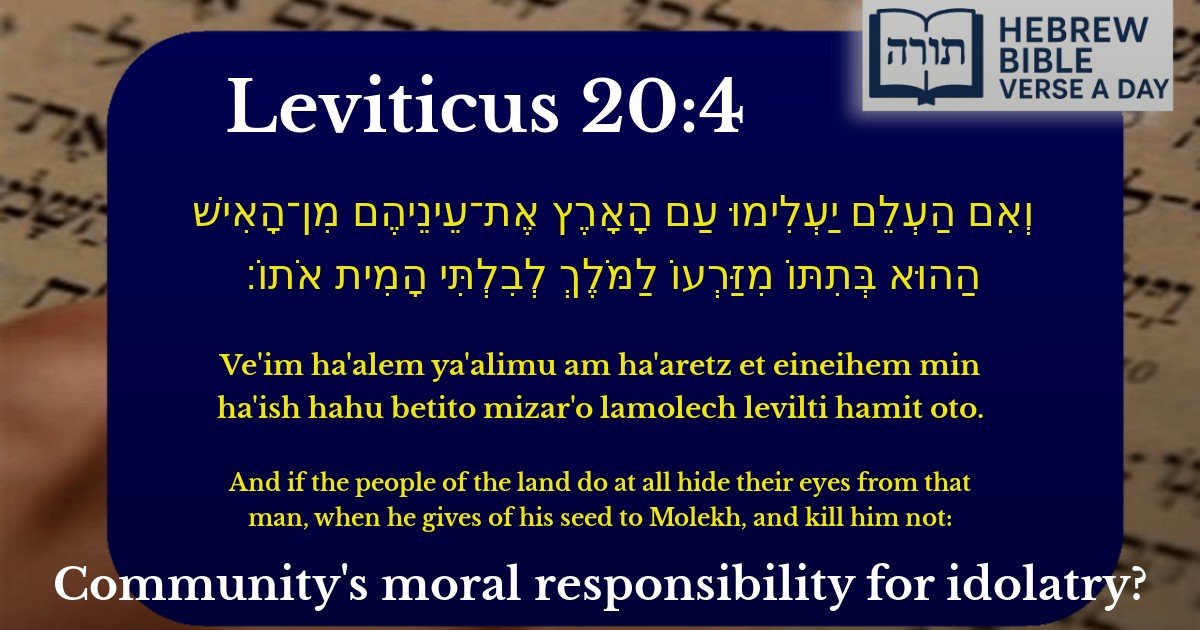

Leviticus 20:4 - Community's moral responsibility for idolatry?

Leviticus 20:4 - ויקרא 20:4

Hebrew Text

וְאִם הַעְלֵם יַעְלִימוּ עַם הָאָרֶץ אֶת־עֵינֵיהֶם מִן־הָאִישׁ הַהוּא בְּתִתּוֹ מִזַּרְעוֹ לַמֹּלֶךְ לְבִלְתִּי הָמִית אֹתוֹ׃

English Translation

And if the people of the land do at all hide their eyes from that man, when he gives of his seed to Molekh, and kill him not:

Transliteration

Ve'im ha'alem ya'alimu am ha'aretz et eineihem min ha'ish hahu betito mizar'o lamolech levilti hamit oto.

Hebrew Leining Text

וְאִ֡ם הַעְלֵ֣ם יַעְלִ֩ימֽוּ֩ עַ֨ם הָאָ֜רֶץ אֶת־עֵֽינֵיהֶם֙ מִן־הָאִ֣ישׁ הַה֔וּא בְּתִתּ֥וֹ מִזַּרְע֖וֹ לַמֹּ֑לֶךְ לְבִלְתִּ֖י הָמִ֥ית אֹתֽוֹ׃

🎵 Listen to leining

Parasha Commentary

Context and Meaning

The verse (Vayikra 20:4) addresses the severe prohibition of giving one's child to Molekh, a form of idolatry involving child sacrifice. The Torah warns that if the community turns a blind eye to this transgression and fails to execute justice, they bear collective responsibility. Rashi explains that "hide their eyes" (הַעְלֵם יַעְלִימוּ) implies deliberate negligence—the people knowingly ignore the sin, thereby enabling it.

Halachic Implications

According to Rambam (Hilchos Avodah Zarah 6:1-3), worshiping Molekh is a capital offense, and the community is obligated to bring the perpetrator to justice. The verse emphasizes that even passive tolerance of such a grave sin is unacceptable. The Ramban adds that this law underscores the principle of areivut (communal responsibility)—when evil is ignored, the entire nation is held accountable.

Moral and Ethical Lessons

  • Collective Responsibility: The Talmud (Sanhedrin 43b) teaches that silence in the face of wrongdoing is akin to complicity. The community must actively oppose evil to maintain moral integrity.
  • Severity of Idolatry: The Midrash (Sifra Kedoshim 9:12) highlights that Molekh worship represents the ultimate corruption of divine service, perverting the sanctity of life.
  • Leadership Obligation: The Sforno notes that leaders bear a heightened duty to enforce justice, as their inaction leads the people astray.

Linguistic Insights

The doubling of the verb העלם יעלימו ("hide their eyes") suggests an intensification—the sin is not merely overlooked but willfully ignored. Ibn Ezra connects this to the phrase לבלתי המית אותו ("and kill him not"), indicating that the community's failure to act is an active choice, not mere passivity.

📚 Talmud Citations

This verse is quoted in the Talmud.

📖 Sanhedrin 64b
The verse is discussed in the context of the prohibition against giving one's offspring to Molekh and the communal responsibility to enforce this law.

Frequently Asked Questions

Q: What does 'giving of his seed to Molekh' mean in Leviticus 20:4?
A: According to Rashi and traditional Jewish sources, 'giving of his seed to Molekh' refers to the forbidden act of passing one's child through fire as part of idolatrous worship to the pagan deity Molekh. This was a severe transgression in biblical times, strictly prohibited by the Torah.
Q: Why does the verse mention the people 'hiding their eyes' from this sin?
A: The Torah warns against ignoring or covering up such a grave sin. The Talmud (Sanhedrin 64b) explains that society has a collective responsibility to uphold justice. If people turn a blind eye to idolatry or moral corruption, they share in the guilt. This teaches the importance of communal accountability in Jewish law.
Q: What is the significance of Molekh worship being mentioned in the Torah?
A: Molekh worship represented one of the most abhorrent forms of idolatry, as it involved child sacrifice. The Rambam (Mishneh Torah, Laws of Idolatry 6:3) emphasizes that the Torah mentions it specifically to highlight the severity of abandoning Hashem's commandments and the sanctity of human life in Jewish tradition.
Q: How does this verse apply to Jewish values today?
A: While Molekh worship isn't practiced today, this verse teaches enduring principles: 1) The infinite value of every Jewish soul (as per Talmud Sanhedrin 37a), 2) The prohibition against any form of child endangerment, and 3) The obligation to speak out against moral wrongs rather than remain silent, as derived from the warning against 'hiding their eyes.'
Q: Why does the verse say 'and kill him not' at the end?
A: This refers to the failure to carry out the court's death penalty for this transgression. The Sifra (a halachic midrash on Leviticus) explains that the verse condemns both the perpetrator and those who neglect their duty to uphold justice. It shows how seriously Jewish law views both the sin itself and the communal responsibility to maintain moral standards.