Frequently Asked Questions
Q: What does Leviticus 21:20 mean?
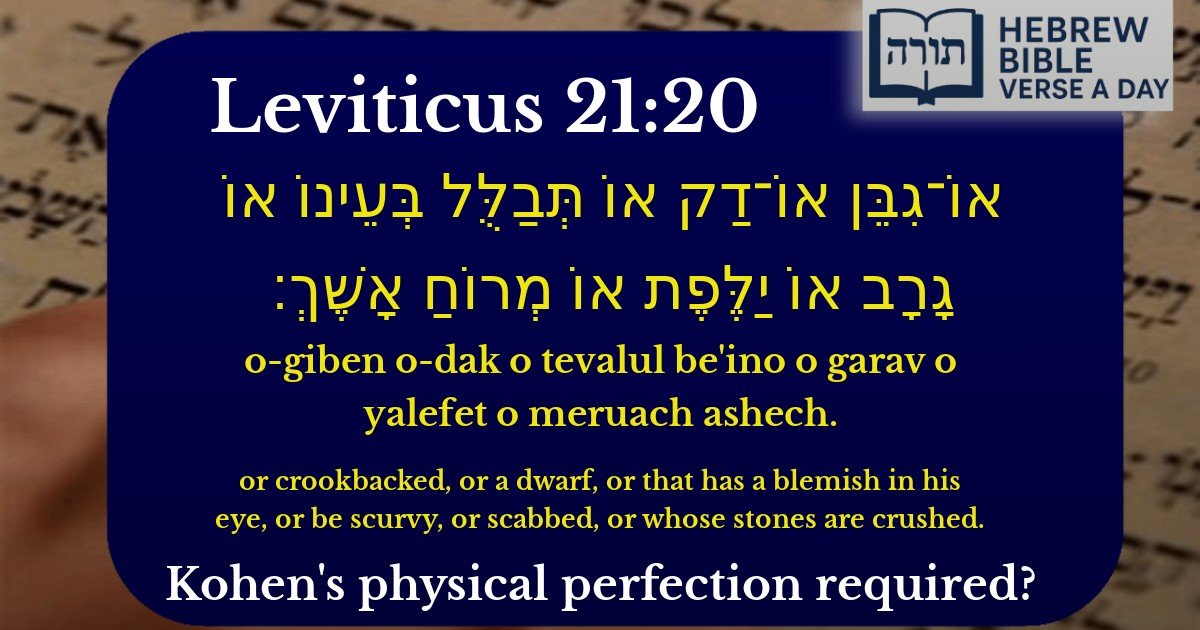
A: Leviticus 21:20 lists physical blemishes that disqualify a Kohen (priest) from performing certain Temple services. According to Rashi and the Talmud (Bechorot 43b), these blemishes include being hunchbacked, dwarfed, having an eye defect, skin afflictions (like scurvy or scabs), or crushed testicles. The Torah emphasizes the importance of physical wholeness for Kohanim serving in the Mishkan (Tabernacle) or Beit HaMikdash (Temple).
Q: Why does the Torah disqualify Kohanim with blemishes from serving?
A: The Rambam (Hilchot Bi'at HaMikdash 7:1) explains that the sanctity of the Temple service requires Kohanim to be in a state of physical completeness, as this reflects spiritual wholeness. The Midrash (Torat Kohanim) teaches that just as sacrifices must be physically unblemished, so too must those offering them. This does not imply that people with disabilities are inferior—only that certain standards apply to Temple service.
Q: Do these laws apply to Kohanim today?
A: Since the Temple is not currently standing, Kohanim do not perform sacrificial services, so these restrictions are not practically applicable today. However, Orthodox Judaism maintains that these laws will be relevant again when the Third Temple is rebuilt, as explained in Mishneh Torah (Hilchot Klei HaMikdash 5:15).
Q: What is the lesson from Leviticus 21:20?
A: The verse teaches the importance of approaching sacred matters with reverence and in an optimal state. The Talmud (Megillah 24b) derives from this that even a Kohen with temporary blemishes (like a beard not fully grown) should not serve. This principle extends beyond the Temple—we learn to prepare ourselves properly, both physically and spiritually, for holy endeavors.
Q: Does this mean Judaism looks down on people with disabilities?
A: Absolutely not. The Talmud (Berachot 32b) teaches that G-d values all people, and physical differences do not reflect spiritual worth. These laws apply only to Kohanim performing specific Temple services. The Torah itself commands us not to mistreat those with disabilities (Leviticus 19:14). Jewish law emphasizes kindness and inclusion for all, as Rambam writes in Hilchot De'ot (4:1).


Context of the Verse
This verse (Vayikra 21:20) is part of the Torah's discussion of physical blemishes that disqualify a kohen (priest) from performing the Temple service. The Torah enumerates various physical conditions that render a kohen unfit to offer sacrifices or enter certain areas of the Temple.
Explanation of the Blemishes
Philosophical and Halachic Insights
The Sefer HaChinuch (Mitzvah 275) explains that the sanctity of the Temple service requires the kohanim to be physically whole, as physical imperfections might distract from the spiritual focus of the service. However, the Talmud (Megillah 24b) emphasizes that these disqualifications apply only to active Temple service; a kohen with blemishes retains all other priestly rights and honors.
Rambam (Moreh Nevuchim 3:45) suggests that these laws also teach the importance of approaching divine service with physical and spiritual completeness, symbolizing the ideal state of serving Hashem.