Frequently Asked Questions
Q: What does 'a male without blemish' mean in Leviticus 22:19?
A: The phrase 'a male without blemish' refers to an animal that is physically perfect, with no defects or injuries, suitable for offering as a sacrifice in the Temple. Rashi explains that this means the animal must be free from any disqualifying imperfections, as detailed in the Torah (Leviticus 22:20-25).
Q: Why does the Torah specify oxen, sheep, and goats for sacrifices?
A: The Torah specifies oxen, sheep, and goats because these animals were commonly owned and valued in ancient Israel, making their sacrifice meaningful. Rambam (Hilchot Ma'aseh HaKorbanot 1:14) explains that these species were chosen for their availability and suitability for offerings, ensuring that sacrifices were accessible to the people.
Q: What is the significance of offering a sacrifice 'that you may be accepted'?
A: The phrase 'that you may be accepted' teaches that sacrifices must be brought with proper intent (kavanah) to be pleasing to Hashem. The Talmud (Menachot 110a) emphasizes that the sincerity and devotion of the person bringing the offering are essential for it to be accepted.
Q: How does Leviticus 22:19 apply to us today without the Temple?
A: While we cannot bring sacrifices without the Temple, the verse teaches us the importance of offering our best to Hashem in other ways, such as prayer, charity, and good deeds. The Midrash (Vayikra Rabbah 7:2) compares prayer to sacrifices, showing how we can still fulfill this spiritual ideal today.
Q: Why must the sacrifice be a male animal?
A: The Torah generally requires male animals for most voluntary offerings (like burnt offerings) because they were considered more valuable in agricultural society, symbolizing a greater commitment. However, certain sacrifices (like sin offerings) could be female, as explained in the Talmud (Zevachim 34b) and by Rashi on Leviticus 4:32.

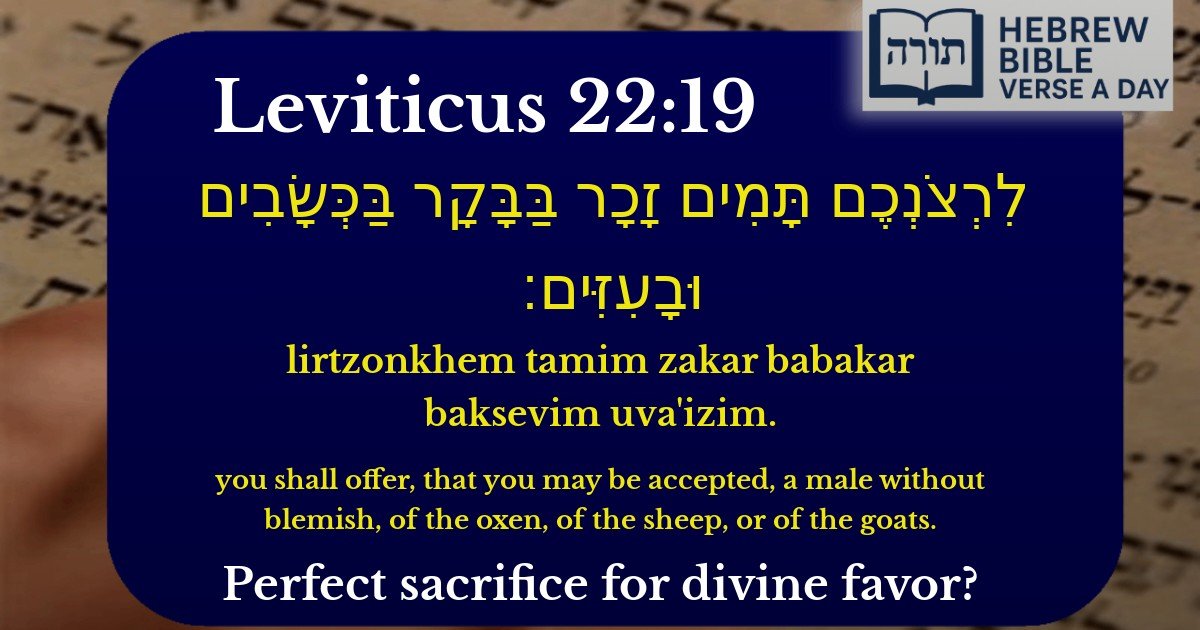

Understanding the Requirement for a Tamim (Unblemished) Sacrifice
The verse (Vayikra 22:19) specifies that offerings must be תָּמִים (tamim)—"without blemish"—and זָכָר (zachar)—"male." Rashi explains that "tamim" refers to physical perfection, meaning the animal must be free from any defects that would disqualify it for sacrifice. The Talmud (Chullin 11a) elaborates on the types of blemishes that invalidate an offering, such as blindness, lameness, or broken limbs, derived from the detailed list in Vayikra 22:22-24.
The Significance of a Male Animal
Rambam (Hilchos Issurei Mizbe'ach 1:14) notes that the Torah generally requires male animals for voluntary offerings (לִרְצֹנְכֶם—"that you may be accepted"), as they are considered more valuable and thus a more fitting gift to Hashem. The Midrash (Vayikra Rabbah 27:6) connects this to the idea of giving the best of one's possessions in divine service, as seen in Kayin and Hevel's offerings (Bereishis 4:3-4).
The Three Permitted Species: Oxen, Sheep, and Goats
The verse permits sacrifices from three categories: בַּבָּקָר (oxen), בַּכְּשָׂבִים (sheep), and וּבָעִזִּים (goats). The Talmud (Menachos 110a) teaches that these species were chosen because they are domesticated and commonly owned, making them accessible for offerings. Additionally, the Kli Yakar highlights that these animals represent different levels of wealth—oxen being the most expensive, sheep intermediate, and goats the most affordable—ensuring all individuals, regardless of means, could participate in sacrificial worship.
The Concept of "Lirtzonchem" (For Your Acceptance)
The term לִרְצֹנְכֶם ("that you may be accepted") emphasizes that the offering must be given with proper intent. The Sforno explains that mere technical compliance is insufficient; the korban must reflect sincere devotion. The Ramban adds that this phrase hints at the idea of כַּוָנָה (kavanah, proper intention), a recurring theme in avodas Hashem (service of G-d).