Frequently Asked Questions
Q: What does it mean to be 'afflicted' on Yom Kippur according to Leviticus 23:29?
A: According to Orthodox Jewish tradition, being 'afflicted' on Yom Kippur refers to the five main prohibitions: fasting (no eating or drinking), not washing or anointing the body, not wearing leather shoes, not engaging in marital relations, and avoiding work (similar to Shabbat). This is based on Talmud Yoma 73b and Rambam's Hilchot Yom HaKippurim.
Q: Why is the punishment so severe ('cut off from his people') for not observing Yom Kippur?
A: The severe consequence of being 'cut off' (karet) teaches how fundamental Yom Kippur is for atonement and spiritual cleansing. The Talmud (Shevuot 13a) explains that willfully neglecting this day shows a rejection of the covenant between Hashem and the Jewish people. Rambam (Hilchot Teshuvah 1:3) also emphasizes that Yom Kippur is the primary day for repentance.
Q: Does Leviticus 23:29 apply to children or sick people?
A: No, traditional Jewish law exempts certain people from fasting. Children below bar/bat mitzvah age, pregnant/nursing women with health concerns, and anyone whose life would be endangered are exempt (Shulchan Aruch Orach Chaim 617). The Talmud (Yoma 82a) states that preserving life overrides Yom Kippur fasting, based on the principle of 'v'chai bahem' - 'and you shall live by them' (Leviticus 18:5).
Q: How do we observe this verse's commandment today on Yom Kippur?
A: Today, Orthodox Jews observe this by strictly keeping the five afflictions mentioned in Talmudic sources: 1) Complete 25-hour fast, 2) No washing for pleasure, 3) No leather shoes, 4) No marital relations, and 5) No work (like on Shabbat). We also spend the day in synagogue praying for forgiveness. The Mishnah (Yoma 8:9) teaches that proper observance brings atonement.
Q: What does 'cut off from his people' actually mean in this verse?
A: Traditional Jewish sources offer several interpretations of 'karet' (being cut off): Rashi explains it means dying prematurely or being childless. The Talmud (Moed Katan 28a) says it refers to dying before age 60. Rambam (Hilchot Teshuvah 8:1) explains it as losing one's share in the World to Come. All agree it's a severe spiritual consequence for deliberately neglecting this sacred day.

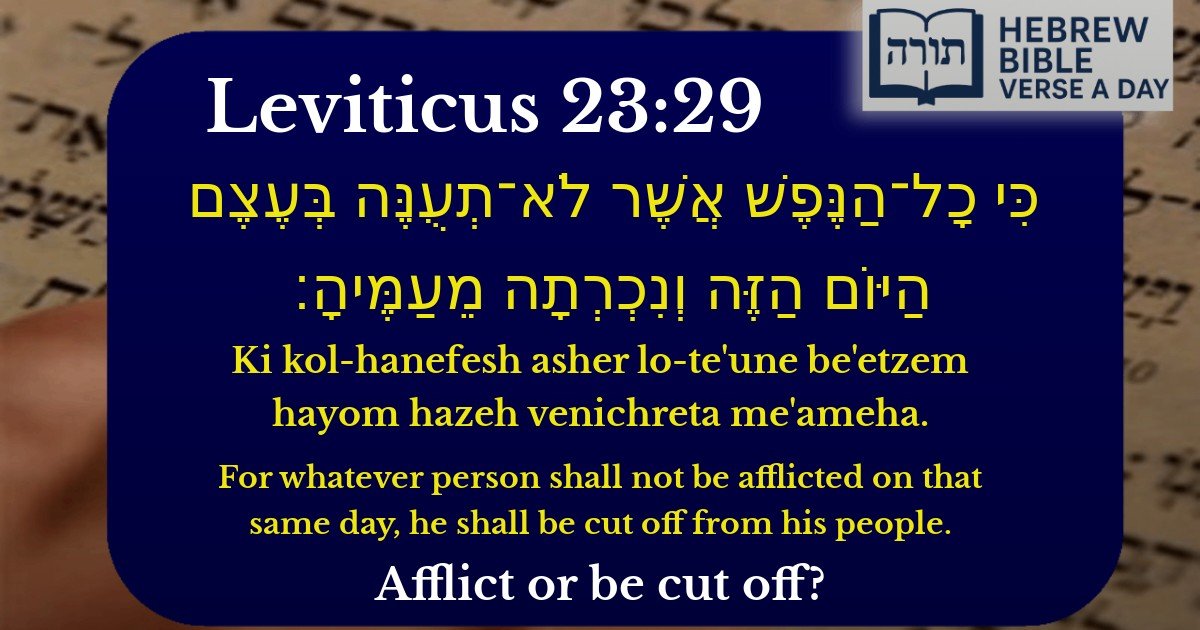

Context of the Verse
The verse (Vayikra 23:29) appears in the context of the laws of Yom Kippur, the Day of Atonement. It emphasizes the obligation of self-affliction (עינוי) on this holy day, which includes fasting and other forms of abstention as prescribed by halacha.
Meaning of "Affliction" (עינוי)
Rashi (Vayikra 23:29) explains that "תְעֻנֶּה" refers to the five afflictions required on Yom Kippur:
These are derived from Talmudic sources (Yoma 73b-74a) and codified by Rambam in Hilchot Shevitat Asor (1:1-5).
Severity of the Transgression
The phrase "וְנִכְרְתָה מֵעַמֶּיהָ" ("shall be cut off from his people") indicates the gravity of neglecting this mitzvah. Rambam (Hilchot Teshuvah 1:4) explains that karet (כרת) is a severe spiritual punishment, implying separation from the divine and the Jewish people. The Talmud (Keritot 2a) discusses that karet applies only when the transgression is done intentionally (במזיד).
Spiritual Purpose of Affliction
The Sforno (Vayikra 23:29) teaches that the afflictions of Yom Kippur are meant to humble the soul and facilitate repentance. By abstaining from physical pleasures, one can focus on spiritual introspection and atonement. The Chatam Sofer adds that the afflictions serve as a reminder of the angelic state we strive for on this holy day, transcending physical needs.
Exceptions to the Rule
While the verse states a strict requirement, halacha recognizes exceptions for health reasons. The Shulchan Aruch (Orach Chaim 618:1) rules that those whose lives would be endangered by fasting (such as the ill or pregnant women) are exempt and even prohibited from afflicting themselves, as preserving life takes precedence.