Frequently Asked Questions
Q: What does 'moadei Hashem' (feasts of the Lord) refer to in Leviticus 23:4?
A: The term 'moadei Hashem' refers to the special appointed times and festivals that God commanded the Jewish people to observe, including Shabbat, Pesach, Shavuot, Rosh Hashanah, Yom Kippur, Sukkot, and Shemini Atzeret. These are times of spiritual connection and mitzvot as explained in the Torah (Rashi on Leviticus 23:4).
Q: Why does the verse say 'mikra'ei kodesh' (holy gatherings)?
A: The term 'mikra'ei kodesh' means that these festivals are times when the Jewish people gather together for holiness and divine service. They are not just days off, but opportunities for prayer, Torah study, and spiritual elevation (Rambam, Hilchot Yom Tov 6:17-18).
Q: What does 'proclaim in their seasons' mean in Leviticus 23:4?
A: This refers to the mitzvah of sanctifying the new month (Kiddush HaChodesh) which determines the dates of the festivals. In ancient times, the Sanhedrin would declare the new month based on witnesses seeing the new moon, thus setting the 'seasons' for the holidays (Talmud Rosh Hashanah 20b).
Q: How do we observe these 'feasts of the Lord' today?
A: Today we observe these festivals based on the fixed calendar established by Hillel II. Each holiday has its unique mitzvot: matzah on Pesach, shofar on Rosh Hashanah, fasting on Yom Kippur, sukkah and lulav on Sukkot, etc. We also refrain from work (except for food preparation) as on Shabbat (Shulchan Aruch, Orach Chaim).
Q: Why are these festivals important in Judaism?
A: These festivals are foundational to Jewish life because they commemorate key events in our relationship with God (like the Exodus on Pesach), provide annual opportunities for repentance (Yom Kippur), and connect us to agricultural cycles in Israel (Shavuot, Sukkot). They are called 'moadei Hashem' because they are God's appointed meeting times with His people (Midrash Vayikra Rabbah 30:7).

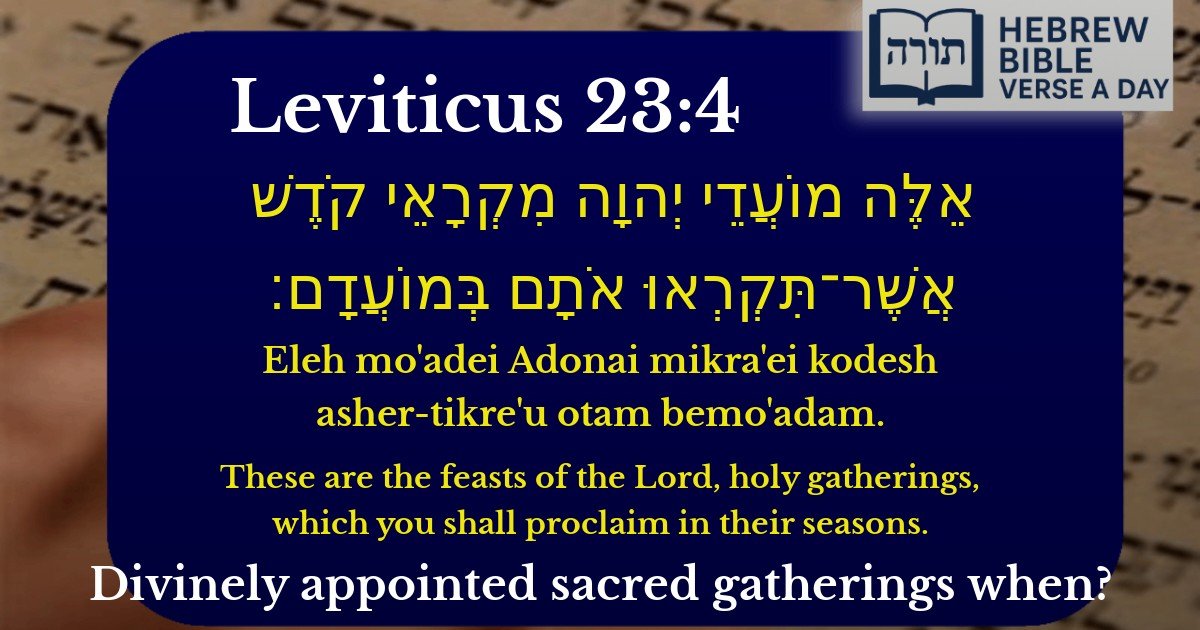

Introduction to the Verse
The verse (Vayikra 23:4) introduces the section detailing the moadim (appointed times) of Hashem. These are the sacred festivals that Bnei Yisrael are commanded to observe at their designated times. The term mikra'ei kodesh (holy gatherings) emphasizes their sanctity and communal nature.
Rashi's Explanation
Rashi comments on the phrase "asher tikre'u otam b'mo'adam" (which you shall proclaim in their seasons), explaining that the Sanhedrin was responsible for declaring the new month (Rosh Chodesh), thereby determining the exact timing of the festivals. This highlights the role of human agency in sanctifying time, as the festivals depend on the Jewish court's proclamation.
Rambam's Perspective
In Hilchot Kiddush HaChodesh (Laws of Sanctifying the New Moon), Rambam elaborates on the mitzvah of establishing the calendar based on lunar cycles. He emphasizes that the declaration of the moadim is a Torah obligation, underscoring the unity of the Jewish people in observing these sacred times as one community.
Talmudic Insights
The Talmud (Rosh Hashanah 25a) discusses the significance of the phrase "mikra'ei kodesh", teaching that these gatherings are not merely for rest but for spiritual elevation. They are occasions for Torah study, prayer, and communal connection, reinforcing their holiness beyond physical cessation from labor.
Midrashic Interpretation
The Midrash (Vayikra Rabbah 28:1) connects the moadim to the relationship between Hashem and the Jewish people, likening them to designated meeting times between a king and his beloved. This metaphor illustrates the intimacy and joy inherent in observing these festivals, as they are opportunities for divine closeness.
Key Themes