
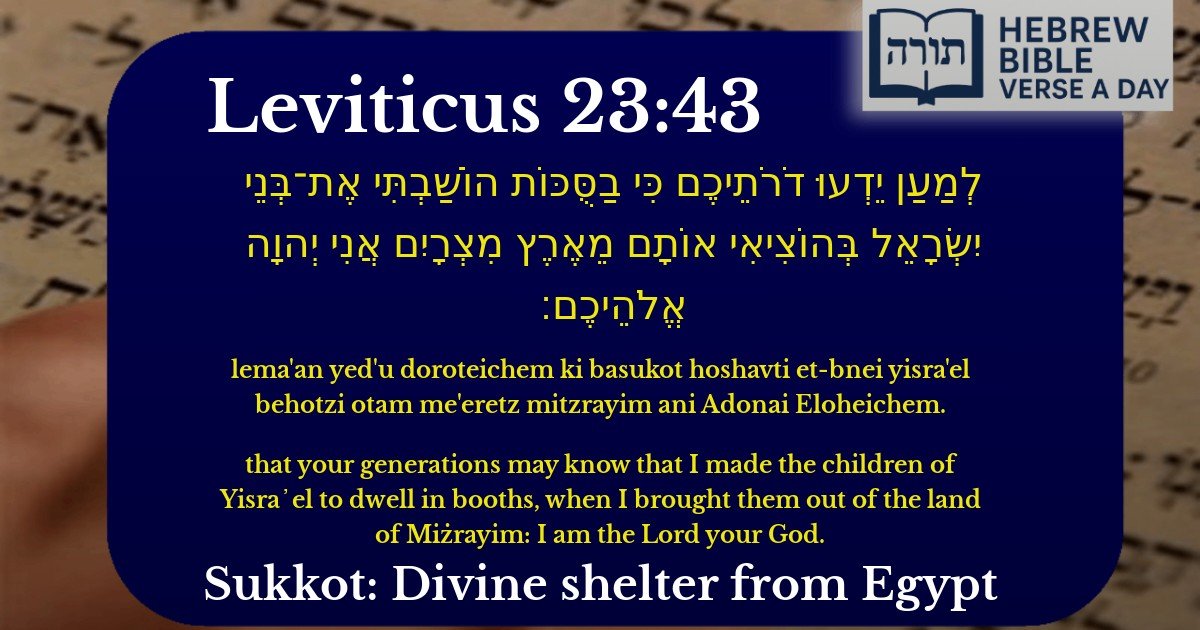

Leviticus 23:43 - Sukkot: Divine shelter from Egypt

Leviticus 23:43 - ויקרא 23:43

Hebrew Text

לְמַעַן יֵדְעוּ דֹרֹתֵיכֶם כִּי בַסֻּכּוֹת הוֹשַׁבְתִּי אֶת־בְּנֵי יִשְׂרָאֵל בְּהוֹצִיאִי אוֹתָם מֵאֶרֶץ מִצְרָיִם אֲנִי יְהוָה אֱלֹהֵיכֶם׃

English Translation

that your generations may know that I made the children of Yisra᾽el to dwell in booths, when I brought them out of the land of Miżrayim: I am the Lord your God.

Transliteration

Lema'an yed'u doroteichem ki basukot hoshavti et-bnei yisra'el behotzi otam me'eretz mitzrayim ani Adonai Eloheichem.

Hebrew Leining Text

לְמַ֘עַן֮ יֵדְע֣וּ דֹרֹֽתֵיכֶם֒ כִּ֣י בַסֻּכּ֗וֹת הוֹשַׁ֙בְתִּי֙ אֶת־בְּנֵ֣י יִשְׂרָאֵ֔ל בְּהוֹצִיאִ֥י אוֹתָ֖ם מֵאֶ֣רֶץ מִצְרָ֑יִם אֲנִ֖י יְהֹוָ֥ה אֱלֹהֵיכֶֽם׃

🎵 Listen to leining

Parasha Commentary

Understanding the Verse in Context

The verse (Vayikra 23:43) is part of the Torah's discussion of the mitzvah of dwelling in sukkot during the festival of Sukkot. It explains that the purpose of this mitzvah is to remind future generations of how Hashem sheltered Bnei Yisrael in sukkot (booths) when He took them out of Mitzrayim.

Rashi's Explanation of "Sukkot"

Rashi (based on the Mechilta and Sukkah 11b) brings two opinions regarding the nature of these "sukkot":

  • Literal Booths: The simple meaning is that Hashem provided actual physical sukkot (temporary dwellings) for Bnei Yisrael in the wilderness.
  • Ananei HaKavod (Clouds of Glory): Alternatively, "sukkot" refers to the miraculous Clouds of Glory that surrounded and protected Bnei Yisrael during their travels in the desert.

Rambam's Perspective on the Mitzvah

In Moreh Nevuchim (3:43), Rambam explains that dwelling in sukkot serves as a reminder of the Exodus and the wilderness experience, reinforcing our faith in Hashem's protection. The temporary nature of the sukkah reminds us that our security comes from Hashem, not physical structures.

The Sifra's Teaching on "Lema'an Yed'u"

The Sifra emphasizes that the phrase "lema'an yed'u" ("so that they may know") teaches that the mitzvah of sukkah is meant to be an experiential education for future generations. By physically dwelling in sukkot, we internalize the lessons of divine protection and our ancestors' wilderness experience.

The Significance of "Ani Hashem Elokeichem"

The verse concludes with "Ani Hashem Elokeichem" ("I am Hashem your God"). The Kli Yakar explains that this emphasizes that just as Hashem protected us in the wilderness, He continues to watch over us. The sukkah thus becomes a tangible demonstration of our ongoing relationship with Hashem.

Practical Halachic Implications

The Gemara (Sukkah 28b) derives from this verse that:

  • The mitzvah applies to all generations, not just the wilderness generation.
  • Women are exempt from this mitzvah as it is a time-bound positive commandment.
  • The sukkah must be a temporary dwelling (dirat arai) to properly commemorate the wilderness experience.

📚 Talmud Citations

This verse is quoted in the Talmud.

📖 Sukkah 11b
The verse is discussed in the context of the mitzvah of dwelling in sukkot, with debates about whether the sukkot in the wilderness were actual booths or clouds of glory.

Frequently Asked Questions

Q: What does the verse 'that your generations may know that I made the children of Israel to dwell in booths' mean?
A: This verse explains the reason for the mitzvah of dwelling in sukkot (booths) during the holiday of Sukkot. It serves as a reminder that Hashem protected the Israelites with 'clouds of glory' during their 40-year journey in the wilderness after leaving Egypt (Rashi on Leviticus 23:43). The sukkah symbolizes divine protection and trust in Hashem.
Q: Why is dwelling in a sukkah important according to this verse?
A: Dwelling in a sukkah is important because it connects us to the experience of our ancestors in the wilderness and reminds us of Hashem's constant protection. The Talmud (Sukkah 11b) discusses how the sukkot represent the 'clouds of glory' that surrounded and shielded the Israelites. This mitzvah helps strengthen our faith and gratitude to Hashem.
Q: How does this verse apply to us today?
A: Today, we fulfill this mitzvah by building and dwelling in a sukkah during the holiday of Sukkot. The Rambam (Hilchot Sukkah 6:12) teaches that sitting in the sukkah reminds us of the miracles Hashem performed for our ancestors, reinforcing our trust in Him. It also helps us focus on spiritual rather than material comforts.
Q: What can we learn from the phrase 'I am the Lord your God' at the end of the verse?
A: The declaration 'I am the Lord your God' emphasizes that the mitzvah of sukkah, like all commandments, comes from Hashem. It reminds us that just as He protected and guided the Israelites in the wilderness, He continues to watch over us (Sifra, Emor 17:11). This reinforces our relationship with Hashem and our commitment to His commandments.
Q: Why does the verse mention the Exodus from Egypt in connection with Sukkot?
A: The verse connects Sukkot to the Exodus because the holiday commemorates Hashem's protection during the Israelites' journey through the wilderness after leaving Egypt. The Midrash (Vayikra Rabbah 30:2) explains that the sukkot symbolize the temporary dwellings and divine shelter provided during that time. Remembering the Exodus strengthens our appreciation for Hashem's ongoing care.