Frequently Asked Questions
Q: What does 'the appointed seasons of the Lord' refer to in Leviticus 23:44?
A: The 'appointed seasons of the Lord' refer to the Jewish holidays and sacred times listed in Leviticus 23, such as Shabbat, Pesach (Passover), Shavuot, Rosh Hashanah, Yom Kippur, and Sukkot. These are special times designated by Hashem for spiritual connection and observance.
Q: Why did Moshe declare the appointed seasons to the children of Israel?
A: Moshe declared these appointed seasons to teach Bnei Yisrael (the children of Israel) about their sacred obligations and the proper way to observe these holy days. According to Rashi, this emphasizes that Moshe faithfully transmitted all of Hashem's commandments regarding these festivals to the people.
Q: What can we learn from Leviticus 23:44 about Jewish holidays today?
A: This verse teaches us that Jewish holidays are not just cultural traditions but divine commandments given by Hashem. The Rambam (Mishneh Torah, Hilchot Yom Tov) explains that observing these festivals strengthens our relationship with Hashem and connects us to our heritage.
Q: How does Leviticus 23:44 relate to the rest of the chapter?
A: Leviticus 23:44 serves as a conclusion to the entire chapter, summarizing that Moshe relayed all the laws of the festivals (detailed earlier in the chapter) to Bnei Yisrael. The Sforno explains that this reaffirms the importance of transmitting Torah teachings accurately to future generations.
Q: Why are the festivals called 'appointed seasons' (mo'adim) in this verse?
A: The term 'mo'adim' (appointed seasons) signifies that these are fixed times set by Hashem for meeting with Him spiritually. The Talmud (Chagigah 18a) teaches that these times are opportunities for divine closeness and renewal, not just historical commemorations.

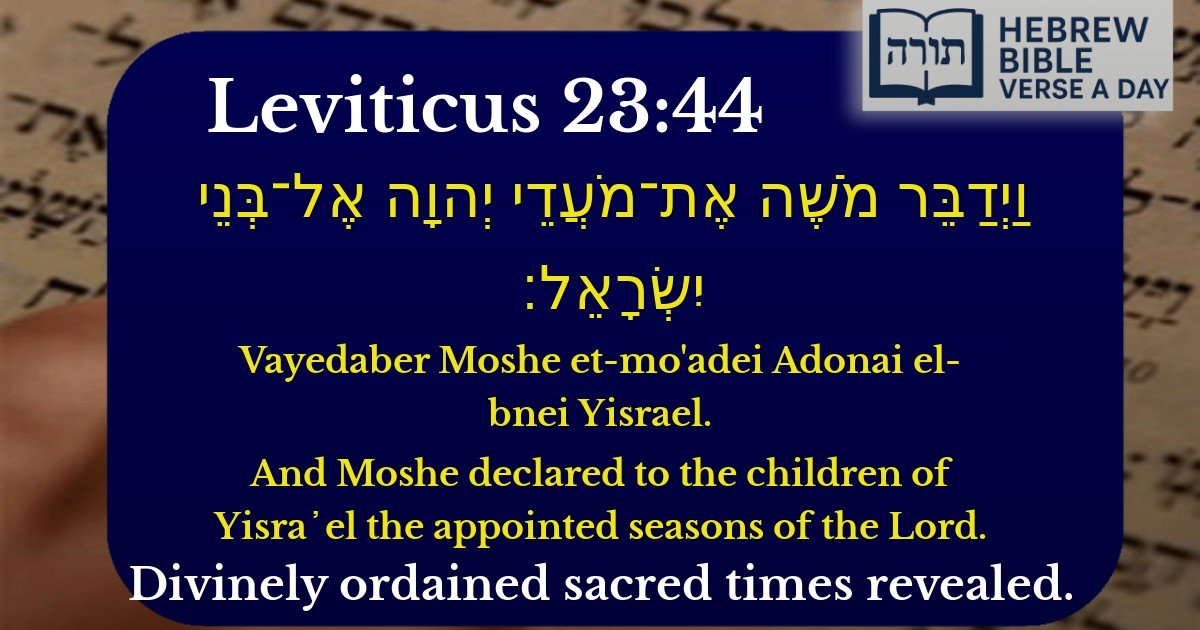

Context of the Verse
The verse (Vayikra 23:44) concludes the section in Sefer Vayikra detailing the moadim (appointed festivals) of Hashem. Rashi explains that this verse serves as a summary, emphasizing that Moshe relayed all the laws of the festivals to Bnei Yisrael exactly as commanded by Hashem.
Meaning of "Moadei Hashem"
The term moadei Hashem refers to the sacred times designated by Hashem for the Jewish people. The Rambam (Hilchot Shvitat Yom Tov 1:1) teaches that these festivals are not merely commemorations of historical events but are divinely ordained opportunities for spiritual elevation and connection to Hashem.
Moshe's Role in Transmission
The Sforno notes that the phrasing "vayedaber Moshe" (And Moshe declared) underscores Moshe's unique role as the faithful transmitter of Torah. Unlike other prophets who received visions, Moshe communicated Hashem's word with absolute clarity, ensuring the precise observance of the moadim.
Significance of "El Bnei Yisrael"
The inclusion of "el Bnei Yisrael" highlights that these laws were given specifically to the Jewish people. The Midrash (Vayikra Rabbah 30:1) elaborates that the festivals are a covenantal sign between Hashem and Klal Yisrael, distinguishing them from other nations.
Practical Implications