Frequently Asked Questions
Q: What does 'an offering made by fire to the Lord for seven days' mean in Leviticus 23:8?
A: This verse refers to the special sacrifices (korbanot) brought during the festival of Passover (Pesach). The 'offering made by fire' (ishsheh) includes the daily Tamid offering and the Musaf offerings brought on each day of the festival. Rashi explains that these offerings demonstrate our devotion to Hashem during the holiday.
Q: Why is the seventh day of Passover called a 'holy gathering' in Leviticus 23:8?
A: The seventh day of Passover is called a 'mikra kodesh' (holy gathering) because it commemorates the splitting of the Red Sea, a great miracle. On this day, we refrain from work and gather for prayer and Torah study, as explained in the Talmud (Megillah 31a) and by Rambam in Hilchot Yom Tov.
Q: What kind of work is prohibited on the seventh day of Passover according to Leviticus 23:8?
A: The verse prohibits 'melachat avodah' (servile work), which refers to the same 39 categories of creative work (melacha) prohibited on Shabbat, as derived from the Talmud (Chagigah 18a). However, cooking and carrying for food preparation are permitted on Yom Tov (festivals), as explained in Shulchan Aruch Orach Chaim.
Q: How do we observe the seventh day of Passover today based on Leviticus 23:8?
A: Today, we observe the seventh day of Passover as a full Yom Tov (festival day): we refrain from prohibited work, attend synagogue services where special prayers are recited (including Hallel and a Torah reading about the Red Sea miracle), and have festive meals. Many also stay awake to study Torah on this night, as the miracle occurred at night.
Q: Why does the Torah specify seven days for Passover offerings in Leviticus 23:8?
A: The seven days correspond to the duration of Passover (Pesach) as commanded in Exodus 12:15. The Midrash (Mechilta) explains that seven represents completion in the physical world, symbolizing our complete transition from slavery to freedom. The daily offerings during this period reinforce our continuous connection to Hashem throughout the festival.


Context in the Torah
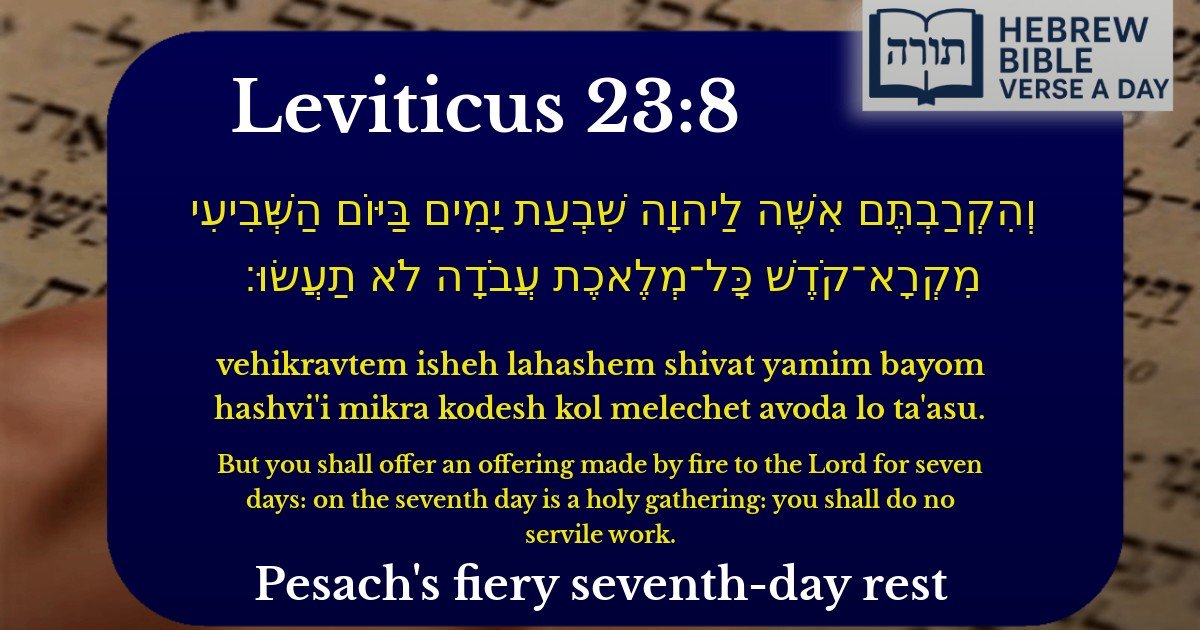
The verse (Vayikra 23:8) appears in the context of the mitzvot concerning the festival of Pesach (Passover) and the subsequent seven days of Chag HaMatzot (the Festival of Unleavened Bread). It instructs the Jewish people to bring a fire-offering (isheh) to Hashem for seven days, with the seventh day designated as a sacred assembly (mikra kodesh) where no melachah (servile work) is permitted.
Rashi's Explanation
Rashi (Vayikra 23:8) clarifies that the "offering made by fire" refers specifically to the Musaf (additional) offerings brought on each day of Chag HaMatzot, as detailed in Bamidbar 28:19-24. He emphasizes that the seventh day is a mikra kodesh, akin to the first day of Pesach, where creative labor (melachah) is prohibited, though food preparation (ochel nefesh) is permitted.
Rambam on Prohibited Labor
Rambam (Hilchot Yom Tov 7:1) elaborates that the prohibition of melachah on the seventh day of Pesach mirrors the restrictions of the first day. He distinguishes between melachah (creative labor) and avodah (servile work), noting that only the former is forbidden, while tasks necessary for sustenance are allowed.
Midrashic Insights
Halachic Implications
The Shulchan Aruch (Orach Chaim 490:1) rules that the seventh day of Pesach carries the same sanctity as the first, with identical prohibitions on melachah. However, the Mishnah Berurah (490:2) notes that some leniencies apply for food-related tasks, provided they are not performed in a professional manner.