
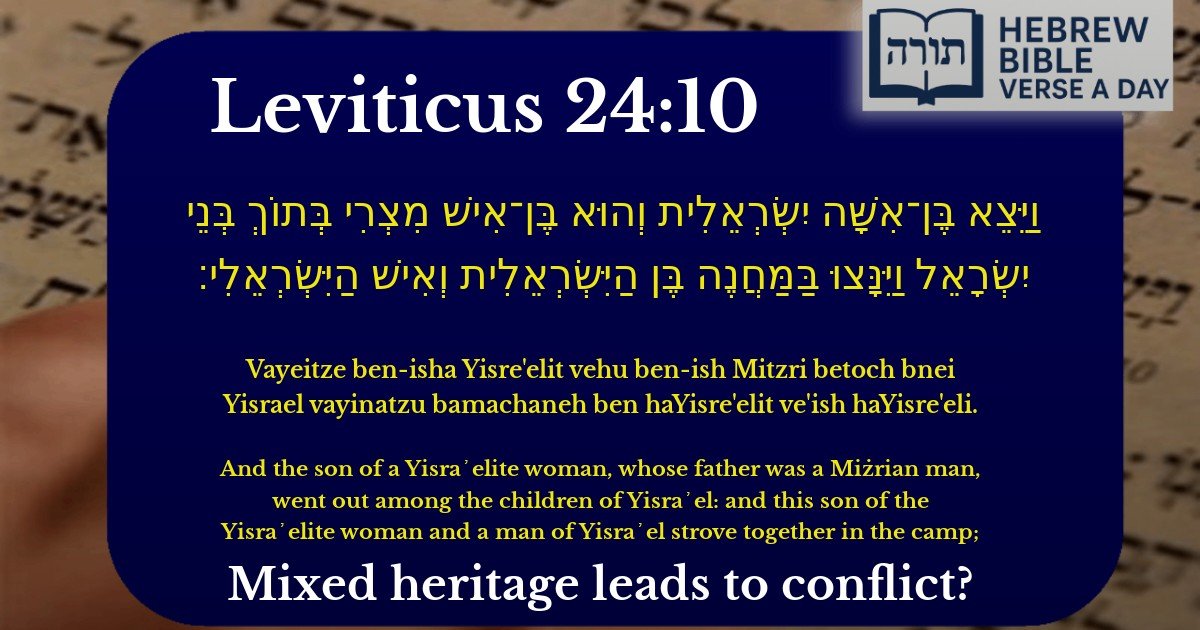

Leviticus 24:10 - Mixed heritage leads to conflict?

Leviticus 24:10 - ויקרא 24:10

Hebrew Text

וַיֵּצֵא בֶּן־אִשָּׁה יִשְׂרְאֵלִית וְהוּא בֶּן־אִישׁ מִצְרִי בְּתוֹךְ בְּנֵי יִשְׂרָאֵל וַיִּנָּצוּ בַּמַּחֲנֶה בֶּן הַיִּשְׂרְאֵלִית וְאִישׁ הַיִּשְׂרְאֵלִי׃

English Translation

And the son of a Yisra᾽elite woman, whose father was a Miżrian man, went out among the children of Yisra᾽el: and this son of the Yisra᾽elite woman and a man of Yisra᾽el strove together in the camp;

Transliteration

Vayeitze ben-isha Yisre'elit vehu ben-ish Mitzri betoch bnei Yisrael vayinatzu bamachaneh ben haYisre'elit ve'ish haYisre'eli.

Hebrew Leining Text

וַיֵּצֵא֙ בֶּן־אִשָּׁ֣ה יִשְׂרְאֵלִ֔ית וְהוּא֙ בֶּן־אִ֣ישׁ מִצְרִ֔י בְּת֖וֹךְ בְּנֵ֣י יִשְׂרָאֵ֑ל וַיִּנָּצוּ֙ בַּֽמַּחֲנֶ֔ה בֶּ֚ן הַיִּשְׂרְאֵלִ֔ית וְאִ֖ישׁ הַיִּשְׂרְאֵלִֽי׃

🎵 Listen to leining

Parasha Commentary

Context and Background

This verse (Vayikra 24:10) describes a conflict involving the son of an Israelite woman and an Egyptian man. The incident occurs in the camp of Bnei Yisrael and leads to a broader legal discussion about blasphemy and justice. Rashi explains that the "going out" refers to the man leaving the community's spiritual framework, as his Egyptian lineage created a conflict regarding his tribal affiliation and status among Bnei Yisrael.

The Identity of the Individuals

  • The Israelite Woman: The Midrash (Sifra) identifies her as Shelomit bat Dibri from the tribe of Dan (Vayikra 24:11). Her name suggests she was overly talkative (shelomit from shalom, implying greeting everyone, and dibri from dibur, speech).
  • The Egyptian Father: Ramban suggests this was the Egyptian taskmaster whom Moshe killed (Shemot 2:11-12), implying the son was conceived through an illicit relationship.

The Nature of the Dispute

The Talmud (Sanhedrin 58b) explains that the quarrel arose when the son of the Israelite woman sought to pitch his tent in the portion of Dan (his mother's tribe), but was challenged by an Israelite man who argued that tribal inheritance follows the father’s line (Bamidbar 1:2). Since his father was Egyptian, he had no tribal claim. This led to a heated confrontation.

Halachic Implications

The dispute highlights the tension between maternal and paternal lineage in Jewish law:

  • Tribal Affiliation: The Torah assigns tribal membership patrilineally (Bamidbar 1:18), excluding this man from Dan’s encampment.
  • Jewish Status: Despite his Egyptian father, his Jewish identity comes from his mother (Devarim 7:3-4), a principle later codified by Rambam (Hilchos Issurei Biah 12:1).

Spiritual Consequences

Rashi (Vayikra 24:11) notes that this conflict escalated into blasphemy, demonstrating how unresolved personal grievances can lead to severe spiritual transgressions. The Midrash (Vayikra Rabbah 32:3) warns that discord (machlokes) undermines communal holiness, as seen here in the camp of Bnei Yisrael.

📚 Talmud Citations

This verse is quoted in the Talmud.

📖 Sanhedrin 58b
The verse is discussed in the context of the laws regarding blasphemy and the incident involving the son of the Israelite woman.
📖 Yevamot 45a
The verse is referenced in a discussion about the status of a child born to an Israelite woman and a non-Israelite man.

Frequently Asked Questions

Q: What is the background of the son of the Israelite woman mentioned in Leviticus 24:10?
A: The verse describes a man whose mother was Israelite and father was Egyptian. According to Rashi, this refers to the son of Shelomith bat Dibri (mentioned later in the passage) and the Egyptian taskmaster whom Moses had killed (Exodus 2:11-12). The Talmud (Sanhedrin 78b) explains that he was trying to pitch his tent in the camp of Dan (his mother's tribe), but was prevented since tribal affiliation follows the father's line in Jewish law.
Q: Why was there a fight between this man and the Israelite man?
A: The Midrash (Vayikra Rabbah 32:3) explains that the dispute arose when the half-Egyptian man wanted to camp with the tribe of Dan (his mother's tribe), but was told he belonged with the general population since Jewish lineage follows the mother but tribal affiliation follows the father. This led to an argument that escalated into a physical fight in the Israelite camp.
Q: What lesson can we learn from this incident in Leviticus 24:10?
A: The Rambam (Hilchos De'os 6:6) derives from this incident the importance of avoiding disputes and how seemingly small arguments can escalate. The Talmud (Sanhedrin 58b) also uses this case to teach about the seriousness of blasphemy (which follows in the next verses), showing how personal conflicts can lead to greater sins if not properly resolved.
Q: How does Jewish law view someone with an Israelite mother and non-Jewish father?
A: Halacha (Jewish law) follows the maternal line for determining Jewish status. As the Mishnah (Kiddushin 3:12) states, a child is Jewish if the mother is Jewish, regardless of the father's status. However, tribal affiliation and priestly status follow the father's line, which is why this individual couldn't camp with a specific tribe (Rashi on Leviticus 24:10).
Q: Why is this story important in the Torah?
A: This incident is significant because it leads to the laws about blasphemy (mentioned in the following verses) and establishes important principles about Jewish identity. The Talmud (Sanhedrin 78b) sees this as a pivotal case that teaches about both interpersonal relationships and the severity of certain sins. It also demonstrates how the Torah addresses complex social situations that arise in a mixed community.