Frequently Asked Questions
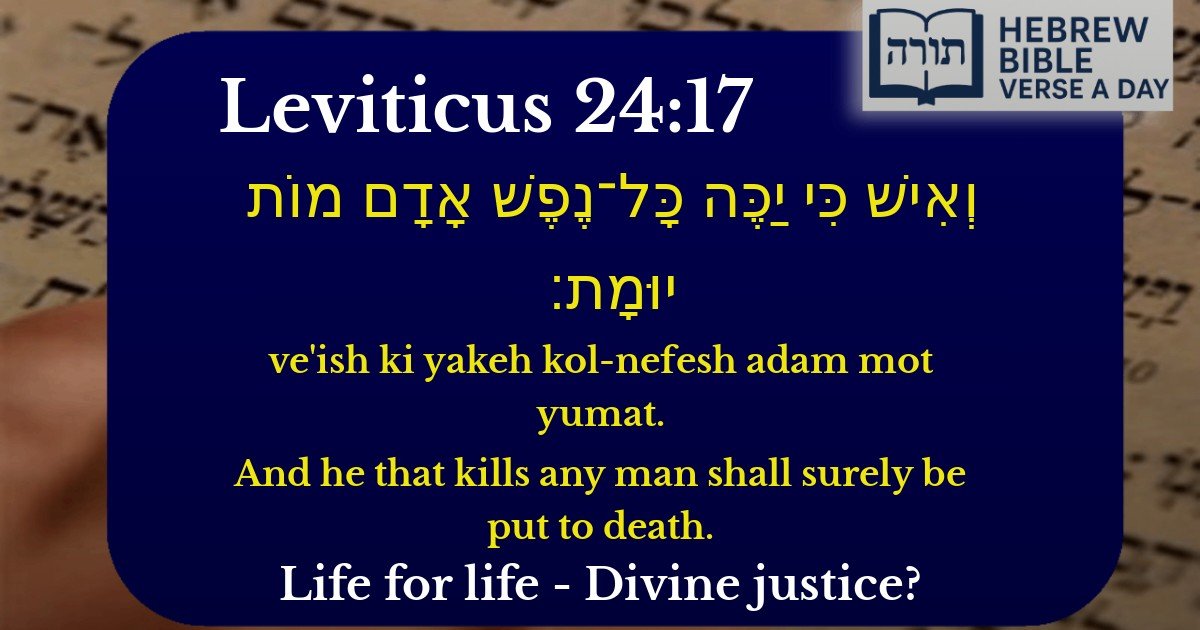
Q: What does 'And he that kills any man shall surely be put to death' mean in Leviticus 24:17?
A: This verse establishes the Torah's strict prohibition against murder. It teaches that taking another person's life intentionally is a capital offense, requiring the death penalty under Jewish law (Sanhedrin 9:1). Rashi explains this applies to any human being, emphasizing the sanctity of all human life.
Q: Why is the death penalty given for murder in the Torah?
A: The Rambam (Hilchot Rotzeach 1:4) explains that murder is considered so severe because every person is created in G-d's image (Bereishit 1:27). Taking a life destroys something sacred and irreplaceable. The death penalty serves as both punishment and deterrent, maintaining societal order according to Torah values.
Q: Does this verse apply to accidental killing?
A: No, this verse specifically refers to intentional murder. The Torah makes a distinction between intentional and accidental killing. For unintentional killing, the Torah provides cities of refuge (Bamidbar 35:9-15). The Talmud (Makkot 7a) discusses the detailed legal criteria that distinguish between murder and manslaughter.
Q: How was this law applied in Jewish courts?
A: The Sanhedrin (Jewish high court) applied extremely strict standards before imposing capital punishment. The Mishnah (Sanhedrin 4:1) states they would warn the murderer in advance, require two witnesses, and investigate thoroughly. The Talmud (Makkot 7a) notes that a court that executed once in 70 years was called 'destructive.'
Q: What can we learn from this verse today?
A: This verse teaches the infinite value of every human life. Even when we don't apply capital punishment today, the principle reminds us to respect all people as created in G-d's image. The Sefer HaChinuch (Mitzvah 34) explains this mitzvah helps society value life and maintain justice.


Verse Context and General Meaning
The verse "וְאִישׁ כִּי יַכֶּה כָּל־נֶפֶשׁ אָדָם מוֹת יוּמָת" (Vayikra 24:17) establishes the severe prohibition against murder and its corresponding capital punishment. This is part of the broader legal framework in the Torah that safeguards the sanctity of human life, as every person is created b'tzelem Elokim (in the image of G-d). The Rambam (Hilchot Rotzeach 1:1) emphasizes that this law applies universally, whether the victim is Jewish or non-Jewish, underscoring the Torah's absolute condemnation of homicide.
Rashi's Commentary
Rashi explains that the phrase "כָּל־נֶפֶשׁ אָדָם" ("any soul of man") includes all human beings, without distinction. He further notes that the repetition in "מוֹת יוּמָת" ("shall surely be put to death") serves to reinforce the inevitability of the punishment, indicating that the court must carry out the sentence once guilt is established beyond doubt (Rashi on Vayikra 24:17).
Legal Requirements and Exceptions
The Talmud (Sanhedrin 73a-74a) elaborates on the conditions for implementing this law:
The Rambam (Hilchot Rotzeach 2:2-3) adds that if any of these conditions are not met, the court cannot impose the death penalty, reflecting the Torah's caution in matters of life and death.
Moral and Theological Implications
The Midrash (Bereishit Rabbah 34:19) teaches that one who kills a person diminishes the Divine presence in the world, as human life reflects G-d's image. The severity of the punishment underscores the gravity of the sin, as it disrupts the moral order. The Sefer HaChinuch (Mitzvah 34) further explains that this law instills reverence for life and deters violence, ensuring societal stability.
Comparison to Other Capital Offenses
Unlike other capital crimes (e.g., idolatry or Shabbat desecration), murder is classified as a mitzvah shebein adam l'chaveiro</em (a transgression between man and man), where restitution or atonement is impossible once the act is committed. The Talmud (Makkot 7a) states that the court's role in such cases is not only punitive but also restorative, purging the spiritual contamination caused by bloodshed.