Frequently Asked Questions
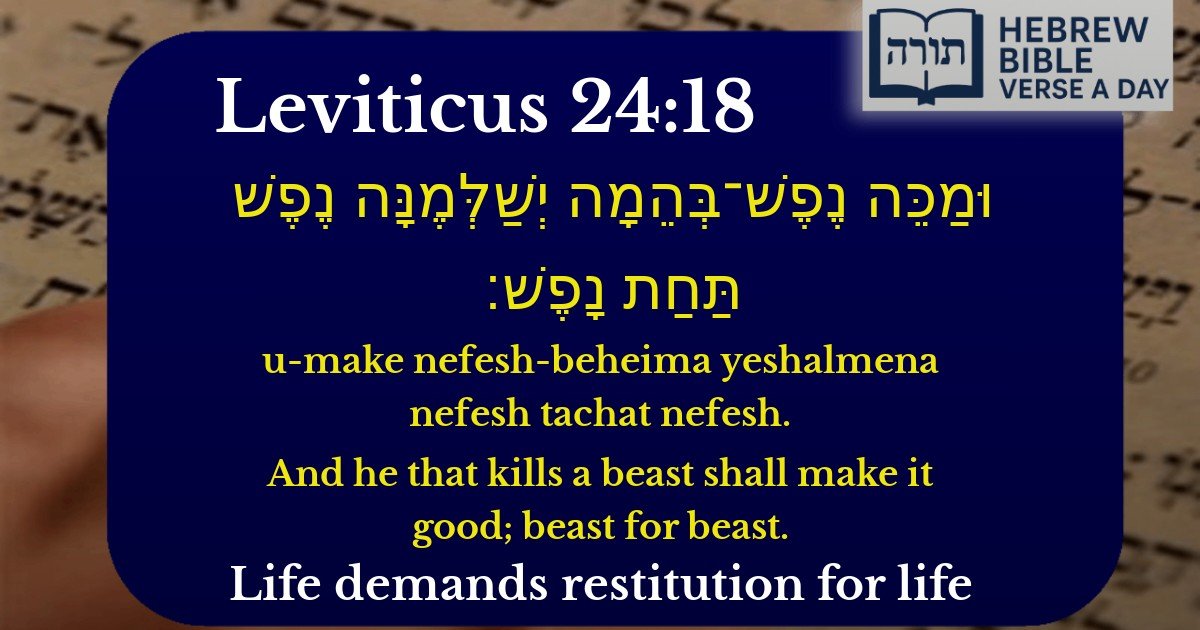
Q: What does 'beast for beast' mean in Leviticus 24:18?
A: The verse teaches that if someone kills another person's animal, they must compensate the owner by replacing it with another animal of equal value ('nefesh tachat nefesh'—a life for a life). Rashi explains this means monetary compensation, not literally taking the life of the person who killed the animal (as the next verse clarifies regarding human life).
Q: Why is this law about animal compensation important in Judaism?
A: This law emphasizes the Torah's value of responsibility and restitution. The Rambam (Hilchot Nizkei Mammon 1:1) explains that causing damage obligates repayment, teaching us to be careful with others' property. The Talmud (Bava Kamma 83b) discusses details of how to assess fair compensation.
Q: Does 'a life for a life' mean literal retaliation for killing an animal?
A: No. While the phrase 'nefesh tachat nefesh' sounds severe, the Talmud (Bava Kamma 83b) clarifies this refers to monetary payment, not physical retaliation. For animals, one pays the animal's value. The Torah distinguishes between laws for damaging property (like animals) and laws for harming humans.
Q: How does this law apply today if someone damages another's pet?
A: Jewish law (based on this verse) requires compensating the owner for the animal's value. The Shulchan Aruch (Choshen Mishpat 390:1) rules that if one kills another's animal intentionally or negligently, they must pay its full market value. This applies to pets, livestock, or any owned animal.
Q: What lesson can we learn from this verse about animals?
A: The verse teaches respect for others' property and living creatures. While animals don't have the same status as humans in Jewish law, causing unnecessary harm is prohibited (Tza'ar Ba'alei Chayim). The Midrash (Bereishit Rabbah 33:1) notes that Noah was worthy because he cared for animals—showing that kindness to creatures is a Jewish value.


Verse Context in Torah
The verse (Shemot 21:33) appears in Parshat Mishpatim, which details civil and tort laws. This specific law addresses restitution for killing another person's animal, establishing the principle of monetary compensation (tashlumei nezek).
Literal Interpretation (Peshat)
Rashi explains that the phrase "nefesh tachat nefesh" (a life for a life) does not imply capital punishment for killing an animal, as that would be illogical. Rather, it means the offender must pay the animal's full value (damim) as restitution to the owner. The Torah uses this phrasing to emphasize equivalence in compensation.
Legal Principles (Halacha)
Moral Lessons (Derash)
The Midrash (Shemot Rabbah 30:19) derives from this verse that even regarding animals, the Torah demands accountability for taking life. This teaches tza'ar ba'alei chayim (avoiding cruelty to animals) and respect for others' property.
Philosophical Insight
Rabbi Samson Raphael Hirsch notes that the term nefesh (life/soul) is used even for animals, reminding us that all life has value before Hashem. While animals may be used for human needs, wanton destruction violates our stewardship role over creation.