Frequently Asked Questions
Q: What does 'an eye for an eye' mean in Leviticus 24:20?
A: The phrase 'an eye for an eye' in Leviticus 24:20 is often misunderstood. According to traditional Jewish interpretation (as explained in the Talmud, Bava Kamma 83b-84a), this verse does not mean literal physical retaliation. Instead, it refers to monetary compensation. If someone causes injury to another, they must pay the value of the injury (including medical costs, pain, embarrassment, lost wages, and healing time) as determined by the courts. This is based on the principle of fair restitution rather than physical retaliation.
Q: Why does the Torah say 'an eye for an eye' if we don't literally take eyes?
A: The Torah uses this strong language to emphasize the seriousness of causing harm to another person. As Rashi explains (on Leviticus 24:20), the verse means the value of an eye, not the actual eye. The Oral Torah (transmitted at Sinai along with the Written Torah) clarifies how to implement this law practically through monetary compensation. This shows the Torah's wisdom in creating a just society where damages are properly compensated without resorting to violence.
Q: How is 'an eye for an eye' applied in Jewish law today?
A: In Jewish law (Halacha), based on Talmudic interpretation, 'an eye for an eye' is always understood as financial compensation. The Beit Din (Jewish court) calculates five types of payments for injuries: 1) damage (nezek), 2) pain (tza'ar), 3) medical costs (ripui), 4) lost wages (shevet), and 5) embarrassment (boshet). The Rambam (Hilchot Chovel U'Mazik 1:3-6) details these laws, showing how the Torah's justice system promotes responsibility while avoiding physical retaliation.
Q: What lesson can we learn from 'an eye for an eye' in daily life?
A: This verse teaches us about personal responsibility and the seriousness of harming others. The Midrash (Sifra on this verse) emphasizes that every person is created in G-d's image, so causing harm is a grave matter. While we don't implement physical punishments, the principle reminds us that our actions have consequences and we must make proper amends when we wrong others. It encourages us to be careful in our interactions and to take responsibility for any harm we cause, whether physical, emotional, or financial.
Q: Does 'an eye for an eye' mean the Torah is harsh?
A: Not at all. The Talmud (Bava Kamma 83b) explains that taking the verse literally would sometimes be impossible (what if a blind person damages someone's eye?), proving it must mean monetary compensation. The Torah's system is actually compassionate - it ensures victims receive fair compensation while preventing endless cycles of violence. As Rambam notes (Moreh Nevuchim 3:41), these laws create a just society where people think carefully before harming others and where damages are properly addressed through a fair legal system.

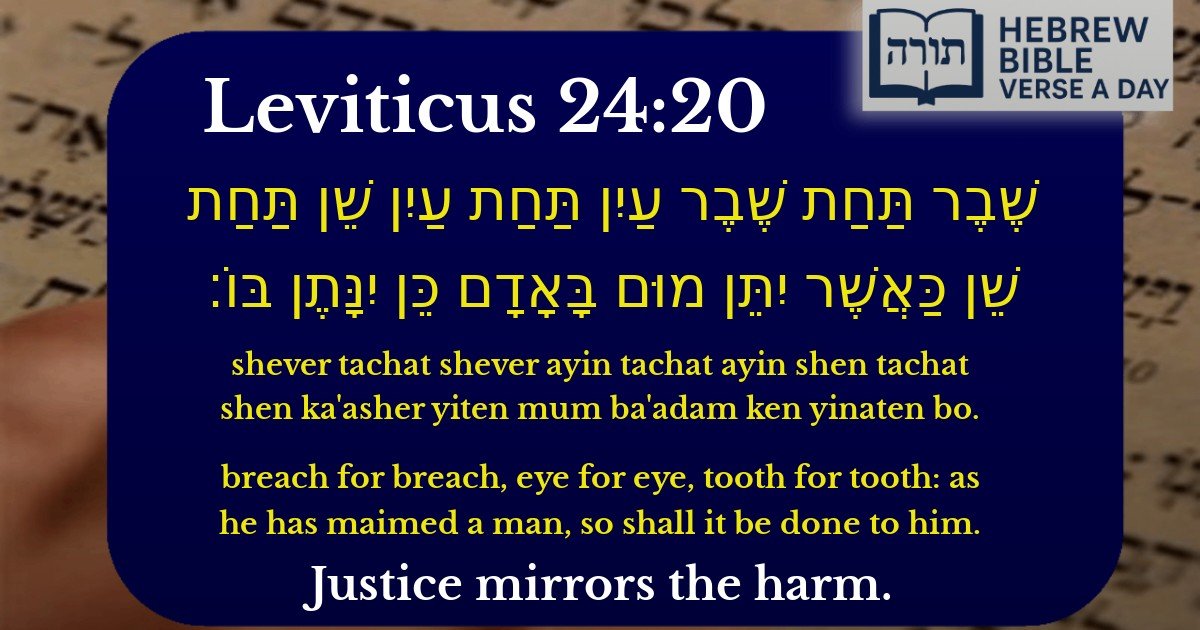

The Principle of "Eye for an Eye" in Jewish Law
The verse (Vayikra 24:20) states: "שֶׁבֶר תַּחַת שֶׁבֶר עַיִן תַּחַת עַיִן שֵׁן תַּחַת שֵׁן כַּאֲשֶׁר יִתֵּן מוּם בָּאָדָם כֵּן יִנָּתֶן בּוֹ" ("breach for breach, eye for eye, tooth for tooth: as he has maimed a man, so shall it be done to him"). This principle is often misunderstood as advocating literal physical retaliation. However, classical Jewish sources interpret this as referring to monetary compensation.
Rashi's Explanation
Rashi (Vayikra 24:20) clarifies that the phrase "eye for an eye" means monetary payment for the value of the eye, not the actual removal of the perpetrator's eye. He bases this on the Talmud (Bava Kamma 83b-84a), which derives from other verses that compensation must be financial. The Torah's language is understood as establishing the principle of proportional justice, not literal retaliation.
Talmudic Interpretation
The Talmud (Bava Kamma 83b-84a) provides a detailed analysis:
Rambam's Codification
Rambam (Hilchot Chovel U'Mazik 1:3-6) rules definitively that "eye for an eye" refers to financial compensation. He explains that the court assesses the permanent depreciation in value caused by the injury (called "nezek"), along with additional payments for pain, medical expenses, lost wages, and embarrassment.
Philosophical Significance
This interpretation reflects fundamental Jewish legal principles:
Midrashic Perspective
The Midrash (Sifra on Vayikra 24:20) emphasizes that the phrase teaches the principle of measure-for-measure justice in divine providence, while human courts implement this through financial means. This maintains both the moral lesson and practical legal application.