Frequently Asked Questions
Q: What does the verse 'And he that kills a beast, he shall restore it: and he that kills a man, he shall be put to death' mean?
A: This verse from Leviticus 24:21 teaches two important laws in Jewish tradition. First, if someone kills another person's animal, they must pay compensation (as explained in Exodus 21:33-34). Second, if someone intentionally kills another human being, the Torah prescribes capital punishment (subject to the strict requirements of Jewish courts, as discussed in Sanhedrin 4:1).
Q: Why does the Torah give different punishments for killing an animal versus killing a person?
A: The Torah values human life above all else, as humans are created in G-d's image (Genesis 1:27). Rashi explains that this distinction shows the severity of murder. While damaging property (like killing an animal) requires financial compensation, taking a human life is considered so grave that it warrants the death penalty when done intentionally and with proper witnesses (as per the strict requirements in Sanhedrin).
Q: Does this verse mean we should always execute murderers today?
A: No. The Rambam (Mishneh Torah, Sanhedrin 14:11) explains that Jewish courts only carried out capital punishment under extremely rare circumstances, requiring two eyewitnesses, clear warning to the perpetrator, and other strict conditions. In practice, Jewish courts avoided executions. Today, without a Sanhedrin (Jewish high court), capital punishment is not carried out in Jewish law.
Q: What lesson can we learn from the part about paying for killing an animal?
A: This teaches the importance of taking responsibility for our actions. Even if someone accidentally or intentionally harms another's property (like their animal), they must make amends. The Talmud (Bava Kamma 3b) discusses how this principle extends to all cases of damages, teaching us to be careful with others' possessions and to take responsibility when we cause harm.
Q: How does this verse show Judaism's view on the value of human life?
A: This verse emphasizes the infinite value of human life in Jewish thought. While animal life is important (we must compensate for killing it), human life is sacred. The Talmud (Sanhedrin 37a) teaches that saving one life is like saving an entire world. This principle underlies many Jewish laws about preserving human life (pikuach nefesh) that take precedence over almost all other commandments.


Literal Interpretation (Peshat)
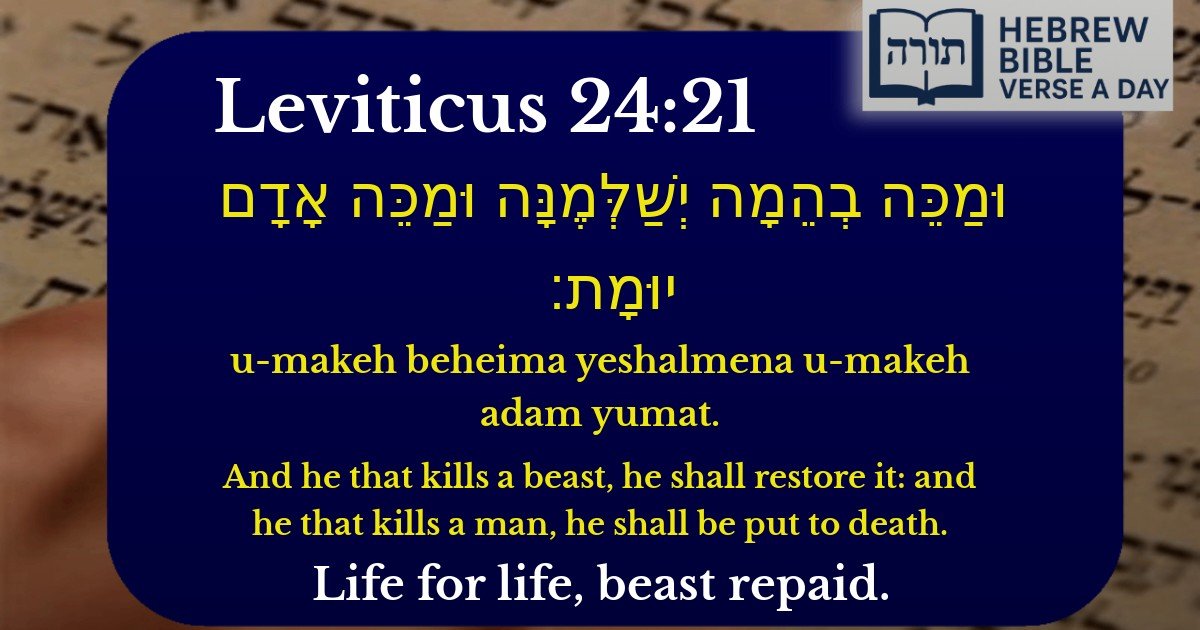
The verse (Shemot 21:35) establishes a fundamental distinction between damages to property (an animal) and damages to human life. Rashi explains that the phrase "וּמַכֵּה בְהֵמָה יְשַׁלְּמֶנָּה" ("he that kills a beast, he shall restore it") refers to monetary compensation for the owner's loss, while "וּמַכֵּה אָדָם יוּמָת" ("he that kills a man, he shall be put to death") underscores the severity of taking human life, which cannot be rectified through financial means.
Legal Context (Halacha)
Rambam (Hilchot Nizkei Mammon 1:1) derives from this verse that damage to property requires restitution, whereas the Sanhedrin (Sanhedrin 9:1) teaches that intentional murder (retzicha) incurs the death penalty. The Talmud (Bava Kamma 83b) elaborates that the compensation for killing an animal falls under the category of "nezek" (damages), while human life is governed by the laws of "nefesh tahat nefesh" (a life for a life).
Moral and Ethical Dimensions (Derash)
The Midrash (Shemot Rabbah 30:19) contrasts the two clauses to emphasize the infinite value of human life. Unlike an animal, which can be replaced, a human being is created b'tzelem Elokim (in the Divine image), making murder an irreparable offense. The Mechilta (Mishpatim 7) further notes that the juxtaposition teaches that one who is careless with animal life may become desensitized to human life.
Practical Implications