Frequently Asked Questions
Q: What is the meaning of the 12 cakes mentioned in Leviticus 24:5?
A: The 12 cakes represent the 12 tribes of Israel. According to Rashi, these 'showbreads' (Lechem HaPanim) were placed in the Mishkan (Tabernacle) and later in the Beit HaMikdash (Temple) as a constant offering before Hashem, symbolizing the unity and connection of the Jewish people to Him.
Q: Why were two tenth measures of flour used for each cake?
A: The measurement of two tenths (עשרון) of an ephah per cake teaches precision in serving Hashem. Rambam explains that exact measurements in Temple service reflect the importance of detail in fulfilling mitzvot properly. This also symbolizes that our spiritual service must be whole and complete.
Q: What can we learn from the mitzvah of the showbread today?
A: Although we no longer have the Temple, the Talmud (Menachot 96b) teaches that the showbread reminds us of Hashem's constant presence. Today, we emulate this by setting our Shabbat tables with two whole loaves (Lechem Mishneh), symbolizing the double portion of manna and the ongoing blessing of sustenance from Hashem.
Q: How were the showbreads prepared according to Jewish tradition?
A: The Mishnah (Menachot 11:4) describes the intricate process: The flour was sifted 12 times for purity, the loaves were kneaded outside the Temple but baked inside, and they were shaped with 'horns' at the corners. This teaches that even physical acts can become holy when performed for Divine service.
Q: Why is fine flour (סלת) specified for the showbread?
A: Rashi explains that only the finest quality flour was used for Temple offerings. This teaches that we must offer our best to Hashem - whether in prayer, charity, or mitzvot. The Midrash (Vayikra Rabbah 3:1) compares this to refining our character traits to serve Hashem with purity.

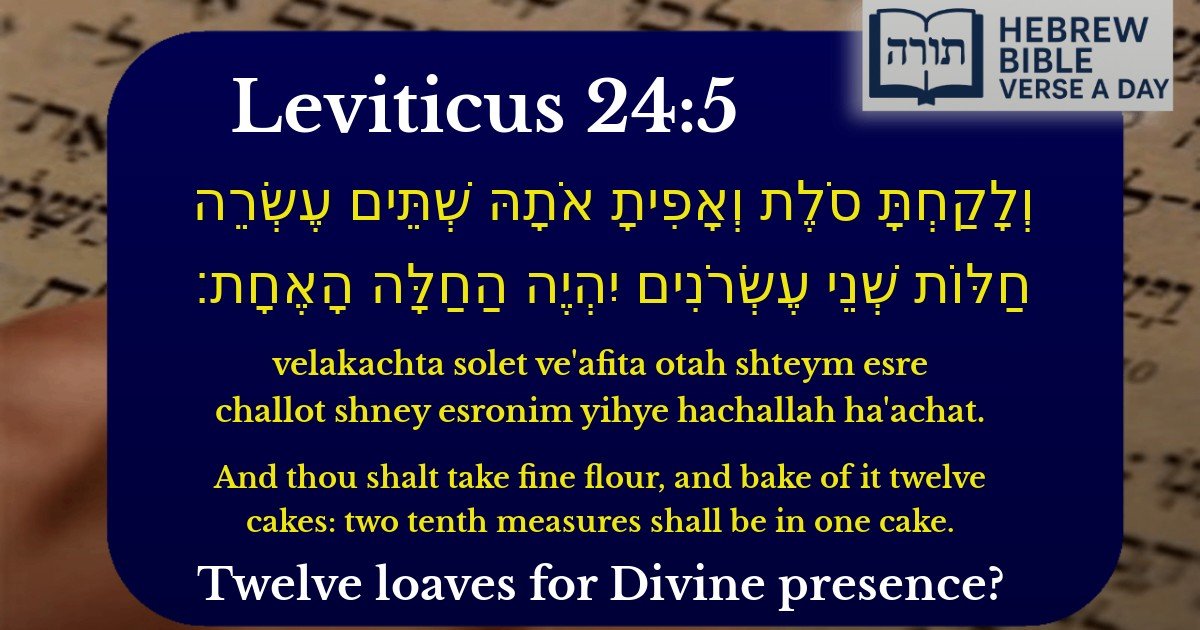

The Twelve Loaves (Lechem HaPanim)
The verse (Vayikra 24:5) describes the mitzvah of preparing twelve loaves of bread, known as Lechem HaPanim (Showbread), which were placed on the golden table in the Mishkan (Tabernacle) and later in the Beit HaMikdash (Temple). These loaves were arranged in two stacks of six loaves each and were replaced every Shabbat.
Rashi's Explanation
Rashi (Vayikra 24:5) explains that the term חַלָּה (challah) here refers to the loaves themselves, not the separated portion of dough (as in the mitzvah of challah for bread baking). Each loaf was made from two issaron measures (approximately 4.3 liters) of fine flour, totaling 24 issaron for all twelve loaves. Rashi also notes that the loaves were shaped like a box with open sides, resembling a "folded book" (based on Menachot 94b).
Symbolism of the Twelve Loaves
Halachic Details from the Talmud
The Talmud (Menachot 94b-96a) elaborates on the preparation and arrangement of the loaves:
Rambam's Perspective
Rambam (Moreh Nevuchim 3:45) explains that the Lechem HaPanim, like other Temple offerings, serves to elevate physical sustenance to a higher spiritual purpose. The meticulous preparation and placement of the loaves teach that even mundane acts like eating can be sanctified when directed toward divine service.