Frequently Asked Questions
Q: What does Leviticus 24:6 mean when it talks about arranging bread in two rows of six?
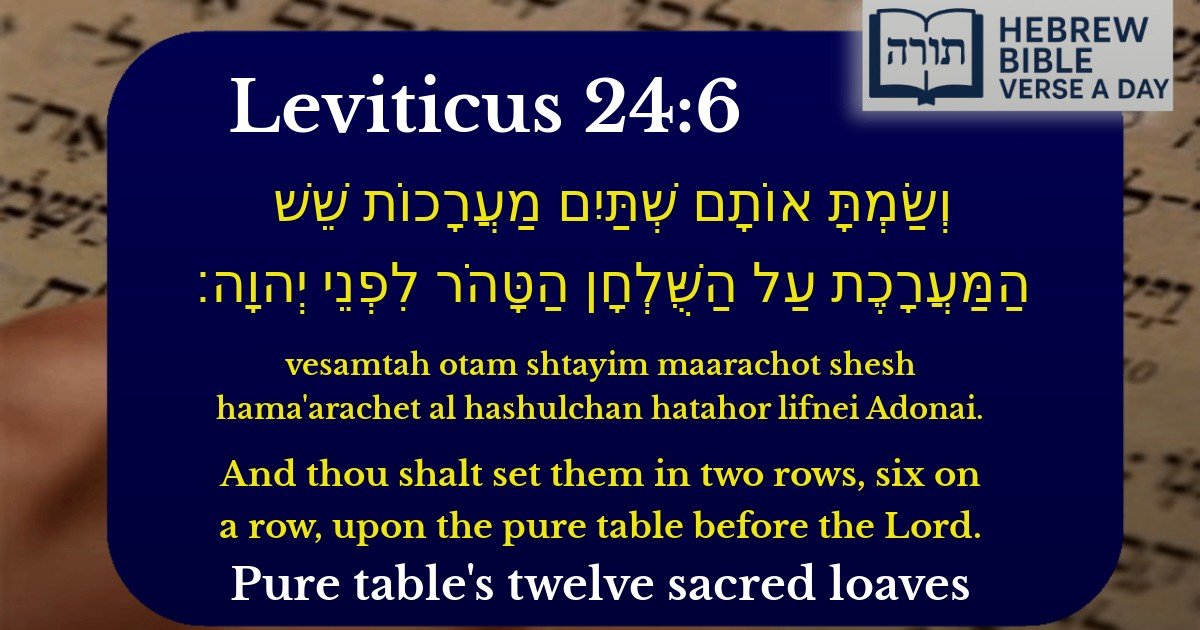
A: This verse refers to the 'Lechem HaPanim' (Showbread) that was placed in the Holy Temple. According to Rashi and the Talmud (Menachot 96a), twelve loaves were arranged in two stacks (or rows) of six loaves each on the golden table in the Mishkan (Tabernacle) and later in the Beit HaMikdash (Temple). This was a weekly offering to Hashem, symbolizing His constant presence and providence.
Q: Why was the table for the Showbread required to be pure (tahor)?
A: The table had to be 'tahor' (pure) because it was used for a sacred purpose in the Mishkan and Temple. The Rambam explains in Hilchot Beit HaBechirah that all vessels used in divine service must be free from any spiritual impurity. The purity of the table reflects the holiness of the Lechem HaPanim, which was a symbol of the divine blessing of sustenance.
Q: What is the significance of the number twelve in the Showbread arrangement?
A: The twelve loaves correspond to the twelve tribes of Israel, as taught in the Midrash (Vayikra Rabbah 21:8). Just as all twelve tribes were united in serving Hashem, the twelve loaves represented the collective spiritual sustenance of the Jewish people. The Talmud (Chagigah 26b) also connects this to the idea that Torah scholars, who provide spiritual nourishment, are like the Showbread.
Q: How does the concept of the Showbread apply to us today without the Temple?
A: While we no longer have the Temple, the mitzvah of the Showbread teaches us about gratitude and recognizing Hashem as the source of our sustenance. The Shulchan Aruch (Orach Chaim 167) mentions that our dining tables are like the Mizbe'ach (altar), and we should approach meals with holiness. Just as the Kohanim ate the Showbread with purity, we should eat with mindfulness and recite blessings.
Q: Why was the Showbread placed 'before Hashem'?
A: The phrase 'before Hashem' (לִפְנֵי יְהוָה) emphasizes that the Showbread was a constant offering, symbolizing that our physical sustenance is always under divine supervision. The Talmud (Bava Batra 25b) explains that the table was placed in the north side of the Mishkan, opposite the Menorah, showing the balance between material and spiritual blessings in serving Hashem.


Context in the Torah
The verse (Vayikra 24:6) describes the arrangement of the lechem hapanim (showbread) on the shulchan hatabor (pure table) in the Mishkan (Tabernacle) and later in the Beit Hamikdash (Temple). This mitzvah is part of the ongoing service performed by the Kohanim (priests).
Explanation of the Arrangement
Rashi explains that the twelve loaves were arranged in two stacks (ma'arakhot), with six loaves in each stack. The Talmud (Menachot 96a) elaborates that the loaves were placed lengthwise on the table, with the two stacks positioned side by side. The space between the stacks allowed for the placement of the ketoret (frankincense) vessels.
Symbolism of the Lechem Hapanim
The Pure Table (Shulchan Hatabor)
The Zohar (Terumah 151a) emphasizes that the table's purity reflects the spiritual purity required when serving before Hashem. The Kli Yakar notes that the table's gold overlay (Shemot 25:24) symbolizes the refinement of material wealth when used for sacred purposes.
Practical Halachic Details
The Mishnah (Menachot 11:5) records that the loaves were baked on Friday and placed on the table on Shabbat. The Gemara (Menachot 97a) discusses the precise measurements of the table and loaves, demonstrating the exacting standards required for divine service.