Frequently Asked Questions
Q: What does Leviticus 25:23 mean when it says 'the land shall not be sold forever'?
A: This verse teaches that the Land of Israel cannot be permanently sold because it ultimately belongs to Hashem. According to Rashi, this refers to the laws of the Jubilee year (Yovel), when all land returns to its original owners. Even when land is 'sold,' it's only a temporary lease until Yovel.
Q: Why does the verse say 'for you are strangers and sojourners with Me'?
A: The Rambam explains that this reminds us that our true home is with Hashem, not in physical possessions. Even in the Land of Israel, we are like temporary residents under Hashem's ownership. The Midrash (Vayikra Rabbah) compares this to a king who lets his servants live in his palace - they may dwell there, but it remains his property.
Q: How does Leviticus 25:23 apply to Jews today?
A: The Talmud (Bava Metzia) derives from this verse that we should have proper respect for the Land of Israel and not treat it as absolute personal property. Many halachic authorities apply this principle to laws about land sales in Israel even today, showing that the land maintains its special kedushah (holiness).
Q: What is the connection between this verse and the Jubilee year?
A: Rashi explains that this verse is the basis for the Yovel (Jubilee) laws where land returns to its original owners every 50 years. The Ramban adds that this cycle reminds us that all land ultimately belongs to Hashem, and we are merely temporary caretakers of His property.
Q: Why does the Torah emphasize that 'the land is Mine'?
A: The Sforno teaches that this declaration prevents arrogance - we must remember that even when we work the land, its true Owner is Hashem. The Talmud (Ketubot 110b) states this is why there are special mitzvot tied to the Land of Israel, as it's uniquely Hashem's holy land given to us to sanctify through Torah observance.

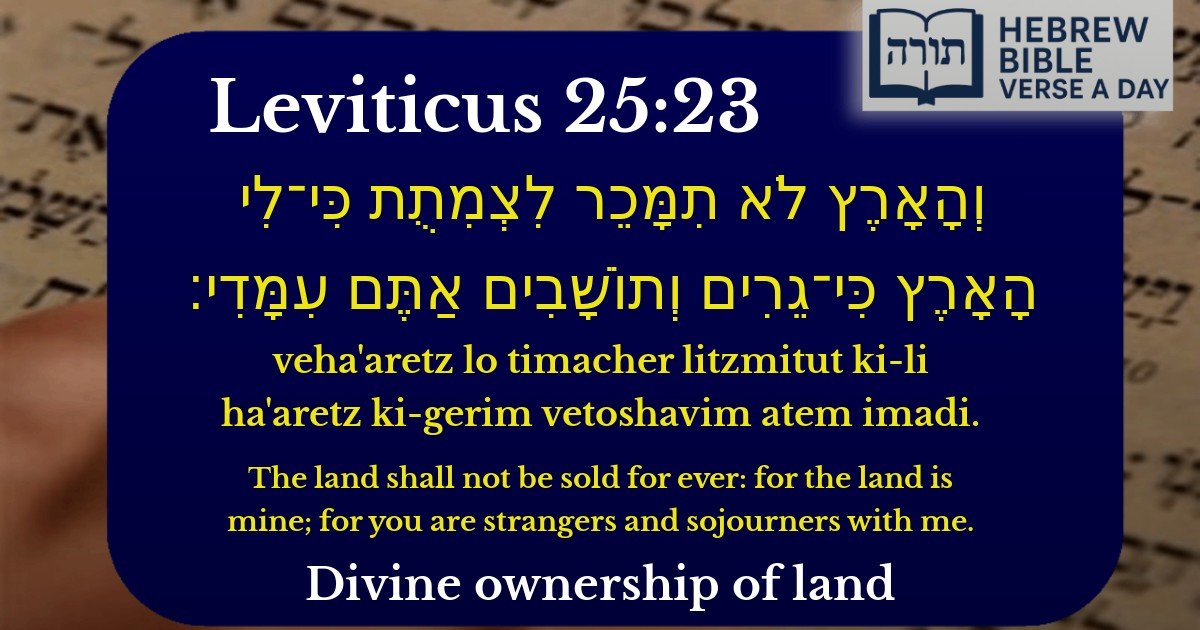

Ownership and Stewardship of the Land
The verse (Vayikra 25:23) emphasizes that the Land of Israel belongs ultimately to Hashem, and human ownership is temporary. Rashi explains that this teaches us that no sale of land in Eretz Yisrael is truly permanent, as the land must return to its original owners during the Yovel (Jubilee) year. This reflects the principle that Bnei Yisrael are merely gerim v’toshavim—strangers and sojourners—in relation to Hashem’s dominion.
The Concept of Gerim v’Toshavim
The Ramban (Nachmanides) elaborates that the terms gerim (strangers) and toshavim (sojourners) highlight our transient status in this world. Even when we dwell in the Land, we must recognize that our true permanence is only in our connection to Hashem. The Sforno adds that this mindset prevents arrogance and reinforces humility, reminding us that all material possessions are temporary.
Halachic Implications of Land Ownership
Moral and Spiritual Lessons
The Midrash (Torat Kohanim 25:23) teaches that this verse serves as a reminder against greed and excessive attachment to physical property. Since the land is Hashem’s, we must use it in accordance with His will, ensuring ethical business practices and care for the less fortunate. The Kli Yakar further explains that recognizing our status as gerim fosters gratitude and responsibility, ensuring we do not exploit the land or its inhabitants.
Connection to Geulah (Redemption)
The Or HaChaim notes that this verse alludes to the eventual return of the Jewish people to their land, as Hashem’s ownership ensures its preservation for His people. This concept is echoed in the prophecies of Yechezkel (36:20-24), where the land’s sanctity is tied to the Jewish people’s divine mission.