Frequently Asked Questions
Q: What does Leviticus 25:27 mean?
A: Leviticus 25:27 discusses the laws of property redemption in the Torah. It states that if a person sells land but later wants to buy it back, they must calculate the years remaining until the Jubilee (Yovel) year, pay the proportional amount, and the land will return to them. This verse emphasizes fairness and the temporary nature of land sales in the biblical land of Israel.
Q: Why is the Jubilee (Yovel) year important in this verse?
A: The Jubilee (Yovel) year, which occurs every 50 years, is crucial because all land in Israel returns to its original owners at that time (Leviticus 25:10). This verse teaches that even if someone sells their land, they or their family can redeem it before Yovel by paying a fair price based on the remaining years until Yovel. This ensures no family permanently loses their ancestral inheritance.
Q: What can we learn from Leviticus 25:27 today?
A: This verse teaches important principles about economic justice, compassion, and the sanctity of ancestral land. While the agricultural laws of Yovel apply only when the majority of Jews live in Israel, the underlying values—fairness in business, helping others regain what they’ve lost, and preserving family heritage—remain timeless lessons for ethical living.
Q: How does this verse apply to modern property laws?
A: While the specific laws of Yovel and land redemption currently apply only when the Sanhedrin and Jubilee year are reinstated, Orthodox Judaism views these laws as part of the Torah’s eternal wisdom. Today, we learn from them the importance of ethical business practices, helping others in financial hardship, and remembering that material possessions are temporary—values that influence Jewish approaches to charity (tzedakah) and loans (gemach).
Q: What does Rashi say about Leviticus 25:27?
A: Rashi explains this verse by clarifying the calculation: if the seller wants to redeem the land, they must determine how many years remain until Yovel and pay the buyer accordingly. For example, if the land was sold for 50 silver pieces (assuming 50 years until Yovel), but 10 years have passed, the redeemer pays 40 silver pieces. This ensures fairness to both buyer and seller (Rashi on Leviticus 25:27).

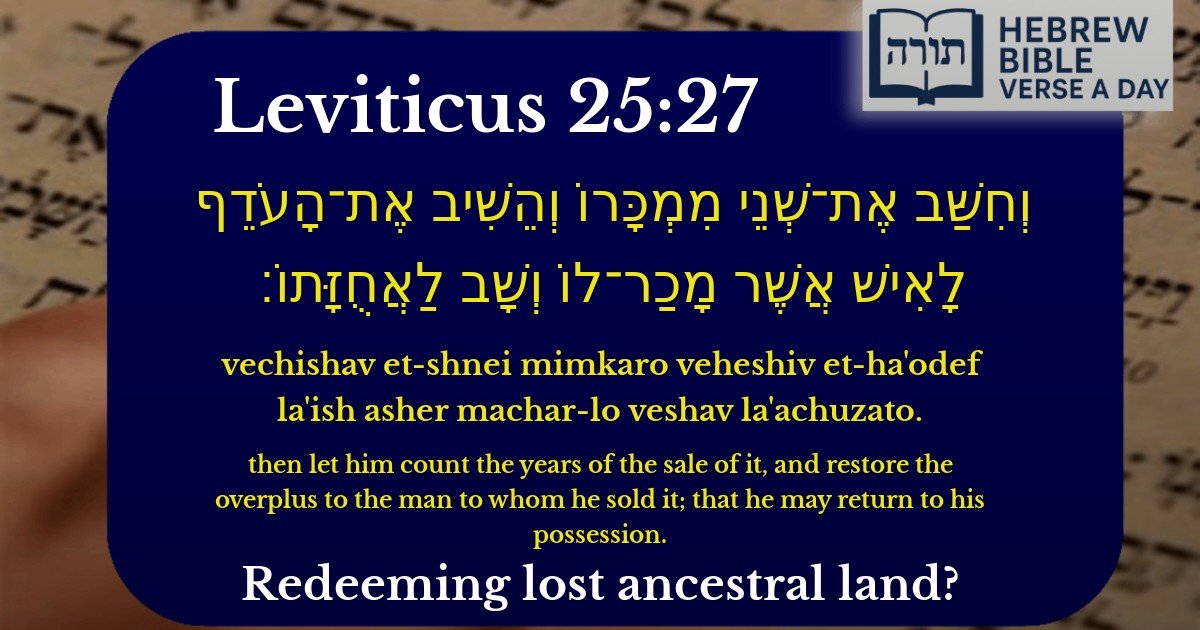

Context of the Verse
The verse (Vayikra 25:27) is part of the Torah's laws regarding the redemption of land in the Yovel (Jubilee) year. It describes the process by which a person who sold his ancestral land may repurchase it from the buyer, calculating the remaining years until Yovel and refunding the proportional amount.
Rashi's Explanation
Rashi (Vayikra 25:27) explains that the seller must calculate the years remaining until Yovel and refund the buyer based on the remaining years. For example, if the land was sold for 50 silver pieces (assuming 50 years until Yovel), and 10 years have passed, the seller must refund 40 silver pieces to reclaim his land. This ensures fairness in land transactions, as land values in the Torah are tied to the Yovel cycle.
Rambam's Legal Perspective
In Hilchot Shemitah v'Yovel (11:1), the Rambam codifies this law, emphasizing that ancestral land must return to its original owner during Yovel. The refund calculation ensures that the buyer is compensated only for the years he actually benefits from the land, reinforcing the Torah's principle that land is not permanently sold but "leased" until Yovel.
Midrashic Insight
The Midrash (Torat Kohanim 25:9) connects this law to the broader theme of divine ownership: "The land shall not be sold permanently, for the land is Mine" (Vayikra 25:23). By requiring the return of land, the Torah reminds us that all possessions are ultimately on loan from Hashem, and our stewardship is temporary.
Practical Implications