Frequently Asked Questions
Q: What does 'You shall keep my sabbaths' mean in Leviticus 26:2?
A: This verse commands the Jewish people to observe and sanctify the Shabbat (Sabbath), which includes refraining from work (melacha) and dedicating the day to spiritual growth and connection with Hashem. Rashi explains that keeping Shabbat is a sign of our covenant with G-d, and the Rambam (Hilchot Shabbat) details the 39 categories of prohibited work.
Q: Why does the verse say 'reverence my sanctuary'?
A: The Torah instructs us to show deep respect for the Beit HaMikdash (Holy Temple) and, by extension, synagogues and study halls (as they are called 'mikdash me'at'—miniature sanctuaries). The Talmud (Berachot 62b) teaches that one must behave with awe in these holy places, avoiding frivolity and maintaining proper decorum.
Q: Why does the verse end with 'I am the Lord'?
A: The phrase 'I am the Lord' emphasizes that these commandments come directly from G-d. The Midrash (Sifra) explains that it reminds us that just as Hashem is eternal, so too are His mitzvot (commandments), including Shabbat and reverence for holiness. It reinforces that our observance is a testimony to His sovereignty.
Q: How do we apply 'reverence for the sanctuary' today without the Temple?
A: Since the destruction of the Beit HaMikdash, halacha (Jewish law) teaches that we transfer this reverence to synagogues and batei midrash (study halls). The Shulchan Aruch (Orach Chaim 151) details proper conduct in shul, such as dressing modestly, speaking respectfully, and avoiding mundane conversation in holy spaces.
Q: What is the connection between Shabbat and the sanctuary in this verse?
A: Rashi and the Sifra connect these two mitzvot by teaching that just as Shabbat is timeless (observed even without the Temple), so too the sanctity of the Mikdash endures. Both represent kedusha (holiness) in time and space. The Ramban adds that observing Shabbat helps us internalize the reverence due to holy places.

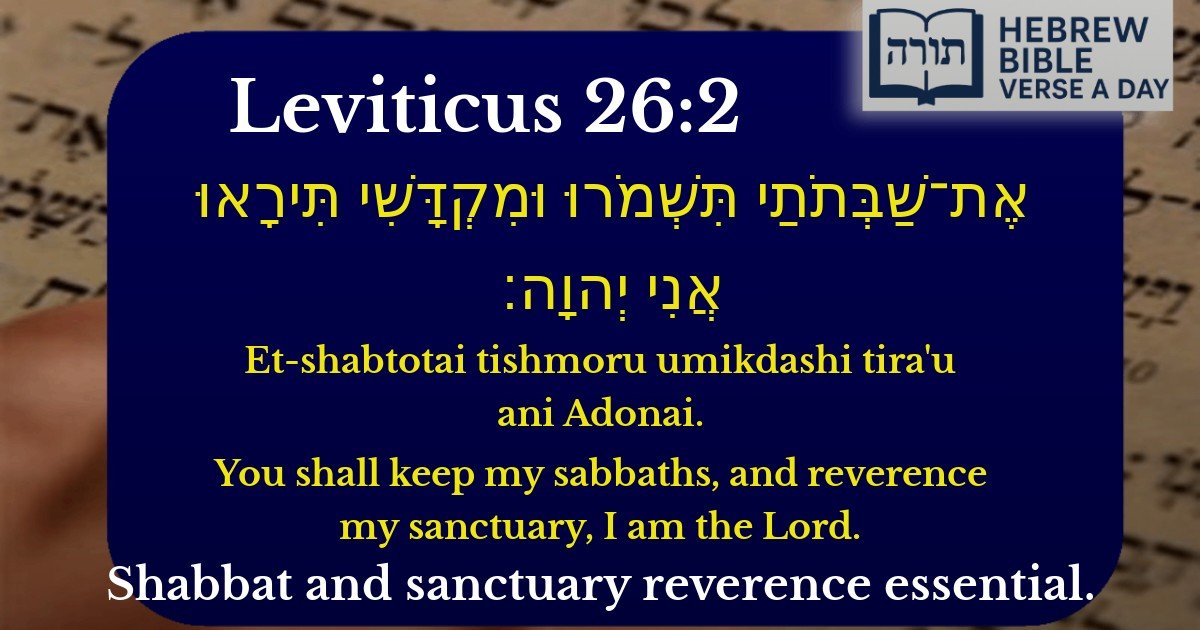

Understanding the Verse
The verse "אֶת־שַׁבְּתֹתַי תִּשְׁמֹרוּ וּמִקְדָּשִׁי תִּירָאוּ אֲנִי יְהוָה" (Vayikra 19:30) commands the observance of Shabbat and reverence for the Mikdash (Sanctuary). It concludes with the declaration "I am the Lord," emphasizing the divine authority behind these mitzvot.
Rashi's Commentary
Rashi explains that the juxtaposition of Shabbat and reverence for the Mikdash teaches that just as Shabbat observance is perpetual, so too must reverence for the Mikdash endure—even when it is in ruins. This extends the obligation of reverence beyond the physical structure to include the site of the Temple (Har HaBayit) at all times.
Rambam's Perspective
In Hilchot Beit HaBechirah (7:1), Rambam elaborates on the mitzvah of revering the Mikdash, stating that one must conduct oneself with awe in its presence, avoiding frivolity, laughter, or casual behavior. This reverence applies not only to the building but also to its sacred vessels and the sanctity of the place.
Talmudic and Midrashic Insights
Practical Implications
This verse underscores two foundational principles:
Theological Significance
The concluding phrase "I am the Lord" reinforces that these commandments are not merely cultural practices but divine imperatives. They are inseparable from our relationship with Hashem, as both Shabbat and the Mikdash symbolize His presence among Bnei Yisrael.