Frequently Asked Questions
Q: What does 'the tenth shall be holy to the Lord' mean in Leviticus 27:32?
A: This verse refers to the mitzvah (commandment) of 'Ma'aser Behemah' (tithing of livestock). According to Jewish law, every tenth animal that passes under the shepherd's rod is designated as holy and must be given to the Kohanim (priests) or brought as a sacrifice in the Temple (Rambam, Hilchot Ma'aser Behemah 1:1).
Q: Why is tithing livestock important in Judaism?
A: Tithing livestock, like other forms of tithing, teaches us gratitude to Hashem for our possessions and reminds us that everything ultimately belongs to Him. It also supports the Kohanim and the service in the Beit Hamikdash (Temple), maintaining the spiritual infrastructure of the Jewish people (Rashi on Leviticus 27:30).
Q: How was the livestock tithe counted according to Jewish tradition?
A: The animals were counted as they passed single file under the shepherd's rod. The owner would mark every tenth animal with red dye, declaring it holy (Chullin 137b). This method ensured fairness and prevented selecting only the best or worst animals.
Q: Does the livestock tithe apply today without the Temple?
A: While we cannot bring sacrifices without the Temple, the laws of Ma'aser Behemah still apply in principle. However, since we lack the Temple service, we don't practically separate this tithe today (Rambam, Hilchot Ma'aser Behemah 1:8). The laws remain important to study in anticipation of the Temple's rebuilding.
Q: What lesson can we learn from the livestock tithe today?
A: This mitzvah teaches us that holiness can be found in our material possessions when we dedicate them to Hashem's service. Just as every tenth animal was sanctified, we should seek to elevate portions of our wealth and resources for spiritual purposes (Midrash Tanchuma, Re'eh 18).

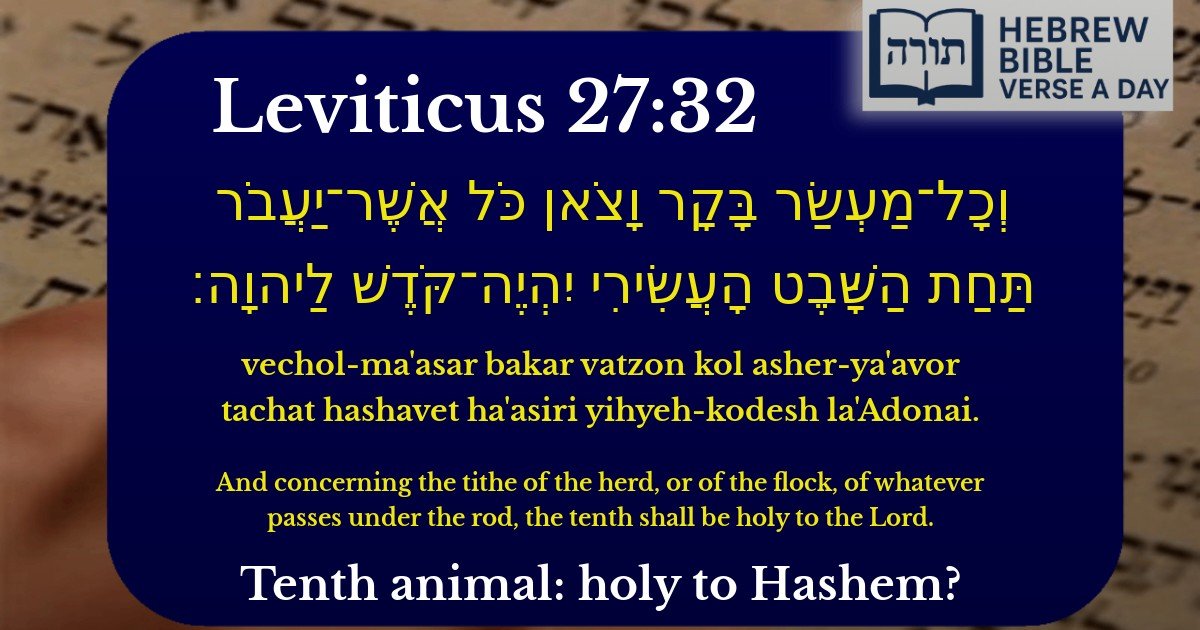

Overview of the Verse
The verse (Vayikra 27:32) discusses the mitzvah of ma'aser behemah (tithing of livestock), a commandment requiring Jewish farmers to dedicate every tenth animal from their herds or flocks to Hashem. This tithe was brought as a korban (offering) in the Beit HaMikdash.
Rashi's Explanation
Rashi explains that the phrase "ya'avor tachat ha'shavet" ("passes under the rod") refers to the method of counting the animals. The owner would gather the animals in a pen, and as each one exited, he would count them with a rod dipped in paint, marking every tenth animal as holy. Rashi emphasizes that this process ensures fairness, as the owner cannot selectively choose which animals to tithe.
Rambam's Halachic Perspective
In Hilchos Bechoros (6:1), the Rambam elaborates on the laws of ma'aser behemah, stating:
Midrashic Insight
The Midrash (Vayikra Rabbah 27:10) connects this mitzvah to the concept of kedushah (holiness). Just as the tenth animal is sanctified, so too must a Jew sanctify a portion of their material wealth for divine service. This teaches that prosperity is a gift from Hashem, and setting aside the tithe acknowledges His ownership over all creation.
Talmudic Discussion
The Talmud (Bechoros 58a-59a) discusses practical details:
Spiritual Lesson
The Sefer HaChinuch (Mitzvah 360) highlights that this mitzvah cultivates generosity and detachment from materialism. By relinquishing a portion of one's livestock—a significant source of wealth—the farmer internalizes that true sustenance comes from Hashem.