Frequently Asked Questions
Q: What is the 'meal offering' mentioned in Leviticus 2:8?
A: The 'meal offering' (מִנְחָה) is a type of sacrifice made from fine flour, oil, and frankincense, as described in Leviticus 2:1. Unlike animal sacrifices, it is a vegetarian offering, often brought by those who couldn't afford animals. Rashi explains that it symbolizes humility and devotion, as flour is a simple, basic food.
Q: Why does the verse say to bring the meal offering 'to the priest'?
A: The Torah instructs bringing the meal offering to the priest (כֹּהֵן) because only the kohanim (priests) were permitted to handle and offer sacrifices in the Mishkan (Tabernacle) and later in the Temple. The Rambam (Hilchot Maaseh HaKorbanot) explains that this emphasizes the importance of proper ritual procedure and the priestly role in connecting the people to Hashem.
Q: What is the significance of the meal offering being brought to the altar?
A: Bringing the meal offering to the altar (מִזְבֵּחַ) signifies its sanctification and acceptance by Hashem. The Talmud (Menachot 21a) teaches that once the offering reaches the altar, certain parts are burned, and the rest is eaten by the kohanim, showing that the offering serves both a divine and communal purpose.
Q: Can the meal offering be brought today without the Temple?
A: No, according to halacha (Jewish law), meal offerings and all sacrifices can only be brought in the Beit HaMikdash (Holy Temple) in Jerusalem. The Rambam (Hilchot Beit HaBechirah) states that until the Temple is rebuilt, sacrifices are not offered. Instead, prayer (תְּפִלָּה) and Torah study fill this role in our relationship with Hashem.
Q: What lesson can we learn from the meal offering today?
A: The meal offering teaches the value of sincerity and simplicity in serving Hashem. Even though we can't bring sacrifices today, the Midrash (Vayikra Rabbah 3:1) explains that acts of kindness, prayer, and Torah study are like 'spiritual offerings.' Just as the meal offering didn't require expensive ingredients, our devotion doesn’t need grand gestures—only a sincere heart.

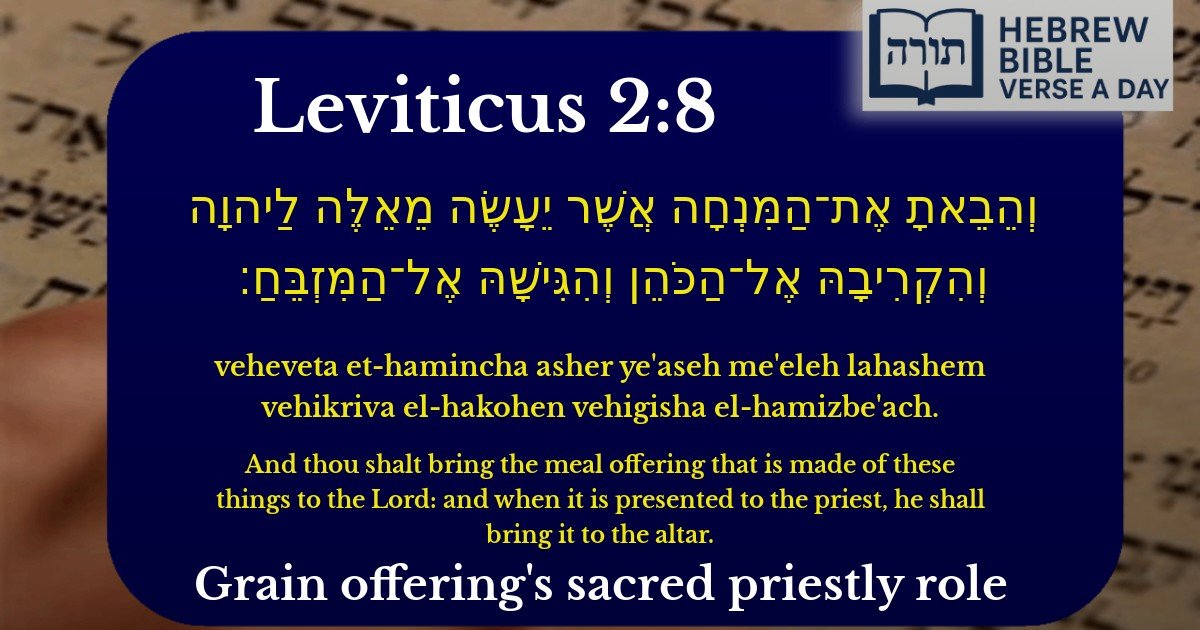

Context of the Verse
This verse (Vayikra 2:8) describes the procedure for bringing a mincha (meal offering) to the Mishkan or Beit HaMikdash. The mincha offering, made from fine flour, oil, and frankincense, was a voluntary gift to Hashem, often brought by those who could not afford animal sacrifices (Rashi, Vayikra 2:1). The verse emphasizes the roles of both the individual bringing the offering and the Kohen in facilitating its presentation.
The Role of the Individual and the Kohen
The Torah states, "And thou shalt bring the meal offering... to the Lord", indicating that the act of bringing the offering is a personal obligation (Rambam, Hilchot Ma'aseh HaKorbanot 9:1). However, the verse then shifts to the Kohen's role: "and when it is presented to the priest, he shall bring it to the altar." This teaches that while the individual initiates the offering, the actual service (e.g., placing it on the altar) must be performed by a Kohen (Talmud, Zevachim 32a).
Symbolism of the Mincha Offering
Halachic Insights
The verse underscores the importance of proper procedure in the Beit HaMikdash. The mincha must first be given to the Kohen, who then brings it to the altar—highlighting the Kohen's intermediary role in divine service (Rambam, Hilchot Klei HaMikdash 8:1). Additionally, the phrase "which is made of these things" implies that only the specified ingredients (flour, oil, and frankincense) are valid for the offering, excluding any unauthorized additions (Talmud, Menachot 50b).