Frequently Asked Questions
Q: What does 'all the fat is the Lord’s' mean in Leviticus 3:16?
A: In Leviticus 3:16, the Torah teaches that the fat portions of certain animal sacrifices (korbanot) must be burned on the altar and dedicated to Hashem. According to Rashi and the Talmud (Chullin 49a), this refers specifically to the fats surrounding the organs, which were considered the choicest parts. This teaches us to offer our best to Hashem and symbolizes devotion in serving Him.
Q: Why is the fat of sacrifices important in Judaism?
A: The fat of sacrifices is important because the Torah designates it as belonging exclusively to Hashem (Leviticus 3:16). The Rambam (Hilchos Maaseh HaKorbanos 5:13) explains that burning the fat on the altar represents complete dedication to Hashem. The Midrash (Vayikra Rabbah 3:4) also teaches that the 'sweet savor' of the fat symbolizes the Jewish people’s willingness to give their best in divine service.
Q: What can we learn from the phrase 'a sweet savor' in Leviticus 3:16?
A: The phrase 'a sweet savor' (רֵיחַ נִיחֹחַ) teaches that sacrifices were meant to be pleasing to Hashem when offered with sincerity. Rashi explains that this term indicates divine acceptance when the mitzvah is performed correctly. The Talmud (Menachos 110a) compares it to a beloved fragrance, showing that proper service of Hashem brings spiritual elevation.
Q: How does the concept of offering fat apply to us today without the Temple?
A: Although we no longer bring physical sacrifices, the principle of giving our best to Hashem still applies. The Rambam (Moreh Nevuchim 3:32) explains that korbanot trained us in devotion. Today, we fulfill this through prayer (Tefillah), Torah study, and acts of kindness (Gemilus Chasadim), offering our 'inner fat'—our highest efforts—in serving Hashem.
Q: Why does the verse mention the priest burning the fat on the altar?
A: The verse emphasizes the role of the Kohen (priest) because only a ritually pure Kohen could perform this sacred service in the Mishkan or Beit HaMikdash. Rashi (on Leviticus 1:7) notes that the Kohanim ensured the offering was prepared according to halacha. This highlights the importance of proper spiritual leadership in serving Hashem.

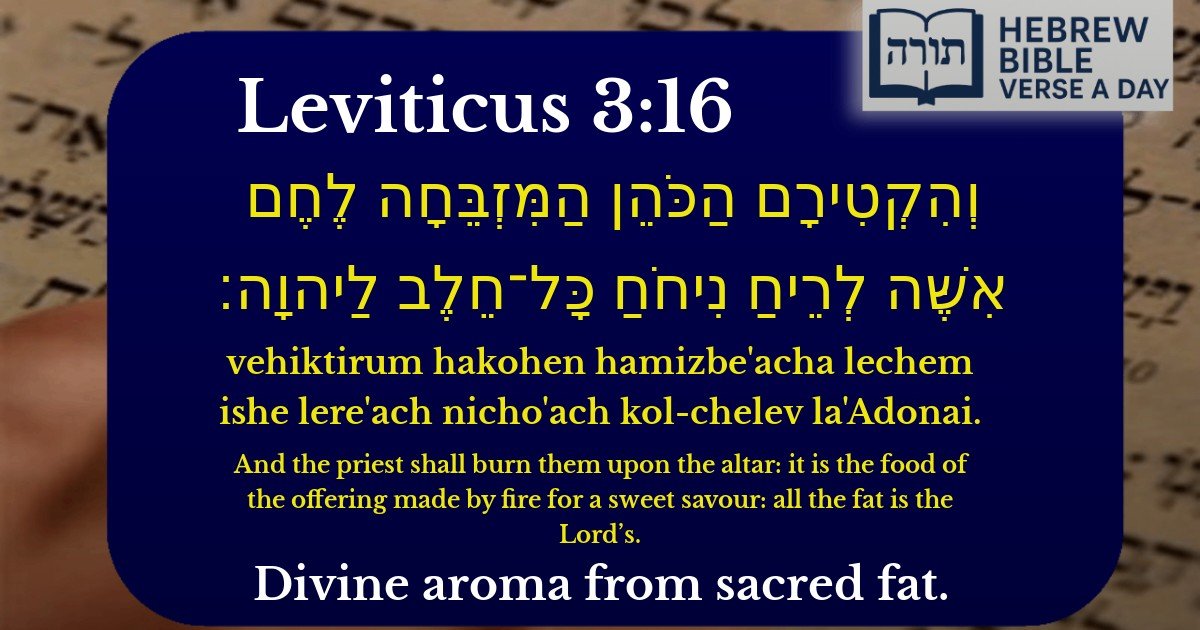

Explanation of the Verse
The verse (Vayikra 3:16) describes the process of offering the fats of a sacrifice upon the altar, emphasizing that they are designated for Hashem. The phrase "לֶחֶם אִשֶּׁה לְרֵיחַ נִיחֹחַ" ("the food of the offering made by fire for a sweet savor") conveys the idea that the korban (sacrifice) is an act of devotion pleasing to Hashem.
Rashi's Commentary
Rashi explains that "כָּל־חֵלֶב לַיהוָה" ("all the fat is the Lord’s") teaches that the fats of certain sacrificial animals must be offered on the altar and are forbidden for human consumption (Chullin 49a). This reinforces the principle that certain parts of the korban are exclusively sanctified for divine service.
Rambam's Perspective
The Rambam (Hilchot Ma'aseh HaKorbanot 5:1) elaborates that burning the fats on the altar symbolizes the complete dedication of the offering to Hashem. The term "לֶחֶם אִשֶּׁה" ("food of the offering") reflects the concept that the korbanot are akin to a "meal" presented before Hashem, demonstrating the intimate relationship between the Jewish people and their Creator.
Midrashic Insight
The Midrash (Vayikra Rabbah 3:4) compares the "רֵיחַ נִיחֹחַ" ("sweet savor") to the satisfaction a king derives from a meal prepared by his beloved child. Similarly, Hashem delights in the sincere offerings of Bnei Yisrael when brought with proper intent.
Halachic Implications