Frequently Asked Questions
Q: What does Leviticus 3:17 mean when it prohibits eating fat and blood?
A: Leviticus 3:17 prohibits eating certain fats (chelev) and blood (dam) as part of the Torah's dietary laws. According to Rashi and traditional Jewish sources, the forbidden fat refers specifically to the fat of kosher animals that was designated for offerings on the altar. Blood is forbidden because it represents life (as stated in Leviticus 17:11), and consuming it is considered a violation of respecting life.
Q: Why is the prohibition of eating fat and blood called a 'perpetual statute' in Leviticus 3:17?
A: The Torah calls this a 'perpetual statute' (chukat olam) to emphasize that this commandment applies for all future generations, in all places where Jews live. The Rambam explains in Mishneh Torah that these laws are timeless and not subject to change, reinforcing their importance in Jewish practice.
Q: How do Jews today observe the prohibition against eating fat and blood?
A: Today, kosher slaughter (shechita) and meat preparation strictly follow these laws. The blood is removed through salting and soaking (melicha), and the forbidden fats (chelev) are carefully separated by trained kosher butchers. The Shulchan Aruch (Yoreh De'ah) provides detailed guidelines to ensure compliance with these Torah commandments.
Q: What is the spiritual reason behind not eating blood and certain fats?
A: The Midrash and Kabbalistic sources teach that blood represents the life force (nefesh), which belongs to Hashem alone. Forbidden fats (chelev) were designated for the altar, symbolizing devotion to G-d. By abstaining from them, we acknowledge holiness and elevate physical consumption into a spiritual act.
Q: Does Leviticus 3:17 apply to all fats, or just specific types?
A: The prohibition applies only to specific fats (chelev) from kosher animals, not all fats. Rashi clarifies that it refers to the fats surrounding organs like the kidneys and liver, which were offered on the altar. Permitted fats (shuman) are not included in this prohibition and may be eaten.

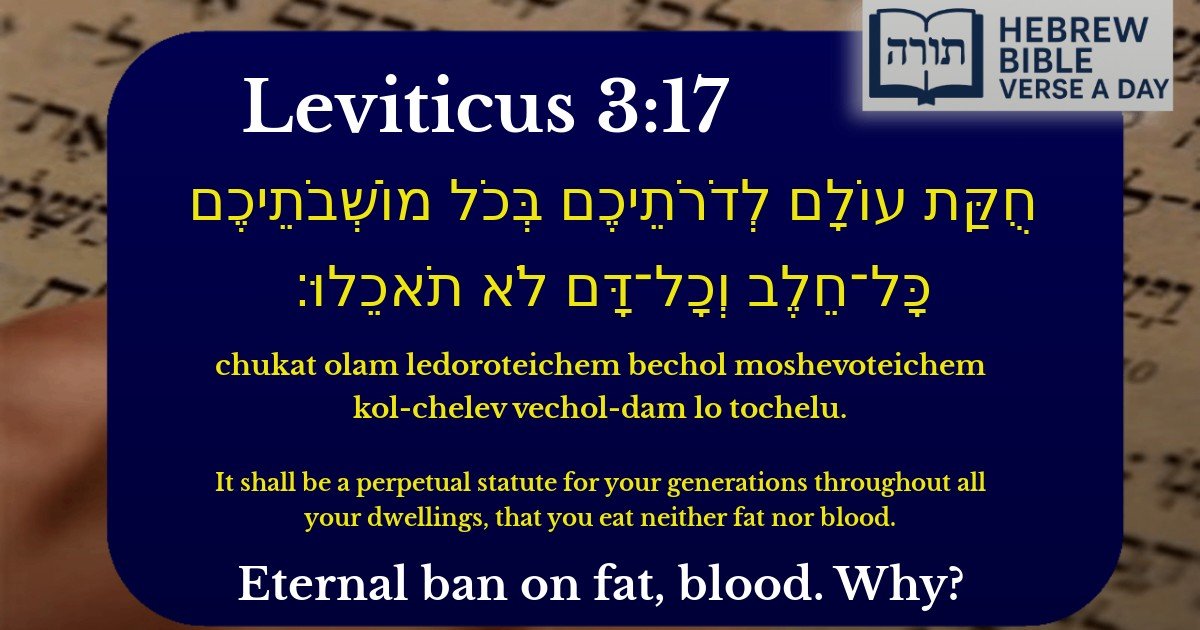

Prohibition of Eating Fat (Chelev) and Blood (Dam)
The verse (Vayikra 3:17) establishes a perpetual prohibition against consuming chelev (forbidden fats) and dam (blood), applying to all generations and all dwelling places. This mitzvah is rooted in the sanctity of sacrificial offerings and extends to non-sacrificial animals as well.
Explanation of Chelev (Forbidden Fat)
According to Rashi (Vayikra 3:17), chelev refers specifically to the fats that were offered on the altar during korbanot (sacrifices), such as the fats covering the innards, kidneys, and the lobe of the liver. The Rambam (Hilchot Ma'achalot Asurot 7:5) clarifies that these fats are distinct from permissible fats (shuman) and are forbidden even if they come from a non-sacrificial animal.
Prohibition of Blood (Dam)
The Torah repeatedly emphasizes the prohibition of consuming blood (e.g., Vayikra 7:26, Devarim 12:23). The Talmud (Chullin 117a) explains that blood represents the nefesh (life force), and its consumption is associated with cruelty and impurity. The Rambam (Hilchot Ma'achalot Asurot 6:1) further states that this prohibition applies to all types of blood, whether from animals, birds, or wild beasts.
Perpetual Statute (Chukat Olam)
The phrase "chukat olam" (perpetual statute) underscores that this mitzvah is immutable and applies in all times and places. The Midrash (Sifra, Shemini 12:4) teaches that this prohibition is not subject to change, even in future generations or outside the Land of Israel. The Sefer HaChinuch (Mitzvah 147) connects this mitzvah to the broader principle of kedushah (holiness), as refraining from blood and forbidden fats elevates the Jewish people spiritually.
Practical Halachic Implications