Frequently Asked Questions
Q: What does 'a sweet savour to the Lord' mean in Leviticus 3:5?
A: The phrase 'a sweet savour to the Lord' (רֵיחַ נִיחֹחַ לַיהוָה) means that the korban (offering) is pleasing and acceptable to Hashem when brought with proper intentions. Rashi explains that this expression signifies that the offering brings satisfaction to Hashem, as if He 'enjoys' the devotion of His people. The Rambam (Hilchos Ma'aseh HaKorbanos) teaches that the physical act of burning the offering represents the spiritual elevation of the one bringing it.
Q: Why does the verse specify that the sons of Aharon must burn the offering on the altar?
A: The Torah specifies that only the sons of Aharon (the Kohanim) may perform the avodah (Temple service) of burning the korban on the Mizbe'ach (altar). This teaches us that the sacrificial service has strict halachic requirements, as outlined in the Talmud (Zevachim). The Rambam (Hilchos Klei HaMikdash) explains that this exclusivity maintains the sanctity and proper order of the avodah.
Q: What is the significance of the offering being placed on the wood and fire in Leviticus 3:5?
A: The wood and fire represent the process of elevating the korban to Hashem. The Midrash (Vayikra Rabbah) teaches that the wood must be arranged properly to ensure complete burning, symbolizing the need for proper preparation in serving Hashem. The fire, which comes from heaven (as described in the Talmud, Yoma 21b), represents Divine acceptance when the offering is brought with sincerity.
Q: How does Leviticus 3:5 apply to us today without the Temple?
A: Although we cannot bring korbanos today, the Talmud (Berachos 17a) teaches that our tefillah (prayer) replaces the korbanos. The Rambam (Hilchos Tefillah) explains that just as korbanos required proper intention (kavanah), so too must our prayers. Additionally, acts of kindness and Torah study are compared to offerings (Proverbs 3:9, Menachos 110a), allowing us to fulfill this ideal in a spiritual way.
Q: What type of offering is being described in Leviticus 3:5?
A: This verse refers to the Shelamim (peace offering), as the entire chapter discusses this type of korban. Rashi explains that Shelamim express gratitude and foster peace (shalom) between a person and Hashem. The Talmud (Chullin 84a) elaborates that parts of this offering are burned on the Mizbe'ach, while other portions are eaten by the Kohanim and the one bringing the offering, creating shared holiness.


Context and Overview
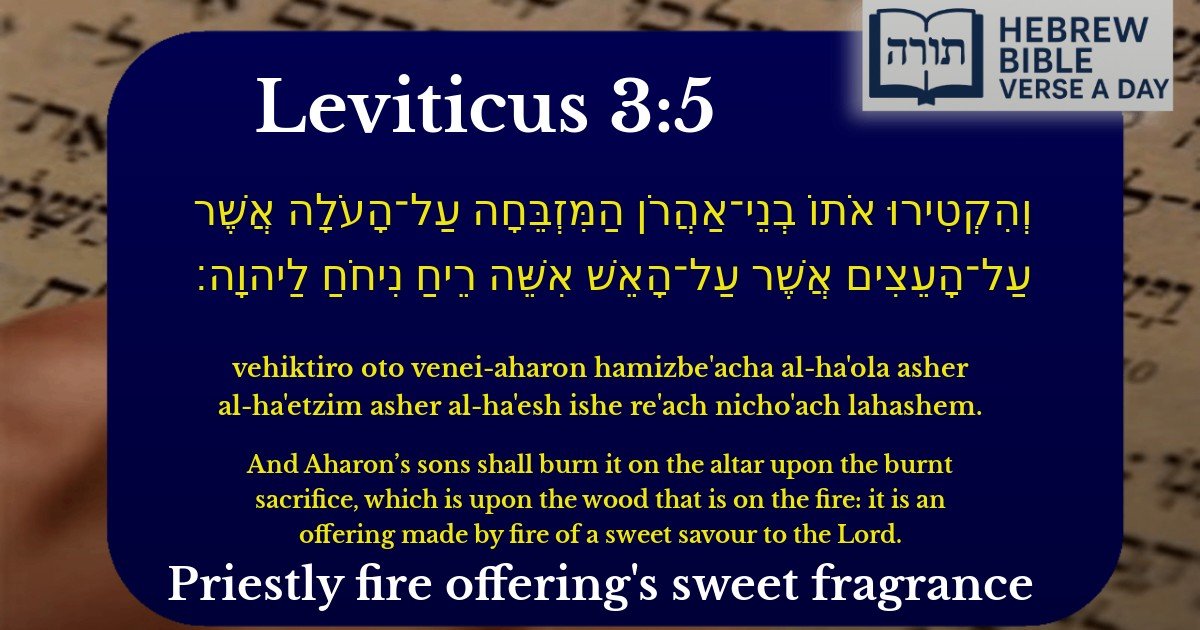
The verse (Vayikra 3:5) describes the procedure for offering certain korbanot (sacrifices) by the Kohanim, the sons of Aharon, on the Mizbe'ach (altar). The phrase "אִשֵּׁה רֵיחַ נִיחֹחַ לַיהוָה" ("an offering made by fire of a sweet savour to the Lord") is a recurring theme in the Torah regarding korbanot, indicating Divine acceptance of the offering when performed properly.
Rashi's Commentary
Rashi (Vayikra 3:5) explains that the phrase "עַל־הָעֹלָה אֲשֶׁר עַל־הָעֵצִים" ("upon the burnt sacrifice, which is upon the wood") refers to the placement of the sacrifice on the existing fire of the Olah (burnt offering) already burning on the altar. This teaches that the korban is not to be placed on new wood but rather on the ongoing fire of the Olah, ensuring continuity in the service of the Mizbe'ach.
Rambam's Perspective
In Hilchot Ma'aseh HaKorbanot (Laws of Sacrificial Procedure), the Rambam (Maimonides) emphasizes the precision required in the sacrificial service. The placement of the korban "עַל־הָעֵצִים אֲשֶׁר עַל־הָאֵשׁ" ("upon the wood that is on the fire") underscores that the fire must be properly prepared and maintained by the Kohanim, as the Mizbe'ach's fire must never extinguish (Vayikra 6:6).
Midrashic Insights
Kabbalistic Interpretation
According to the Zohar (Vayikra 14b), the "אִשֵּׁה" ("offering made by fire") represents the elevation of the physical to the spiritual. The fire symbolizes the Divine spark within creation, and the korban serves as a vehicle for connecting the material world with the higher realms.
Halachic Implications
The Gemara (Zevachim 59b) derives from this verse that the korban must be placed specifically on the wood already burning on the Mizbe'ach, not on a separate fire. This reflects the principle that all korbanot must adhere to the precise details of the Torah's instructions to be valid.