
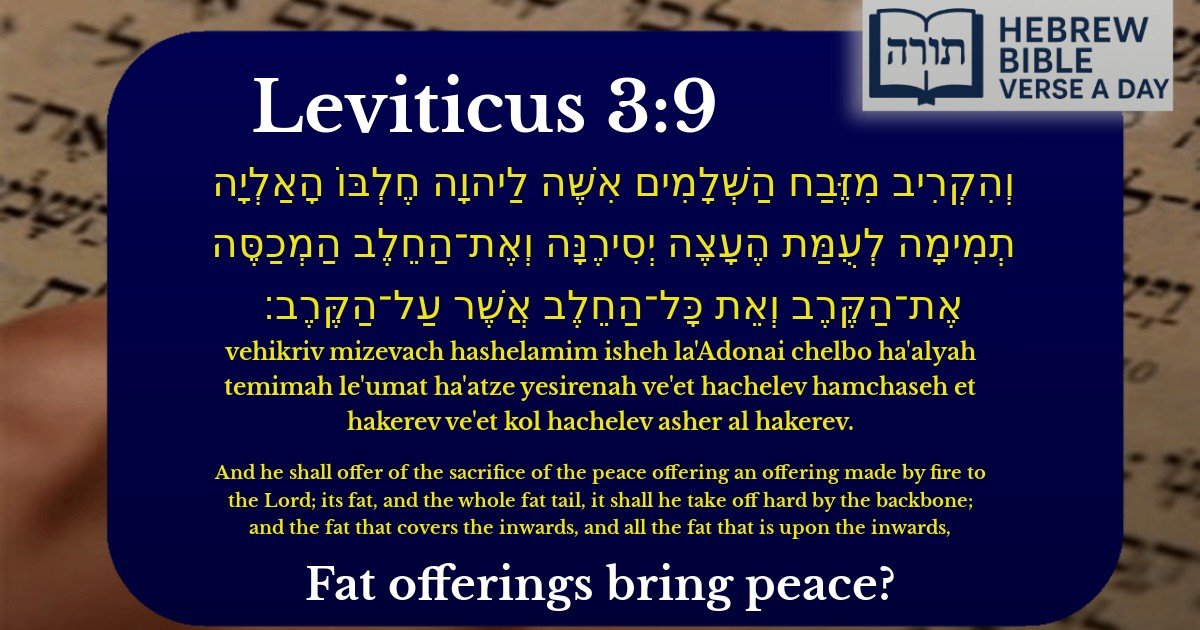

Leviticus 3:9 - Fat offerings bring peace?

Leviticus 3:9 - ויקרא 3:9

Hebrew Text

וְהִקְרִיב מִזֶּבַח הַשְּׁלָמִים אִשֶּׁה לַיהוָה חֶלְבּוֹ הָאַלְיָה תְמִימָה לְעֻמַּת הֶעָצֶה יְסִירֶנָּה וְאֶת־הַחֵלֶב הַמְכַסֶּה אֶת־הַקֶּרֶב וְאֵת כָּל־הַחֵלֶב אֲשֶׁר עַל־הַקֶּרֶב׃

English Translation

And he shall offer of the sacrifice of the peace offering an offering made by fire to the Lord; its fat, and the whole fat tail, it shall he take off hard by the backbone; and the fat that covers the inwards, and all the fat that is upon the inwards,

Transliteration

Vehikriv mizevach hashelamim isheh la'Adonai chelbo ha'alyah temimah le'umat ha'atze yesirenah ve'et hachelev hamchaseh et hakerev ve'et kol hachelev asher al hakerev.

Hebrew Leining Text

וְהִקְרִ֨יב מִזֶּ֣בַח הַשְּׁלָמִים֮ אִשֶּׁ֣ה לַיהֹוָה֒ חֶלְבּוֹ֙ הָאַלְיָ֣ה תְמִימָ֔ה לְעֻמַּ֥ת הֶעָצֶ֖ה יְסִירֶ֑נָּה וְאֶת־הַחֵ֙לֶב֙ הַֽמְכַסֶּ֣ה אֶת־הַקֶּ֔רֶב וְאֵת֙ כׇּל־הַחֵ֔לֶב אֲשֶׁ֖ר עַל־הַקֶּֽרֶב׃

🎵 Listen to leining

Parasha Commentary

Explanation of the Verse from Vayikra (Leviticus) 3:9

This verse details the laws concerning the זבח שלמים (Korban Shelamim), the peace offering, specifically the portions of fat that are to be offered on the altar as אשה לה' (a fire-offering to Hashem). The Torah emphasizes the removal and burning of specific fats, including the חלב האליה (the fat tail) and the fats covering the innards.

Key Components of the Offering

  • חלב האליה תמימה (The Whole Fat Tail): Rashi (on Vayikra 3:9) explains that this refers to the tail of a sheep, which is entirely fat and must be removed לעומת העצה (close to the backbone). The term תמימה (whole) indicates that it must be intact and not cut into pieces before being offered.
  • החלב המכסה את הקרב (The Fat Covering the Innards): Rambam (Hilchos Maaseh HaKorbanos 5:3) clarifies that this refers to the layer of fat surrounding the stomach and intestines, which must be completely separated and burned on the altar.
  • כל החלב אשר על הקרב (All the Fat Upon the Innards): The Sifra (Torat Kohanim) interprets this as including additional fatty deposits attached to the organs, all of which are designated for the altar.

Symbolism and Halachic Significance

The Zevach Shelamim represents a voluntary offering of gratitude or fulfillment of a vow, symbolizing peace and closeness to Hashem. The removal and burning of the fats signify the dedication of the choicest parts to Hashem, as fat was considered a delicacy in ancient times (Chizkuni on Vayikra 3:16). The Talmud (Chullin 49b) further discusses the precise anatomical definitions of these fats to ensure proper fulfillment of the mitzvah.

Practical Halachic Considerations

According to the Shulchan Aruch (Yoreh De'ah 64), these laws also influence the rules of kashrus, as the forbidden fats (חלב) must be removed before consumption. The Gemara (Menachos 49a) notes that the proper handling of these fats was a critical duty of the Kohanim in the Beis HaMikdash.

📚 Talmud Citations

This verse is quoted in the Talmud.

📖 Menachot 62a
The verse is discussed in the context of the laws regarding the sacrifice of peace offerings, specifically the parts of the animal that are to be offered.
📖 Chullin 120a
The verse is referenced in a discussion about the proper way to remove and offer the fat portions of the sacrifice.

Frequently Asked Questions

Q: What is the meaning of the 'sacrifice of the peace offering' in Leviticus 3:9?
A: The 'sacrifice of the peace offering' (זֶבַח הַשְּׁלָמִים) is one of the offerings brought in the Temple to express gratitude, fulfill a vow, or as a voluntary gift to Hashem. Unlike other offerings, parts of it are eaten by the person bringing it, symbolizing peace and closeness between the individual and Hashem. Rashi explains that it is called 'peace' because it brings peace to the world.
Q: Why does the verse specify removing the fat from the sacrifice?
A: The Torah commands that certain fats (חֵלֶב) from sacrifices must be removed and burned on the altar because they are designated as 'an offering made by fire to Hashem.' According to Rambam (Hilchos Maaseh HaKorbanos), these fats are considered sacred and may not be eaten. This teaches us the importance of separating and elevating the best portions for holiness.
Q: What is the significance of the 'fat tail' mentioned in Leviticus 3:9?
A: The 'fat tail' (הָאַלְיָה תְמִימָה) refers to a special fatty portion found in certain sheep breeds in ancient times. Rashi explains that it had to be removed 'close to the backbone' entirely, without leaving any behind. This teaches precision in fulfilling mitzvos and giving the best of what we have to Hashem.
Q: How does this verse apply today if we don’t have the Temple?
A: While we cannot bring sacrifices today, the Talmud (Berachos 17a) teaches that prayer and acts of kindness can take the place of offerings. The deeper lesson is to dedicate our best efforts—whether in Torah study, charity, or mitzvos—with the same devotion as the sacrifices, as Rambam writes (Moreh Nevuchim 3:32).
Q: Why does the Torah emphasize the fats covering the inner organs?
A: The fats covering the inner organs (חֵלֶב הַמְכַסֶּה אֶת־הַקֶּרֶב) represent vitality and richness. By offering them, we acknowledge that all blessings come from Hashem. The Midrash (Vayikra Rabbah 3:4) compares this to a king who takes the finest portion, teaching us to prioritize holiness in our lives.