
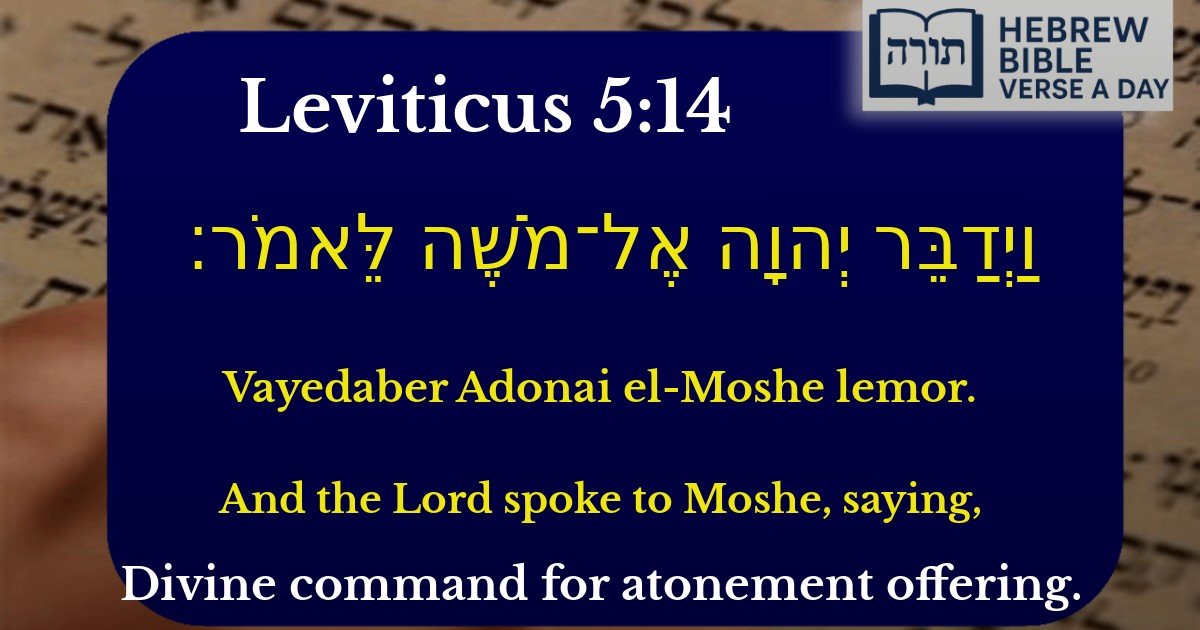

Leviticus 5:14 - Divine command for atonement offering.

Leviticus 5:14 - ויקרא 5:14

Hebrew Text

וַיְדַבֵּר יְהוָה אֶל־מֹשֶׁה לֵּאמֹר׃

English Translation

And the Lord spoke to Moshe, saying,

Transliteration

Vayedaber Adonai el-Moshe lemor.

Hebrew Leining Text

וַיְדַבֵּ֥ר יְהֹוָ֖ה אֶל־מֹשֶׁ֥ה לֵּאמֹֽר׃

🎵 Listen to leining

Parasha Commentary

The Divine Communication to Moshe

The phrase "וַיְדַבֵּר יְהוָה אֶל־מֹשֶׁה לֵּאמֹר" ("And the Lord spoke to Moshe, saying") appears frequently in the Torah, marking the transmission of divine commandments and teachings. Rashi (Shemot 6:2) notes that this expression emphasizes the direct and clear communication between Hashem and Moshe, distinguishing Moshe's prophetic level from that of other prophets.

The Significance of "לֵּאמֹר"

The word "לֵּאמֹר" ("saying") is interpreted in multiple ways by our Sages:

  • Rashi (Bereishit 1:1) explains that it indicates Moshe should relay the message to Bnei Yisrael, underscoring his role as the intermediary.
  • Rambam (Moreh Nevuchim 2:34) teaches that this phrasing highlights the precision of prophecy—Moshe received the exact words to convey without alteration.

The Unique Prophethood of Moshe

The Talmud (Yevamot 49b) elaborates that Moshe's prophecy was distinct in its clarity, as he received divine communication "פֶּה אֶל פֶּה" ("mouth to mouth"), unlike other prophets who experienced visions or allegories. The Midrash (Shemot Rabbah 28:6) adds that Moshe was like a trusted scribe, faithfully recording Hashem's words.

Context in the Torah

This phrase often introduces mitzvot or pivotal events. The Ohr HaChaim (Shemot 25:1) notes that each instance of divine speech to Moshe carries layers of meaning, including hidden lessons for future generations. The repetition of this phrase throughout the Torah reinforces the centrality of Moshe's role in transmitting the divine will.

📚 Talmud Citations

This verse is not quoted in the Talmud.

Frequently Asked Questions

Q: What does 'And the Lord spoke to Moshe, saying' mean in Leviticus 5:14?
A: This phrase is a common introduction in the Torah indicating that Hashem is giving a new commandment or instruction to Moshe (Moses) to transmit to the Jewish people. Rashi explains that this wording emphasizes the divine origin of the laws that follow.
Q: Why does the Torah keep repeating 'And the Lord spoke to Moshe'?
A: The repetition teaches us that each communication from Hashem to Moshe was a distinct event with its own importance. The Rambam explains that this shows Moshe didn't receive the Torah in one general prophecy, but each law was given separately with precise wording.
Q: What can we learn from the way Hashem spoke to Moshe?
A: We learn about the importance of clear communication in transmitting Torah. The Talmud (Yevamot 49b) teaches that Moshe was unique in that he heard Hashem's words with perfect clarity, unlike other prophets who received messages through visions or parables.
Q: Why is it important that the Torah specifies 'saying' after 'spoke'?
A: The Midrash (Sifra) explains that 'saying' implies Moshe was commanded to repeat these words exactly to the Jewish people. This teaches us the precision required in transmitting Torah teachings without adding or omitting anything.
Q: How does this verse connect to the laws that follow about sacrifices?
A: This introduction shows that the laws of sacrifices (korbanot) that follow are divine commandments, not human inventions. As the Rambam explains in Moreh Nevuchim, these laws have deep spiritual purposes even when we don't fully understand them.