

Join Our Newsletter To Be Informed When New Videos Are Posted
Hebrew Text
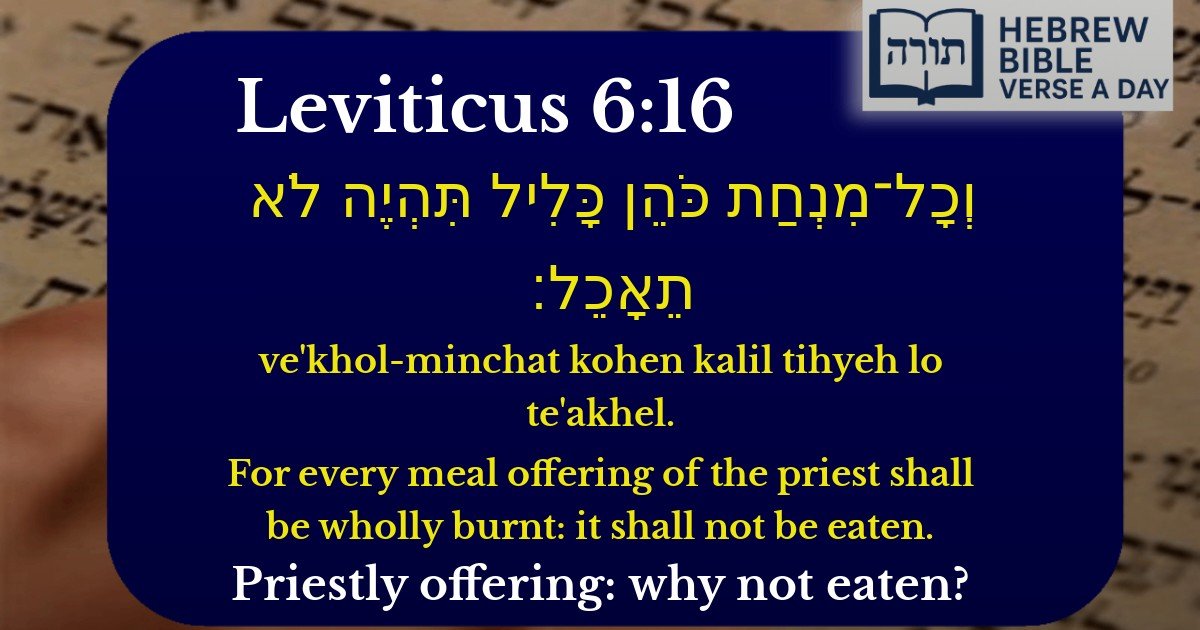
וְכָל־מִנְחַת כֹּהֵן כָּלִיל תִּהְיֶה לֹא תֵאָכֵל׃
English Translation
For every meal offering of the priest shall be wholly burnt: it shall not be eaten.
Transliteration
Ve'khol-minchat kohen kalil tihyeh lo te'akhel.
Hebrew Leining Text
וְכׇל־מִנְחַ֥ת כֹּהֵ֛ן כָּלִ֥יל תִּהְיֶ֖ה לֹ֥א תֵאָכֵֽל׃ {פ}
🎵 Listen to leining
Parasha Commentary
📚 Talmud Citations
This verse is quoted in the Talmud.
📖 Menachot 73b
The verse is discussed in the context of the laws regarding the meal offerings of priests, emphasizing that such offerings must be entirely burnt and not eaten.
📖 Zevachim 44a
The verse is referenced in a discussion about the different types of offerings and their respective laws, particularly focusing on the priestly meal offerings.
Understanding the Verse
The verse (Vayikra 6:16) states that the meal offering (minchat kohen) brought by a priest must be entirely burned on the altar and not eaten. This differs from other meal offerings, where a portion is given to the kohanim for consumption. Rashi explains that this refers specifically to the minchat chavitin, the daily meal offering brought by the Kohen Gadol (High Priest), which is entirely burned as a dedication to Hashem.
Halachic Implications
According to Rambam (Hilchot Ma'aseh HaKorbanot 13:8), this law applies to any voluntary meal offering brought by a regular kohen as well. Unlike communal or individual offerings where parts are eaten, the priest's personal offering is entirely consecrated to Hashem. The Talmud (Menachot 73a) derives this from the phrase "כָּלִיל תִּהְיֶה" ("shall be wholly burnt"), emphasizing its complete dedication.
Symbolic Meaning
The Midrash (Torat Kohanim) suggests that since the kohen serves as an intermediary between Bnei Yisrael and Hashem, his personal offering must reflect total devotion, with no personal benefit. This teaches that spiritual leaders must demonstrate complete selflessness in their service.
Practical Applications