Frequently Asked Questions
Q: What does Leviticus 6:23 mean when it says a sin offering should not be eaten but burned?
A: Leviticus 6:23 teaches that certain sin offerings (חַטָּאת) whose blood was brought into the Tent of Meeting for atonement could not be eaten by the kohanim (priests) like other offerings. Instead, they had to be completely burned. Rashi explains that this applies specifically to the inner sin offerings (like those of Yom Kippur), where the blood was brought into the Kodesh (Holy Place). Since these offerings achieved a higher level of atonement, they were entirely dedicated to Hashem and not consumed.
Q: Why is the burning of certain sin offerings important in Judaism?
A: The burning of certain sin offerings (as commanded in Leviticus 6:23) emphasizes the seriousness of atonement and the complete dedication of these sacrifices to Hashem. The Rambam (Hilchot Maaseh HaKorbanot) explains that offerings with the highest level of sanctity—those brought into the inner sanctuary—must be entirely consumed by fire, showing that their purpose is solely for spiritual rectification and not for human benefit.
Q: What can we learn from Leviticus 6:23 today, even though we no longer bring sacrifices?
A: Although we no longer bring sacrifices, Leviticus 6:23 teaches us about the gravity of repentance and spiritual purity. The Talmud (Berachot 17a) explains that today, prayer and sincere teshuvah (repentance) replace sacrifices. Just as certain offerings were entirely given to Hashem, we too should approach repentance with complete sincerity, dedicating ourselves wholly to spiritual improvement.
Q: Which sin offerings had to be burned, and which could be eaten by the kohanim?
A: According to Rashi and the Talmud (Zevachim 83b), sin offerings where the blood was sprinkled inside the Tent of Meeting (like those of Yom Kippur or a communal sin offering) had to be completely burned. However, other sin offerings (such as those for an individual's unintentional sin) were partially eaten by the kohanim, as their blood was only placed on the outer altar (Mizbeach HaChitzon).
Q: How does the Torah's command to burn certain offerings relate to holiness?
A: The Torah (Leviticus 6:23) teaches that offerings with the highest degree of sanctity—those brought into the Kodesh—must be burned, symbolizing their complete devotion to Hashem. The Midrash (Vayikra Rabbah 7:3) compares this to how holiness requires separation from physical use. Just as these offerings were not eaten but entirely given to Hashem, we learn that true kedushah (holiness) sometimes requires setting things apart for a higher purpose.

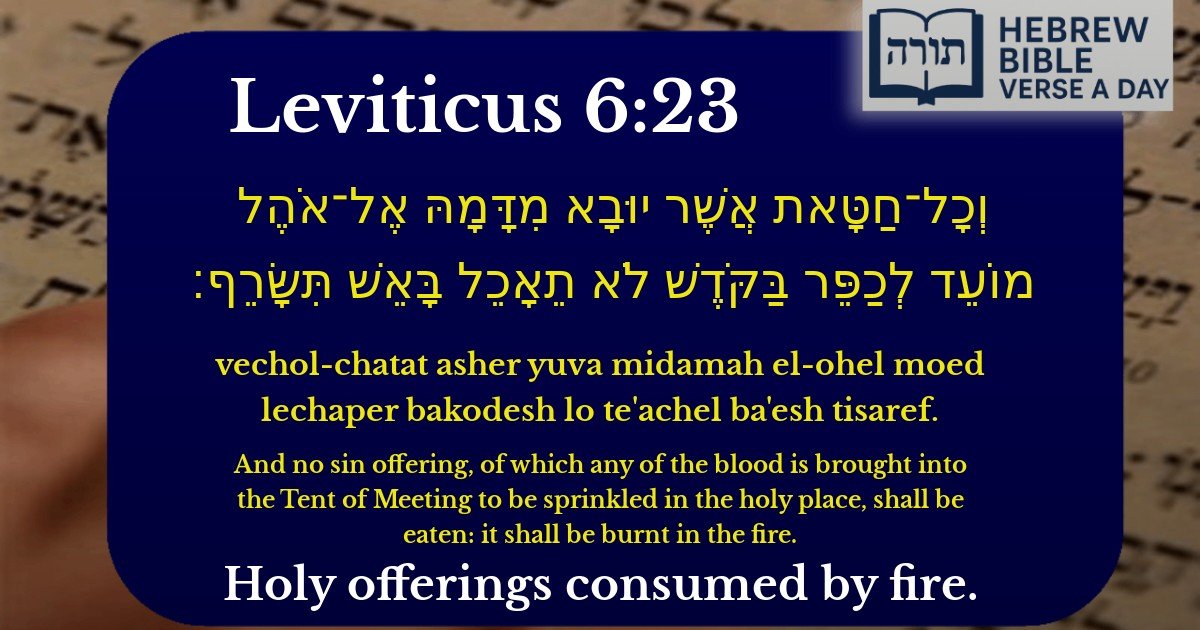

General Context of the Verse
This verse (Vayikra 6:23) discusses the laws pertaining to certain chatat (sin offerings) whose blood is brought into the Ohel Moed (Tent of Meeting) for atonement. Unlike other sin offerings that may be eaten by the kohanim (priests), these offerings must be entirely burned in fire and not consumed.
Rashi's Explanation
Rashi (Vayikra 6:23) clarifies that this ruling applies specifically to the chatat offerings of the kohen gadol (high priest) and the community (tzibbur), such as the sin offering brought on Yom Kippur or for communal idolatry. Since their blood is brought into the Kodesh (the inner sanctum), their meat cannot be eaten and must be burned outside the camp.
Rambam's Halachic Perspective
In Hilchot Maaseh HaKorbanot (10:7), the Rambam codifies this law, stating that any sin offering whose blood is sprinkled in the Kodesh (such as the inner altar or the Parochet curtain) is entirely burned and not eaten. This includes the sin offerings of Yom Kippur and those brought for certain severe communal sins.
Reasoning Behind the Law
The Sefer HaChinuch (Mitzvah 124) explains that these offerings attain a higher level of sanctity due to the entry of their blood into the innermost parts of the Mishkan. As a result, their meat is too holy to be consumed and must be burned, similar to the notar (leftover sacrificial meat) that becomes disqualified.
Midrashic Insight
The Torat Kohanim (Sifra, Vayikra 6:23) emphasizes that this law teaches the gravity of atonement—when the sin is severe enough to require blood in the Kodesh, the entire offering is devoted to purification and cannot be treated as ordinary priestly food.
Practical Implications