Frequently Asked Questions
Q: What is the 'meal offering' (mincha) mentioned in Leviticus 6:7?
A: The 'meal offering' (mincha) is one of the sacrifices described in the Torah, made from fine flour, oil, and frankincense. Unlike animal sacrifices, it is a vegetarian offering. Rashi explains that this verse specifies the proper procedure for the kohanim (priests, the sons of Aharon) when offering it on the altar.
Q: Why does the verse specify that the sons of Aharon must bring the meal offering?
A: The Torah designates the kohanim (descendants of Aharon) as the only ones permitted to perform sacrificial services in the Mishkan (Tabernacle) and later the Temple. Rambam (Hilchot Ma'aseh HaKorbanot) explains that this emphasizes the unique role of the kohanim in facilitating the connection between the Jewish people and Hashem through the Temple service.
Q: What is the significance of offering the mincha 'before the Lord, before the altar'?
A: The double language ('before the Lord, before the altar') teaches that the offering must be brought with proper intent (kavanah) as if standing directly before Hashem, not just performing a ritual act. The Talmud (Menachot 13a) derives from this that sacrifices require proper focus and sincerity to be valid.
Q: Are there any practical lessons we can learn today from the laws of the meal offering?
A: Yes! Though we currently lack the Temple, the mincha teaches important values: 1) Simple flour offerings show that even modest gifts are precious when given sincerely (Midrash Vayikra Rabba 3:1). 2) The kohanim's role reminds us to respect Torah leadership. 3) The emphasis on proper intent teaches that our mitzvot should be done with full devotion.
Q: What was the purpose of the frankincense added to the meal offering?
A: Rashi (on Leviticus 2:1) explains that the frankincense (levonah) was a fragrant spice added to give the offering a pleasant smell. The Talmud (Menachot 20a) teaches that this represents the importance of adding beauty and dignity to mitzvot. Just as the smell enhanced the offering, we should perform mitzvot in the most beautiful way possible.

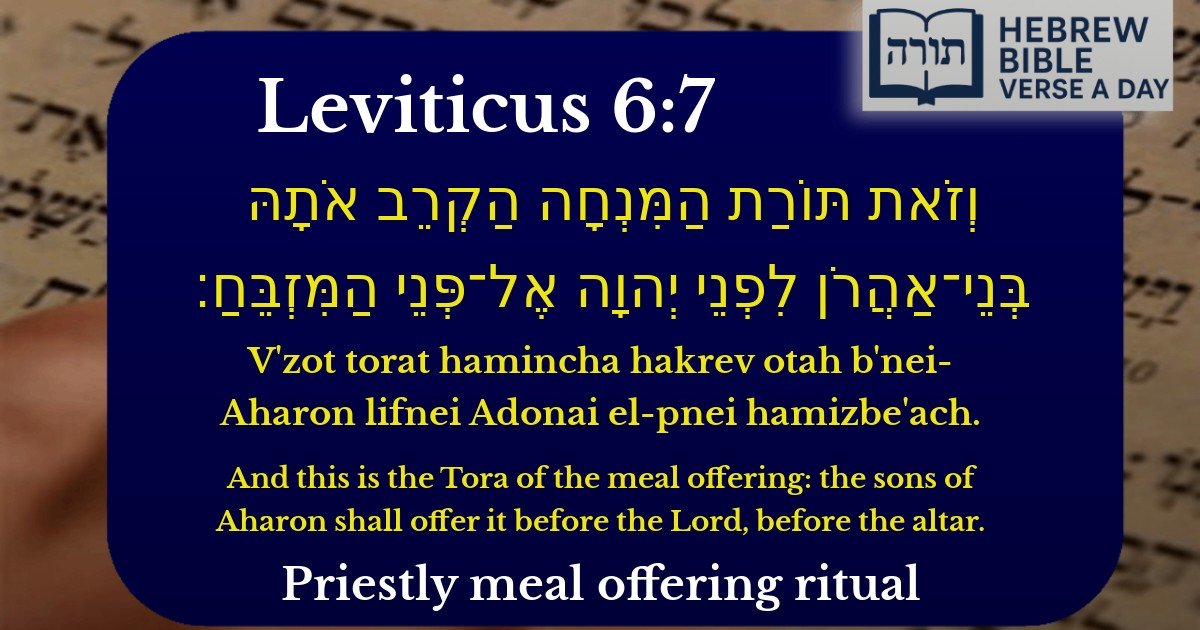

The Meaning of "Torat HaMincha"
The verse begins with "זֹאת תּוֹרַת הַמִּנְחָה" ("This is the Torat HaMincha"), emphasizing that the meal offering has its own unique set of laws and procedures. Rashi (Vayikra 6:7) explains that the term Torah here refers to the detailed instructions governing how the mincha (meal offering) must be prepared and offered. Unlike animal sacrifices, which involve slaughter, the mincha consists of fine flour, oil, and frankincense, requiring different halachic guidelines.
The Role of the Kohanim
The verse specifies that the sons of Aharon—the kohanim—must bring the offering "before Hashem, before the altar." The Sifra (Torat Kohanim) notes that this underscores the exclusive role of the kohanim in handling offerings. The Rambam (Hilchot Ma'aseh HaKorbanot 9:1) elaborates that while a non-kohen may contribute a mincha, only a kohen may perform the actual service of offering it on the altar.
Symbolism of the Mincha Offering
The Midrash (Vayikra Rabbah 3:1) teaches that the mincha represents humility, as it consists of simple flour rather than a costly animal. The Kli Yakar (Vayikra 2:1) adds that the fine flour symbolizes refinement of character, while the oil represents wisdom—both necessary for proper service of Hashem. The frankincense, which emits a pleasant fragrance, alludes to the hidden righteous deeds that bring merit even when unnoticed by others.
Halachic Details