
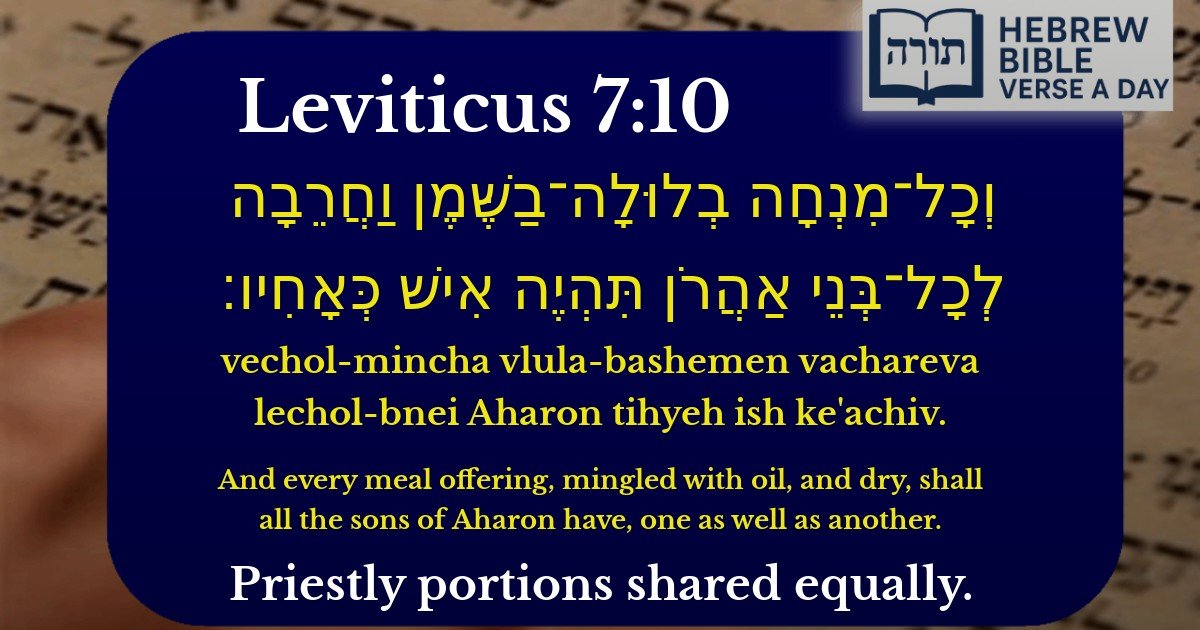

Leviticus 7:10 - Priestly portions shared equally.

Leviticus 7:10 - ויקרא 7:10

Hebrew Text

וְכָל־מִנְחָה בְלוּלָה־בַשֶּׁמֶן וַחֲרֵבָה לְכָל־בְּנֵי אַהֲרֹן תִּהְיֶה אִישׁ כְּאָחִיו׃

English Translation

And every meal offering, mingled with oil, and dry, shall all the sons of Aharon have, one as well as another.

Transliteration

Vechol-mincha vlula-bashemen vachareva lechol-bnei Aharon tihyeh ish ke'achiv.

Hebrew Leining Text

וְכׇל־מִנְחָ֥ה בְלוּלָֽה־בַשֶּׁ֖מֶן וַחֲרֵבָ֑ה לְכׇל־בְּנֵ֧י אַהֲרֹ֛ן תִּהְיֶ֖ה אִ֥ישׁ כְּאָחִֽיו׃ {פ}

🎵 Listen to leining

Parasha Commentary

Verse Context

The verse (Vayikra 7:10) discusses the distribution of the mincha (meal offering) among the kohanim (priests), specifically the sons of Aharon. It emphasizes that all priests share equally in this offering, whether it is mixed with oil (belulah ba-shemen) or dry (charavah).

Rashi's Explanation

Rashi (Vayikra 7:10) clarifies that the phrase "one as well as another" (ish ke-achiv) teaches that all priests receive an equal portion, regardless of the type of mincha. This ensures fairness in distribution, preventing disputes among the kohanim.

Rambam's Perspective

In Hilchos Maaseh HaKorbanos (10:12), the Rambam codifies this law, stating that all meal offerings—whether brought by an individual or the community—are divided equally among the priests serving in the Temple at that time.

Talmudic Insights

  • Menachos 73a: The Talmud discusses the equal distribution principle, emphasizing that even a newly appointed kohen receives a share alongside veteran priests.
  • Chullin 132b: Expands on the phrase "belulah ba-shemen", explaining that it refers to offerings mixed with oil before baking, while "charavah" refers to offerings prepared without oil.

Midrashic Interpretation

The Sifra (Torat Kohanim) connects this verse to the broader theme of unity among the priesthood. By ensuring equal shares, the Torah fosters harmony, reflecting the ideal that all descendants of Aharon are equally worthy of their sacred role.

Practical Halachic Implications

This verse establishes a foundational principle in halacha: communal offerings are distributed without favoritism. The Shulchan Aruch (Yoreh De'ah 128) later applies this concept to other priestly gifts (terumah and maaser), reinforcing equitable treatment.

📚 Talmud Citations

This verse is not quoted in the Talmud.

Frequently Asked Questions

Q: What does Leviticus 7:10 mean?
A: Leviticus 7:10 teaches that all meal offerings (minchah) brought in the Temple—whether mixed with oil (blulah) or dry (charavah)—must be shared equally among the sons of Aharon (the Kohanim). Rashi explains that this emphasizes fairness, ensuring no Kohen receives preferential treatment in the distribution of offerings.
Q: Why is this verse important?
A: This verse highlights the principle of equality among Kohanim in Temple service. The Rambam (Hilchos Maaseh HaKorbanos 10:4) derives from here that all Kohanim have equal rights to portions of certain offerings, reinforcing unity and preventing disputes among those serving in the Mishkan (and later the Temple).
Q: What can we learn from Leviticus 7:10 today?
A: Though we no longer bring meal offerings, the message of equitable treatment remains relevant. The Talmud (Yoma 18a) applies this principle to other areas of communal life, teaching that leaders must distribute resources fairly. This inspires us to practice fairness in our own communities.
Q: Why does the Torah specify both oil-mixed and dry offerings?
A: The Midrash (Toras Kohanim) notes that this inclusive language teaches that all types of minchah offerings—regardless of preparation method—follow the same distribution rules. This prevents anyone from claiming certain offerings should be treated differently.
Q: How does 'one as well as another' apply practically?
A: The Talmud (Menachos 73a) explains this means portions must be divided precisely, not favoring senior or junior Kohanim. The Shulchan Aruch (Yoreh Deah 61:22) later applies this concept to other priestly gifts (terumah), showing how Torah principles extend beyond Temple service.