Frequently Asked Questions
Q: What does Leviticus 7:14 mean?
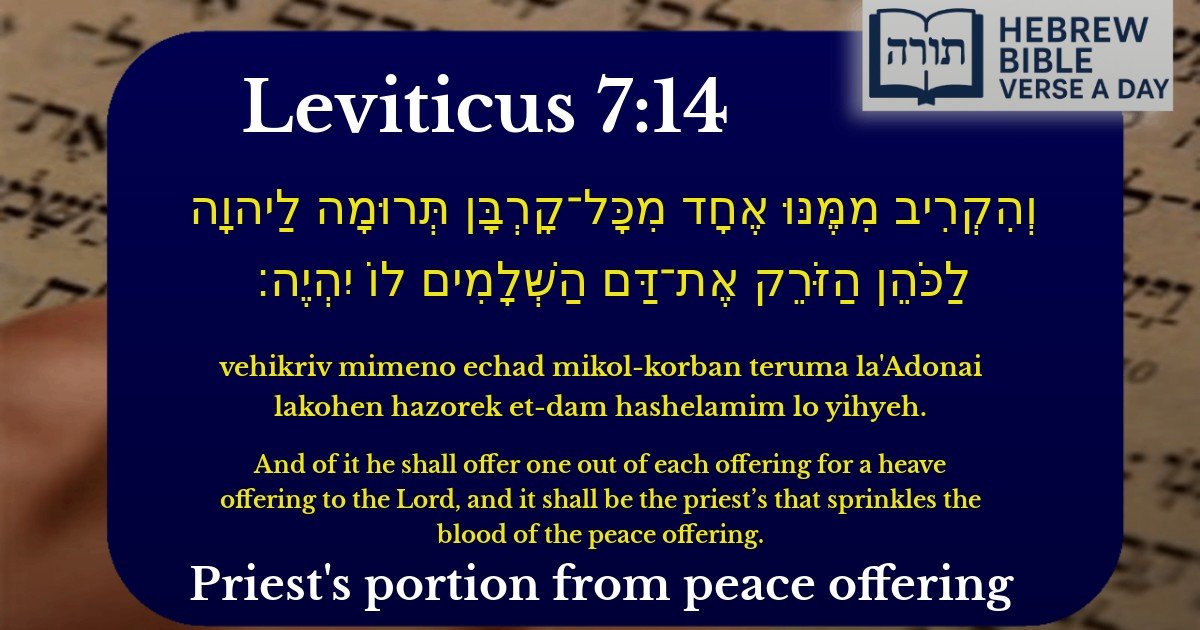
A: Leviticus 7:14 describes the portion of a peace offering (שלמים) that is given to the Kohen (priest). The verse teaches that from every peace offering brought, one part is separated as a 'terumah' (heave offering) to Hashem, and this portion is given to the Kohen who performs the sprinkling of the blood during the sacrifice.
Q: Why is the priest given a portion of the peace offering?
A: The Torah assigns portions of certain sacrifices to the Kohanim (priests) as their due for serving in the Mishkan (Tabernacle) and later the Beit HaMikdash (Temple). This teaches the importance of supporting those who dedicate their lives to divine service, as explained in the Talmud (Chullin 132a) and Rambam's Mishneh Torah (Hilchot Ma'aseh HaKorbanot).
Q: What is a 'peace offering' (שלמים) in the Torah?
A: A peace offering (שלמים) is a voluntary sacrifice expressing gratitude, fulfillment of a vow, or general thanksgiving to Hashem. Unlike other offerings, parts are given to the altar, the Kohen, and the owner, symbolizing peace (שלום) between Hashem, the priests, and the Jewish people, as Rashi and the Midrash (Vayikra Rabbah 9:7) explain.
Q: How does this verse apply today without the Temple?
A: While we cannot bring sacrifices today, the principle of supporting Torah scholars and communal leaders—like the Kohanim—remains. The Rambam (Hilchot Matnot Aniyim 10:1) teaches that giving to those who serve spiritual roles fulfills a similar ideal. Additionally, we recite prayers and perform acts of kindness as substitutes for sacrifices (Hoshea 14:3, Talmud Berachot 26b).
Q: What is the significance of the priest receiving the 'heave offering' (תרומה)?
A: The 'terumah' (heave offering) elevates the sacrifice by designating a portion specifically for Hashem's service through the Kohen. Rashi (on Leviticus 7:14) notes that this honors the Kohen's role in facilitating atonement and connection to Hashem. It also reminds us that material possessions should be used for holiness, as taught in the Mishnah (Avot 3:8): 'Give to Him of what is His, for you and yours are His.'


Context in Vayikra (Leviticus)
The verse (Vayikra 7:14) discusses the portion of the shelamim (peace offering) that is designated as terumah (a heave offering) for Hashem, given to the kohen (priest) who performs the sacrificial service. The shelamim is unique among offerings because parts are given to the altar, the kohanim, and the owner, symbolizing peace and shared sanctity.
Rashi's Explanation
Rashi (Vayikra 7:14) clarifies that the phrase "מִכָּל־קָרְבָּן" ("from each offering") refers to one of each type of bread or cake accompanying the shelamim (as detailed in Vayikra 7:12-13). The kohen who sprinkles the blood receives this portion as his due for performing the service. Rashi emphasizes that this allocation ensures the kohanim are sustained in their sacred duties (cf. Bamidbar 18:8).
Rambam on Priestly Portions
In Hilchot Maaseh HaKorbanot (9:15), the Rambam codifies this law, stating that the terumah from the shelamim is given specifically to the kohen who actively participates in the blood ritual. This reinforces the principle that mitzvot require action (mitzvah ha-ba'ah ba'avera), and the laborer is entitled to his share (Pirkei Avot 3:15).
Talmudic and Midrashic Insights
Symbolism of the Shelamim
The Or HaChaim (Vayikra 7:14) notes that the shelamim represents harmony between the divine, the priests, and the people. By allocating a portion to the kohen, the Torah teaches that those who facilitate closeness to Hashem (korban) must be honored materially and spiritually, as in the case of the Levites (Devarim 18:1-2).