Frequently Asked Questions
Q: Why does the Torah prohibit eating blood?
A: The Torah prohibits eating blood because blood represents the life force (nefesh) of an animal (Leviticus 17:11). Rashi explains that consuming blood is akin to consuming the animal's soul, which is sacred to Hashem. The Rambam (Hilchot Ma'achalot Asurot 6:1) also states that this prohibition teaches us respect for life and reinforces the sanctity of all living creatures.
Q: Does the prohibition against eating blood apply today?
A: Yes, the prohibition against eating blood remains in effect today. The Shulchan Aruch (Yoreh De'ah 66) details the laws of kashering meat to remove blood through salting or roasting. This mitzvah is observed by kosher-keeping Jews worldwide, ensuring no blood is consumed according to halacha (Jewish law).
Q: What types of blood are forbidden according to this verse?
A: The verse explicitly prohibits blood from birds and domesticated animals (behemah). The Talmud (Chullin 117a) expands this to include wild animals (chayah) as well. However, fish blood is not included in this prohibition (Talmud Keritot 21b) as they are a different category of creature.
Q: How do we remove blood from meat to make it kosher?
A: There are two primary methods to remove blood: salting (melicha) and roasting (tzli). The Shulchan Aruch (Yoreh De'ah 69) explains that meat must be soaked for 30 minutes, covered with coarse salt for an hour, then rinsed three times. Alternatively, roasting draws out the blood through fire. Both methods must be done according to halachic guidelines.
Q: What's the spiritual reason behind not eating blood?
A: The Sefer HaChinuch (Mitzvah 148) explains that avoiding blood elevates us spiritually by distancing us from cruelty and violence. Since blood represents life, abstaining from it reminds us that life belongs to Hashem. The Midrash (Vayikra Rabbah 22:6) also connects this to developing self-control and holiness in our eating habits.

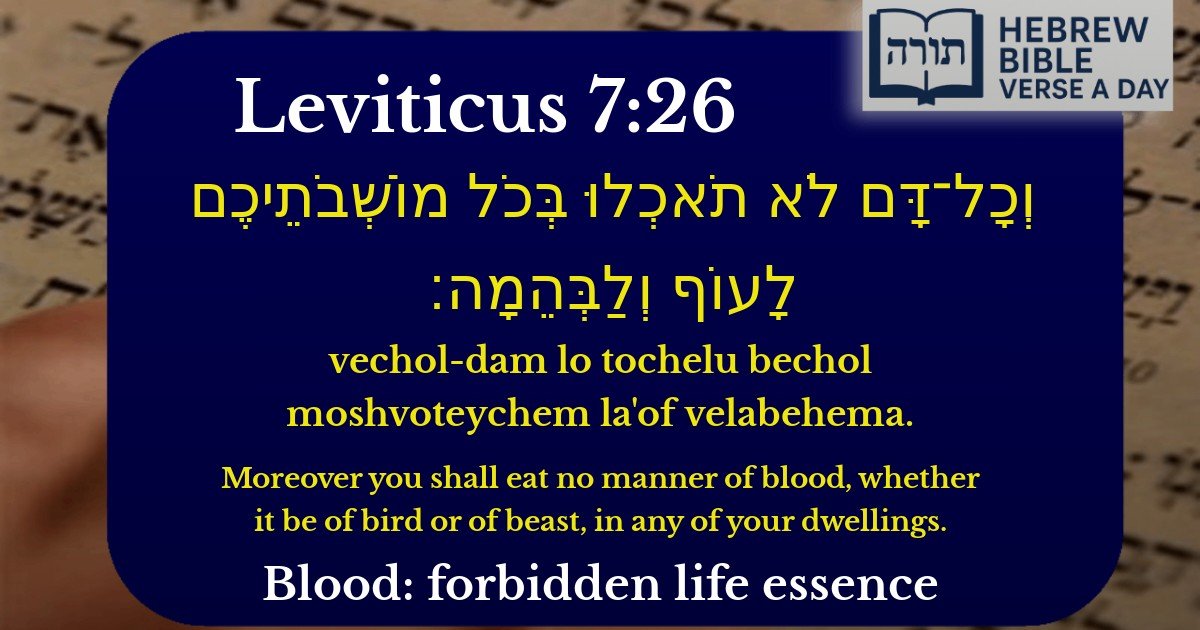

Prohibition of Consuming Blood
The verse (Vayikra 7:26) states: "Moreover you shall eat no manner of blood, whether it be of bird or of beast, in any of your dwellings." This prohibition is one of the fundamental dietary laws in Judaism, emphasizing the sanctity of blood as the life-force of a creature.
Rashi's Explanation
Rashi comments on this verse that the prohibition applies to all types of blood, whether from domesticated animals (behemah), wild animals (chayah), or birds (of). He further clarifies that the phrase "in any of your dwellings" extends the prohibition beyond the boundaries of the Beit HaMikdash (Temple), applying it universally in all Jewish homes.
Rambam's Perspective
In Mishneh Torah (Hilchot Ma'achalot Asurot 6:1), the Rambam elaborates that consuming blood is a severe transgression, punishable by karet (spiritual excision). He explains that blood represents the soul (nefesh) of the animal, as stated in Devarim 12:23: "For the blood is the life." Thus, consuming blood is akin to consuming the life-force itself, which is reserved for Hashem alone.
Midrashic Insights
The Midrash (Torat Kohanim) connects this prohibition to the episode of Kayin and Hevel, where bloodshed first corrupted the world. By abstaining from blood, Jews affirm the sanctity of life and distance themselves from violence and cruelty.
Practical Halachic Implications
Philosophical Significance
The Sefer HaChinuch (Mitzvah 148) explains that this law trains Jews to respect life and recognize Hashem's dominion over it. By refraining from blood—the symbol of life—we internalize humility and gratitude for the gift of existence.