

Join Our Newsletter To Be Informed When New Videos Are Posted
Hebrew Text
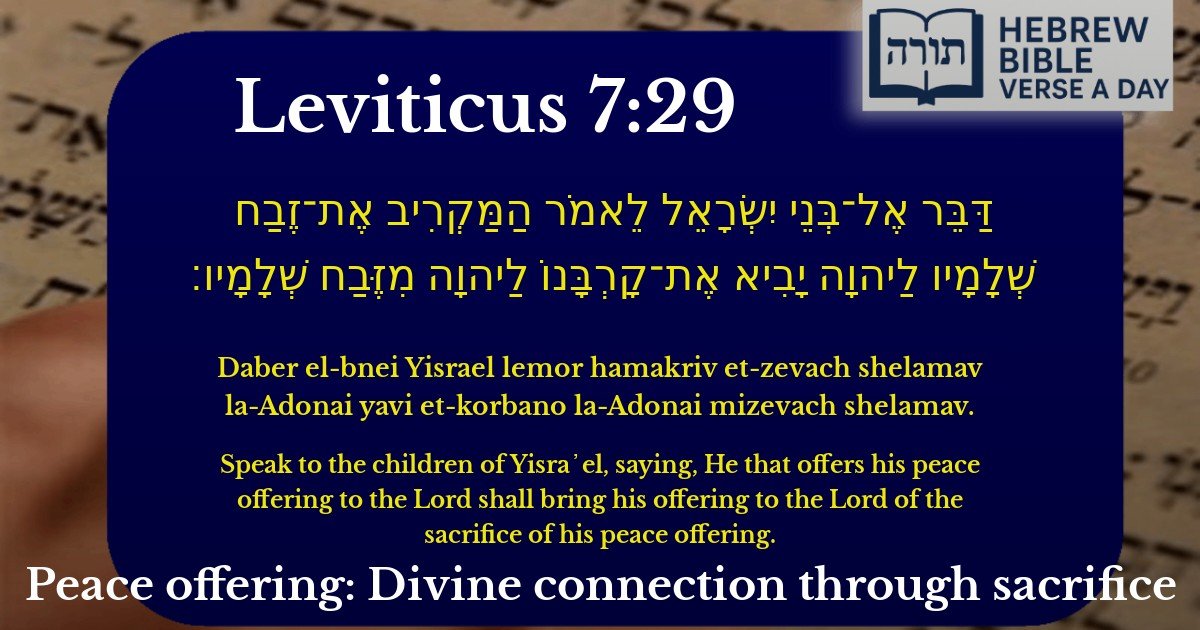
דַּבֵּר אֶל־בְּנֵי יִשְׂרָאֵל לֵאמֹר הַמַּקְרִיב אֶת־זֶבַח שְׁלָמָיו לַיהוָה יָבִיא אֶת־קָרְבָּנוֹ לַיהוָה מִזֶּבַח שְׁלָמָיו׃
English Translation
Speak to the children of Yisra᾽el, saying, He that offers his peace offering to the Lord shall bring his offering to the Lord of the sacrifice of his peace offering.
Transliteration
Daber el-bnei Yisrael lemor hamakriv et-zevach shelamav la-Adonai yavi et-korbano la-Adonai mizevach shelamav.
Hebrew Leining Text
דַּבֵּ֛ר אֶל־בְּנֵ֥י יִשְׂרָאֵ֖ל לֵאמֹ֑ר הַמַּקְרִ֞יב אֶת־זֶ֤בַח שְׁלָמָיו֙ לַיהֹוָ֔ה יָבִ֧יא אֶת־קׇרְבָּנ֛וֹ לַיהֹוָ֖ה מִזֶּ֥בַח שְׁלָמָֽיו׃
🎵 Listen to leining
Parasha Commentary
📚 Talmud Citations
This verse is quoted in the Talmud.
📖 Menachot 61b
The verse is discussed in the context of the laws of peace offerings and the proper way to bring sacrifices to the Lord.
📖 Zevachim 5a
The verse is referenced in a discussion about the types of offerings and the specific requirements for peace offerings.
Overview of the Verse
The verse (Vayikra 7:29) discusses the laws of the zevach shelamim (peace offering), a voluntary sacrifice brought to express gratitude, fulfill a vow, or as a freewill offering. The Torah emphasizes that the one bringing this offering must present it properly before Hashem.
Rashi's Explanation
Rashi notes that the phrase "מִזֶּבַח שְׁלָמָיו" ("from the sacrifice of his peace offerings") teaches that the owner must bring the offering from his own possessions, not stolen or improperly acquired animals. This reinforces the principle that mitzvot must be performed with integrity (mitzvah haba'ah ba'aveira—a mitzvah fulfilled through sin is invalid).
Rambam's Perspective
In Hilchot Ma'aseh HaKorbanot (Laws of Sacrificial Procedure), the Rambam explains that the peace offering symbolizes harmony (shalom) between a person and Hashem. Unlike other sacrifices, parts of the shelamim are eaten by the owner, the kohanim, and the altar, representing shared sanctity and gratitude.
Midrashic Insight
The Midrash (Vayikra Rabbah 9:7) connects the term shelamim to shalom (peace), teaching that this offering brings peace to the world. It also notes that the repetition of "לַיהוָה" ("to the Lord") underscores that the sacrifice must be brought with pure intent, solely for Divine service.
Halachic Implications
Symbolic Meaning
The shelamim represents a person's desire to draw closer to Hashem while also sharing with others (through communal meals). The Talmud (Chullin 84a) notes that this sacrifice fosters unity, as it is often eaten in groups, embodying the ideal of ahavat Yisrael.