Frequently Asked Questions
Q: What does Leviticus 7:9 mean?
A: Leviticus 7:9 explains that certain types of meal offerings (minchah) baked in an oven, cooked in a pan, or prepared on a griddle belong to the kohen (priest) who brings the offering. This is part of the Torah's laws regarding the portions given to the kohanim for their service in the Mishkan (Tabernacle) and later the Beit HaMikdash (Temple).
Q: Why is this verse important?
A: This verse is important because it establishes the rights of the kohanim (priests) to receive specific portions of the offerings. The Torah teaches that since the kohanim dedicate their lives to serving Hashem and the Jewish people, they are entitled to these portions as their sustenance (see Rambam, Hilchot Ma'aseh HaKorbanot 10:1).
Q: What can we learn from Leviticus 7:9 today?
A: Even though we do not currently bring offerings, we learn the principle of supporting those who devote themselves to spiritual service. Today, this applies to supporting Torah scholars and community leaders, ensuring they can focus on their sacred work (see Talmud, Ketubot 105b).
Q: What is the difference between an oven-baked, pan-cooked, and griddle-prepared offering?
A: Rashi (on Leviticus 7:9) explains that these refer to different preparation methods of the meal offering (minchah). 'Baked in the oven' refers to thick loaves, 'dressed in the frying pan' refers to deep-fried cakes, and 'on the griddle' refers to thin wafers. Each type was given to the kohen who brought it.
Q: Did all meal offerings belong to the kohanim?
A: No, not all meal offerings were given entirely to the kohanim. Some, like the Minchat Chotei (sin offering) or Minchat Sotah (suspected adulteress offering), were completely burned on the altar. Leviticus 7:9 specifically refers to voluntary meal offerings, where the kohen received a portion (see Rambam, Hilchot Ma'aseh HaKorbanot 10:3).


Overview of the Verse
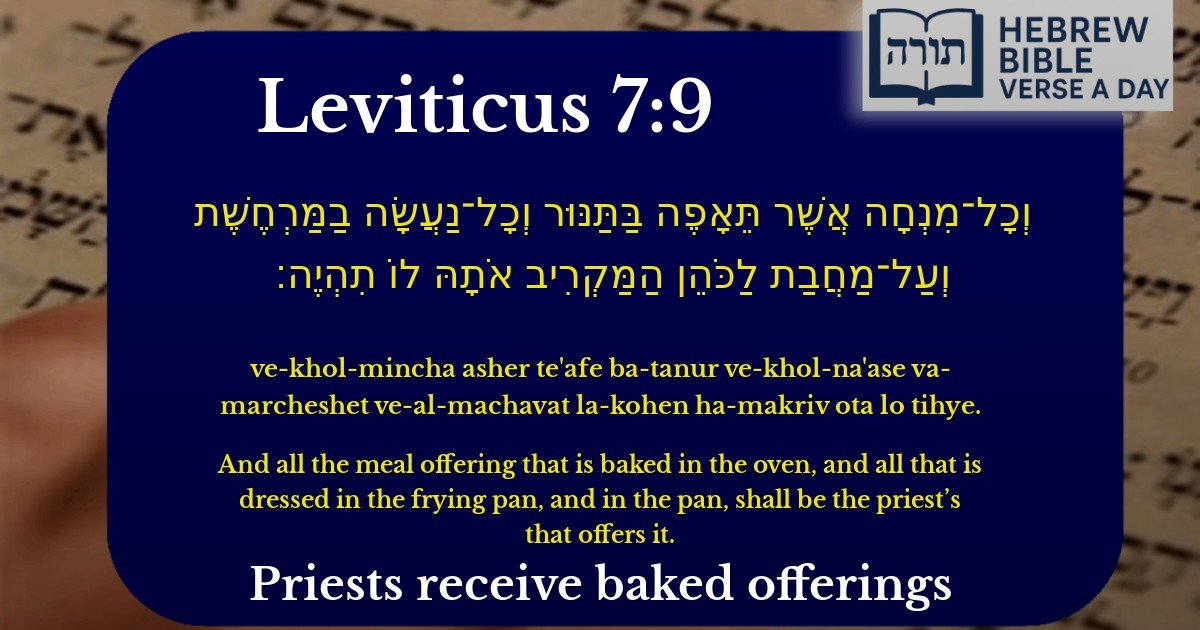
The verse (Vayikra 7:9) discusses the distribution of various types of minchah (meal offerings) to the kohanim (priests). It specifies that meal offerings baked in an oven, prepared in a marcheshet (frying pan), or cooked on a machavat (griddle) belong to the kohen who performs the sacrificial service.
Rashi's Commentary
Rashi explains that this verse refers to the minchah offerings brought by individuals, not the communal offerings. He clarifies that the marcheshet is a deep pan used for frying, while the machavat is a flat griddle. The kohen who actually performs the hakravah (sacrificial service) is entitled to these portions, not just any kohen on duty.
Rambam's Explanation
In Hilchos Ma'aseh HaKorbanos (Laws of Sacrificial Procedures), the Rambam elaborates that these meal offerings are part of the matnot kehunah (priestly gifts). The kohen who offers the minchah receives it as compensation for his service, reinforcing the principle that those who serve in the Beit HaMikdash are supported by their sacred duties.
Talmudic Insights
Midrashic Perspective
The Sifra (Torat Kohanim) connects this verse to the broader theme of hakaras hatov (gratitude). Just as the kohen is rewarded for his service, we learn the importance of recognizing and compensating those who dedicate themselves to spiritual labor.
Halachic Implications
This verse establishes practical halachah regarding the rights of kohanim. The Shulchan Aruch (Yoreh De'ah 129) codifies that these portions are given exclusively to the officiating kohen, ensuring orderly distribution of priestly gifts in the Beit HaMikdash.