Frequently Asked Questions
Q: What is a 'wave offering' (tenufah) in Leviticus 8:27?
A: A 'wave offering' (tenufah) is a ritual where the kohen (priest) moves a sacrifice in a waving motion—forward and backward or up and down—before Hashem. Rashi explains this symbolizes dedicating the offering to Heaven (upward) and Earth (downward), showing it is for the sake of the Divine. This was done during the consecration of Aharon and his sons as kohanim.
Q: Why did Moshe place the offerings on Aharon and his sons' hands in Leviticus 8:27?
A: Moshe placed the offerings on their hands to involve them directly in the service, as this was part of their initiation as kohanim (priests). The Ramban teaches that this act symbolized transferring authority and sanctity to them, showing they were now responsible for performing the avodah (Temple service) before Hashem.
Q: What can we learn from the wave offering in Leviticus 8:27 today?
A: Though we no longer bring sacrifices, the wave offering teaches the importance of dedicating our actions to Hashem. The Midrash (Vayikra Rabbah) connects this to using our 'hands'—our physical efforts—for holiness. Today, this reminds us to direct our work, food (like waving challah on Shabbat), and resources toward spiritual purposes.
Q: Why were Aharon and his sons waving the offerings themselves in this verse?
A: The Talmud (Menachot 61a) notes that typically, the kohen would wave the offering, but here Moshe guided their hands because they were not yet fully consecrated. This highlights the transitional moment of their initiation—Moshe, as their teacher, assisted them until they could serve independently.
Q: What was included in the 'all' that was waved in Leviticus 8:27?
A: Rashi explains that 'all' refers to the fats and organs of the ram of consecration (along with matzah), which were placed on Aharon and his sons' hands. These parts were later burned on the altar (Vayikra 8:28), while the meat was eaten by the kohanim, symbolizing their sustenance from holy service.

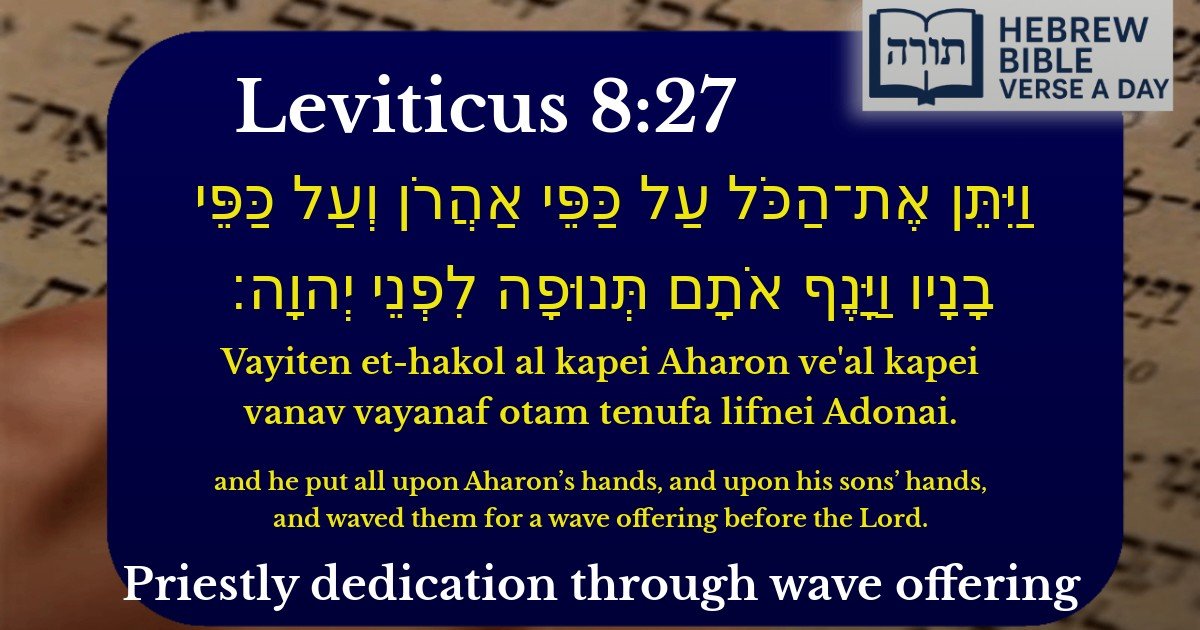

The Wave Offering (Tenufah) in the Consecration of Aharon and His Sons
The verse describes Moshe placing the offerings upon the hands of Aharon and his sons and waving them as a tenufah (wave offering) before Hashem. This act was part of the consecration ceremony for the Kohanim (Vayikra 8:27). Rashi explains that the tenufah involved moving the offering forward and backward, as well as upward and downward, symbolizing dedication to Hashem, who controls all directions of the universe.
Symbolism of the Wave Offering
According to the Rambam (Moreh Nevuchim 3:46), the tenufah represents the acknowledgment that all offerings belong to Hashem and are merely entrusted to human hands. The Talmud (Menachot 61b) further elaborates that the waving motion signifies:
The Role of Aharon and His Sons
The Midrash Tanchuma (Tzav 14) emphasizes that the placement of the offerings on Aharon’s and his sons’ hands signifies their acceptance of the Kehunah (priesthood) and its responsibilities. The Kli Yakar adds that the act of waving together reinforced the unity of the priesthood, showing that their service was a collective duty before Hashem.
Practical Halachic Implications
The Shulchan Aruch (Yoreh De’ah 128) discusses the laws of tenufah, noting that while the wave offering was primarily a Temple ritual, its principles extend to other mitzvos involving dedication to Hashem. The Mishneh Torah (Hilchos Ma’aseh HaKorbanos 9:6) further clarifies that the Kohen’s physical act of waving was a necessary component of the offering’s validity.