Frequently Asked Questions
Q: What does Leviticus 8:28 mean?
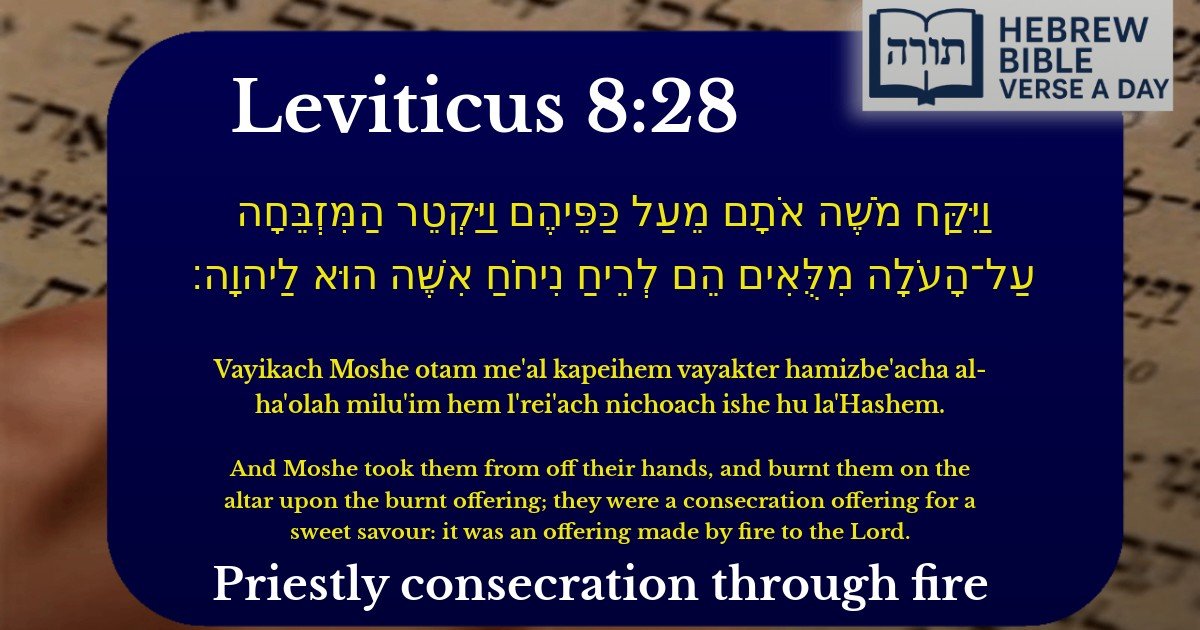
A: Leviticus 8:28 describes part of the consecration ceremony for Aaron and his sons as Kohanim (priests). Moshe takes portions of the ram of consecration (מִלֻּאִים) from their hands and burns them on the altar along with the burnt offering (עֹלָה). This symbolizes complete dedication to serving Hashem, as the offering ascends in smoke ('a sweet savor') to heaven. Rashi explains that the term 'מִלֻּאִים' refers to filling the hands of the priests with their new priestly responsibilities.
Q: Why was the offering called 'a sweet savor'?
A: The phrase 'רֵיחַ נִיחֹחַ' (sweet savor) signifies that the offering was pleasing to Hashem. According to Ramban, this doesn't mean G-d literally smells the sacrifice; rather, it symbolizes human beings fulfilling His will with complete devotion. The Talmud (Menachot 110a) teaches that whether one brings a large or small offering, what matters most is directing one's heart to Heaven.
Q: What can we learn from the consecration ceremony in this verse?
A: This verse teaches the importance of dedication in divine service. Just as Aaron and his sons were consecrated through specific rituals, we learn from Chassidic thought (e.g., Tanya) that every Jew has a 'inner Kohen'—a spark of holiness to elevate mundane actions into divine service. The burning of the offering represents transforming physicality into spirituality, a key concept in Jewish worship.
Q: How does this apply today without the Temple?
A: Though we lack the Temple today, the Rambam (Hilchot Me'ilah 8:8) teaches that studying the laws of sacrifices has merit akin to bringing them. Additionally, the Midrash (Vayikra Rabbah 7:3) states that prayer replaces sacrifices. When we pray with sincerity, it ascends like the 'sweet savor' of the offerings. The verse thus reminds us to approach prayer and mitzvot with the same dedication as the Kohanim did in their service.
Q: Why did Moshe perform this instead of Aaron?
A: Rashi (on Leviticus 8:15) explains that since the Mishkan (Tabernacle) was first being inaugurated, Moshe served as the Kohen temporarily until Aaron and his sons were fully consecrated. The Sforno adds that Moshe's role emphasized the divine origin of the priesthood—it wasn't assumed by Aaron himself but was granted through Moshe as Hashem's representative. This teaches humility in leadership roles.


Context of the Verse
The verse (Vayikra 8:28) describes part of the consecration ceremony of Aharon and his sons as Kohanim (priests) during the inauguration of the Mishkan (Tabernacle). Moshe takes portions of the ram of consecration (איל המילואים) from the hands of Aharon and his sons and burns them on the altar alongside the burnt offering (עולה). This act symbolizes the complete dedication of the Kohanim to divine service.
Explanation of Key Terms
Symbolism of the Act
The Midrash (Torat Kohanim) highlights that Moshe's role in taking the offerings from Aharon and his sons and burning them signifies the transfer of priestly authority. The act of burning the portions on the altar alongside the burnt offering (עולה) teaches that the Milu'im offering was an essential part of their initiation, reinforcing their complete submission to divine service.
Halachic Insights
The Rambam (Hilchot Klei HaMikdash 4:12) derives from this verse that the inauguration of Kohanim requires specific offerings and rituals, emphasizing the gravity of their role. The burning of the Milu'im offering alongside the עולה also establishes a precedent for how certain sacrifices are to be combined in service.
Spiritual Message
The Kli Yakar notes that the phrase "וַיִּקַּח מֹשֶׁה אֹתָם מֵעַל כַּפֵּיהֶם" ("Moshe took them from off their hands") teaches that true dedication to Hashem requires relinquishing personal ownership—symbolized by the Kohanim releasing the offerings from their hands. This act reflects the ideal of complete devotion in avodat Hashem (divine service).