
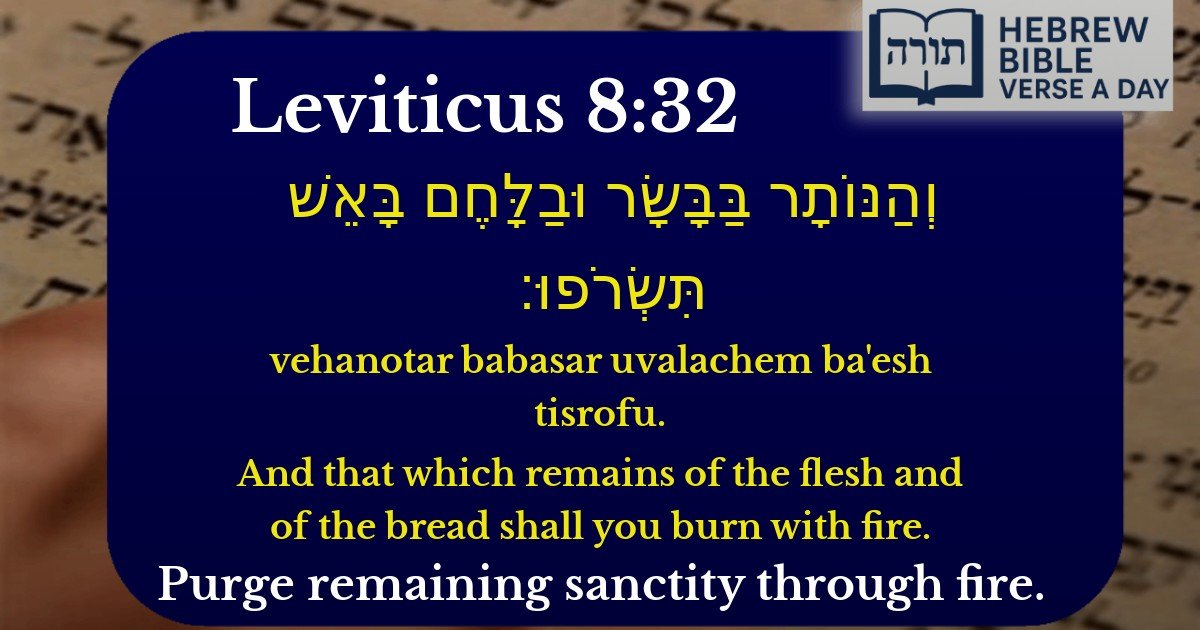

Leviticus 8:32 - Purge remaining sanctity through fire.

Leviticus 8:32 - ויקרא 8:32

Hebrew Text

וְהַנּוֹתָר בַּבָּשָׂר וּבַלָּחֶם בָּאֵשׁ תִּשְׂרֹפוּ׃

English Translation

And that which remains of the flesh and of the bread shall you burn with fire.

Transliteration

Vehanotar babasar uvalachem ba'esh tisrofu.

Hebrew Leining Text

וְהַנּוֹתָ֥ר בַּבָּשָׂ֖ר וּבַלָּ֑חֶם בָּאֵ֖שׁ תִּשְׂרֹֽפוּ׃

🎵 Listen to leining

Parasha Commentary

Context of the Verse

The verse (Shemot 12:10) appears in the context of the Korban Pesach (Paschal sacrifice) in Egypt, where the Israelites were commanded to roast and eat the lamb with matzah and maror. The instruction to burn any remaining portions emphasizes the sanctity of the offering and the prohibition against leaving it to spoil.

Rashi's Commentary

Rashi explains that the command to burn the leftovers ensures that no part of the Korban Pesach remains beyond its designated time. He cites the principle of לא תותירו ממנו עד בוקר ("you shall not leave any of it until morning") from earlier in the verse, linking it to the prohibition of נותר (leaving sacrificial meat beyond its permitted time). Burning it prevents any misuse or degradation of the holy offering.

Rambam's Perspective

In Mishneh Torah (Hilchot Korban Pesach 8:16), Rambam rules that any remaining meat of the Korban Pesach must be burned on the morning of the 15th of Nisan, even if it is Yom Tov. This underscores the severity of the prohibition of נותר and the need to treat the sacrifice with reverence.

Midrashic Insights

  • The Mechilta connects this mitzvah to the broader theme of kedushat ha'korban (sanctity of the sacrifice). Just as the Korban must be consumed with proper intent, its disposal must also reflect holiness—hence burning, which elevates it rather than letting it decay.
  • The Sifrei adds that this commandment teaches ביעור חמץ (the removal of chametz), symbolizing the eradication of spiritual "leftovers" like arrogance (represented by leaven).

Halachic Implications

The Gemara (Pesachim 84b) discusses whether the burning must be done specifically with fire or if other methods of destruction suffice. The conclusion follows the plain meaning of the verse: fire is required, as it entirely consumes the remains, leaving no trace—a metaphor for complete spiritual commitment.

📚 Talmud Citations

This verse is not quoted in the Talmud.

Frequently Asked Questions

Q: What does Leviticus 8:32 mean when it says to burn the remaining flesh and bread?
A: Leviticus 8:32 refers to the leftovers from the consecration offerings of Aaron and his sons as kohanim (priests). According to Rashi and the Talmud (Zevachim 88b), burning the remnants ensures that no part of the sacred offering is misused or treated disrespectfully. This teaches us the importance of treating holy items with proper reverence.
Q: Why was it important to burn the leftovers in Leviticus 8:32?
A: Burning the leftovers was a mitzvah (commandment) to prevent any improper use of the sacrificial remains. The Rambam (Hilchos Ma'aseh HaKorbanos 10:12) explains that sacrificial meat had strict rules—it could only be eaten by kohanim within a specific time. Burning ensured no violation occurred, teaching us about boundaries in kedushah (holiness).
Q: What lesson can we learn today from Leviticus 8:32?
A: This verse teaches the principle of 'respect for holy things' (kavod ha'kedushah). Just as the Torah commands careful handling of sacrificial leftovers, we learn to treat mitzvos (commandments) and sacred objects—like sifrei Torah (Torah scrolls) or tefillin—with utmost care. The Midrash (Toras Kohanim) connects this to avoiding wastefulness with holiness.
Q: Does Leviticus 8:32 apply to non-sacrificial food today?
A: While the verse specifically addresses sacrificial food, the principle extends to general conduct. The Talmud (Berachos 53b) derives from such verses that we must not treat food wastefully. Many poskim (halachic authorities) apply this idea to saying blessings properly and avoiding unnecessary waste, as all sustenance ultimately comes from Hashem.